
Custom MIM Oil Pump Impellers | High-Precision Powder Metallurgy Components
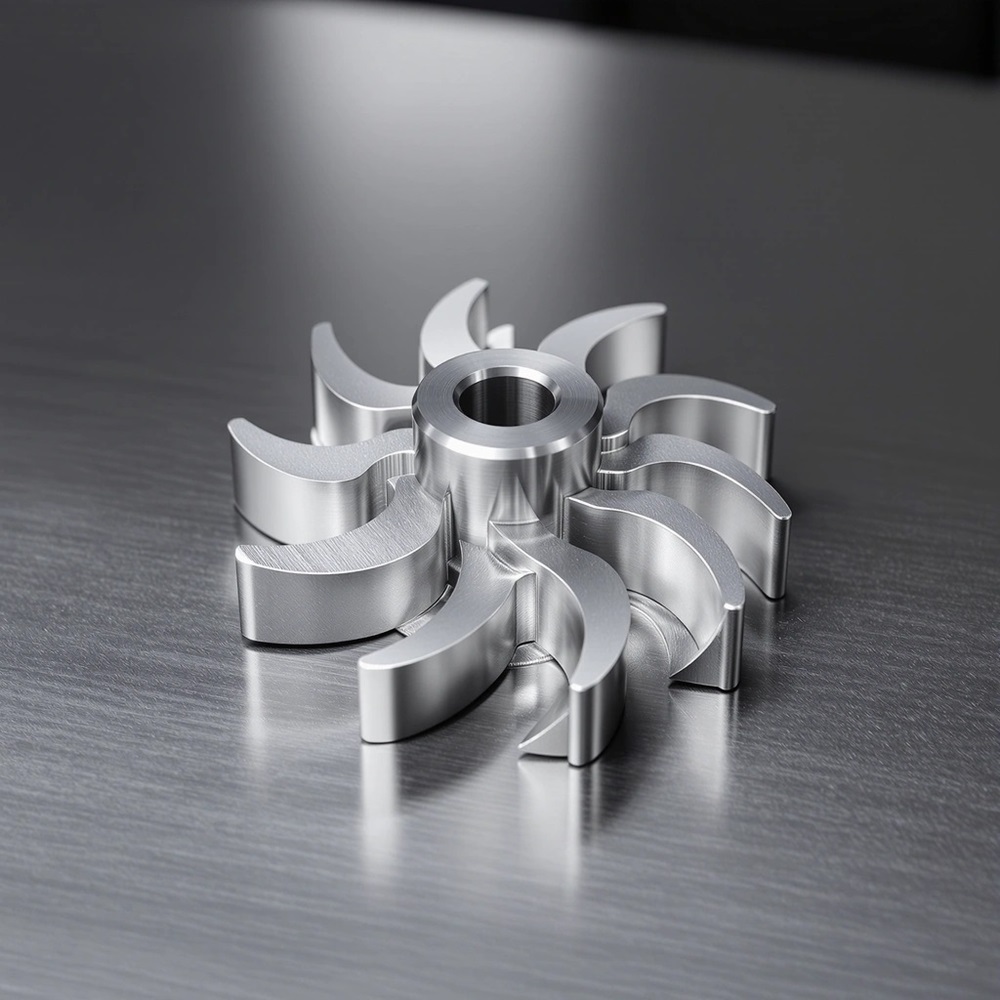
Metal injection molding produces oil pump impellers with intricate three-dimensional vane geometries that standard manufacturing methods cannot achieve economically. These sintered steel pump rotors drive oil circulation in automotive engines, transmission assemblies and industrial hydraulic systems. Engine oil pumps maintain pressure at approximately 10 psi per 1000 rpm, with peaks reaching 55-65 psi. MIM technology uses fine metal powders, under 20 micrometers, mixed with thermoplastic binders to create feedstock that gets injected into precision molds.
The process delivers custom pump impeller manufacturing capabilities for complex internal features and thin-walled sections with multi-blade configurations. Powder metallurgy oil pump impellers serve automotive transmission systems, hydraulic assemblies and turbocharger components. High-strength steel and stainless steel alloys provide wear resistance in abrasive fluid environments. The sintering process bonds metal particles through controlled heating and achieves densities exceeding 95% of theoretical values.
OEM oil pump components manufactured through MIM benefit from near-net shape production that reduces secondary machining operations. Automotive oil pump impellers need precise vane angles and surface finishes to minimize flow turbulence. Industrial applications demand corrosion-resistant materials for chemical processing fluids. Metal injection molding accommodates both high-volume production runs and specialized low-quantity orders for prototype validation.
Understanding MIM Oil Pump Impellers
What Are MIM Oil Pump Impellers?
An oil pump impeller is a rotating component within centrifugal pump assemblies designed to transfer energy from the motor to fluid. The impeller consists of blades or vanes that extend from a central hub, creating pressure differentials that help oil movement through engine lubrication circuits and hydraulic systems. These powder metallurgy oil pump impellers can feature open, semi-open, or closed vane configurations depending on application requirements and fluid characteristics.
How Metal Injection Molding Achieves Complex 3D Vane Geometries
Metal injection molding oil pump impeller production uses fine metal powders, less than 20 micrometers in particle size. This feedstock combines metal powder with thermoplastic binders at 60:40 metal-to-binder volume ratios. The mixture is injected into precision mold cavities at temperatures between 150-200°C and forms intricate vane profiles with thin walls and complex internal features. Debinding removes the polymer binders, and high-temperature sintering at 1250-1380°C fuses metal particles through diffusion bonding.
MIM vs. Traditional Powder Metallurgy (PM) & CNC Machining
MIM powder particles measure 2-15 microns compared to conventional PM’s 50-100 micron particles. MIM achieves 95-99% theoretical density after sintering, whereas traditional PM reaches only 85-92% maximum density. MIM produces three-dimensional design freedom with undercuts and complex geometries that uniaxial PM compaction cannot create. MIM becomes cost-effective for complex parts requiring multiple machining operations compared to CNC machining, reducing material waste by up to 95%.
Material Composition and Technical Specifications
High-Strength Steel & Iron-Based Alloy Formulations
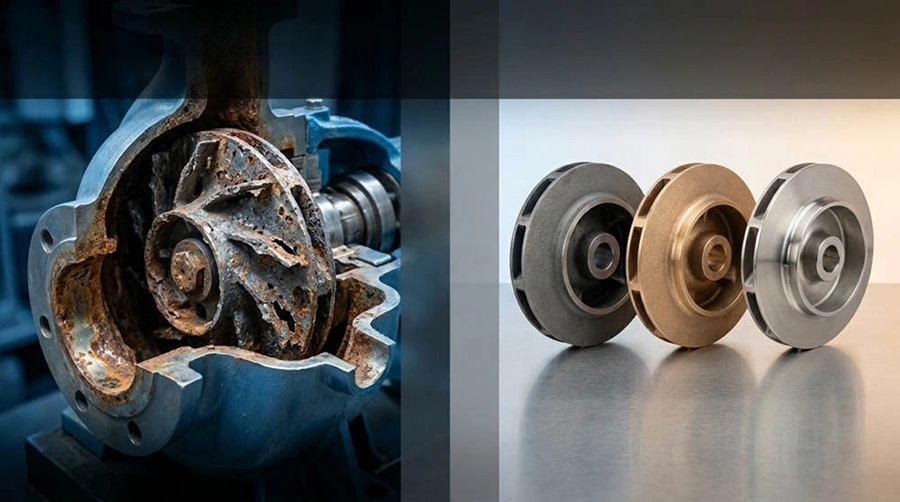
Iron-based powder metallurgy components employ Fe-2Ni and Fe-8Ni compositions for automotive and machinery structural parts. Low alloy steel formulations incorporate carbon, manganese, chromium and molybdenum to improve strength and hardenability. MIM-4605 grades achieve 415 MPa tensile strength in as-sintered condition. Quenching and tempering increase this to 1655 MPa with 48 HRC hardness.
Stainless Steel Alloys (316L / 17-4PH) for Wear & Corrosion Resistance
Stainless steel 316L contains 19% chromium, 9% nickel, and 2% molybdenum. It delivers 520 MPa tensile strength with 50% elongation. This austenitic grade provides corrosion resistance for medical equipment and fluid handling applications. Precipitation-hardening 17-4PH stainless steel offers 900 MPa tensile strength in sintered condition and reaches 1185 MPa after heat treatment with 40 HRC hardness. Both alloys suit oil pump impeller manufacturing where chemical resistance matters.
High Sintered Density (>95%) and Hardness Requirements (HRC 45-60)
Metal injection molding achieves 95-99% theoretical density during sintering. Hardness testing uses the Rockwell C scale for hardened materials and measures indentation depth under 150 kgf load. Tool steels and heat-treated components reach HRC 55-66 for cutting and high-wear applications.
Superior Surface Finish Standards (Ra 0.8–1.6 μm)
As-sintered MIM surfaces measure Ra 0.8-1.6 μm for 316L and 17-4PH stainless steels. Surface roughness depends on powder particle size and sintering parameters.
Custom Manufacturing Process for Oil Pump Impellers
Feedstock Preparation: Fine Metal Powder and Binder Mixing
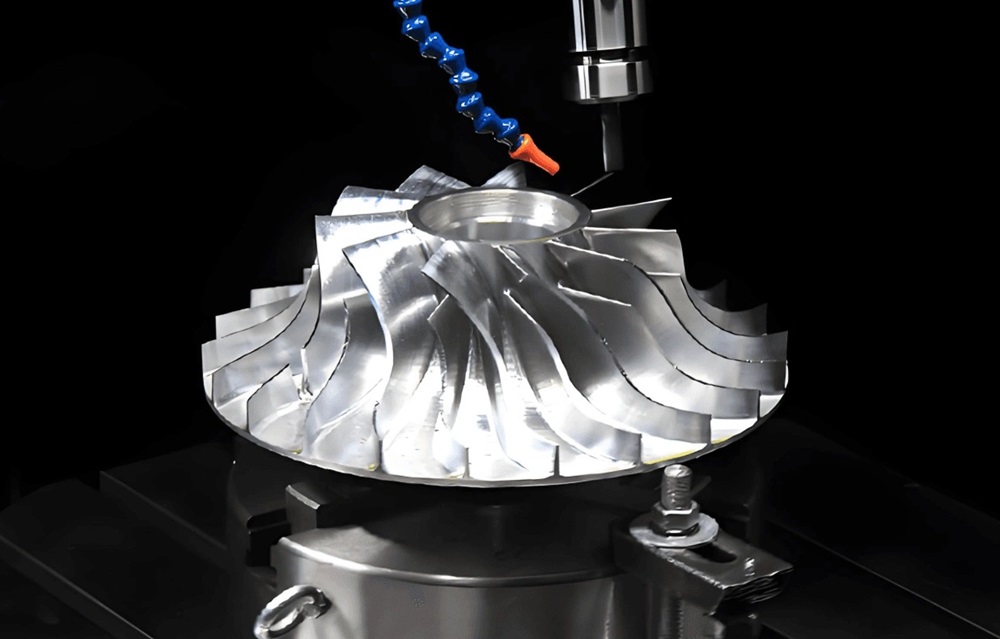
Custom oil pump impeller production begins with feedstock formulation, where fine metal powders combine with polymer binders in heated mixers at 170-180°C. The mixture contains about 60% metal powder and 40% binder by volume. The process runs for 40-45 minutes at 60 rpm rotor speed until each powder particle receives a uniform binder coating. The compound gets granulated into pellets for injection molding machines.
Precision Injection Molding: Cavity Filling at High Temperatures (150–200°C)
Feedstock pellets enter injection molding machines where heating barrels and screw mechanisms bring material to viscous consistency. Cavity pressure and mold temperature control final part quality, with injection temperatures ranging from 150-200°C. The reciprocating screw forces material through gates into precision mold cavities and forms green parts with complete vane geometries.
Debinding Stage: Two-Step Solvent & Thermal Solvent Removal
Debinding removes binders through sequential processes. Solvent debinding extracts primary binder components at 50-70°C and creates interconnected pore channels. Thermal debinding follows, where parts heat to 400-600°C under a controlled atmosphere to eliminate remaining polymers.
High-Temperature Vacuum Sintering & Densification (1250–1380°C)
Vacuum sintering furnaces heat debound parts to 1250-1380°C. Particles fuse through diffusion bonding and achieve densities exceeding 95% of theoretical density.
Secondary Operations: Precision Sizing, Heat Treatment & Surface Finishing
Post-sintering operations include CNC sizing for exceptionally tight tolerances, specialized heat treatment to maximize hardness, and refined surface finishing through electropolishing or bead blasting.
Applications and Performance Advantages
Automotive Transmission & Engine Oil Pump Systems
Sintered steel pump rotors serve critical lubrication functions in automotive powertrains. Transmission oil pumps maintain fluid pressure in gearbox assemblies, automatic transmissions and dual-clutch systems. MIM oil pump impellers handle flow rates up to 100 liters per minute with differential pressures reaching 80 bar. Engine lubrication circuits require compact rotor geometries with thin vane sections that conventional manufacturing cannot produce economically.
Hydraulic & Fluid Pump Assemblies for Heavy Machinery
Industrial hydraulic systems use powder metallurgy oil pump impellers in construction equipment, agricultural machinery and material handling devices. Custom pump impeller manufacturing accommodates viscosity ranges from 1 to 10,000 mPas over temperature ranges of -40°C to 160°C. Heavy machinery applications demand corrosion-resistant alloys for extended service life in abrasive environments.
Big Cost Savings: 30%–50% Reduction vs. 5-Axis CNC Machining
Metal injection molding delivers substantial economic advantages for complex geometries. Production costs decrease by 30-50% compared to multi-axis CNC operations when volume exceeds break-even thresholds. Small complex parts benefit most from MIM’s ability to eliminate repeated machining setups, tool changes and deburring operations.
Near-Net Shape Manufacturing Cuts Material Waste by Up to 95%
Traditional machining generates 30-40% material waste through chip removal. Near-net shape MIM processes reduce scrap to around 5% and recover up to 95% more raw material.
OEM Production Capabilities, Tooling & Quality Assurance
Strict Tolerances (±0.01 mm) for Micro & Complex Impellers
OEM oil pump components demand dimensional accuracy within ±0.01 mm for critical features affecting hydraulic performance. Micro impeller geometries with vane thicknesses below 0.5 mm require controlled shrinkage rates during sintering. Tolerance specifications vary based on part size, with smaller impellers maintaining tighter dimensional control. Precision CMM inspection systems verify blade angles and hub concentricity across all production batches.
Tooling Lead Times, Prototyping (Binder Jetting) & Rapid PPAP Validation
Mold tooling fabrication requires 4-8 weeks depending on cavity complexity. Binder jetting additive manufacturing accelerates prototype development and produces functional test samples within days to validate designs. Iterative refinement becomes possible with this rapid prototyping approach before committing to production tooling investments. PPAP documentation packages include dimensional reports and material certifications to approve automotive supply chain requirements.
Quality Certifications: IATF 16949 & ISO 9001 Compliance
Automotive oil pump impeller manufacturers maintain IATF 16949 certification for quality management systems specific to automotive production. ISO 9001 compliance establishes standardized procedures for process control and full lot traceability. Quality protocols include statistical process control monitoring and failure mode analysis with documented inspection procedures throughout the manufacturing sequence.
Partner with JHMIM for Custom Oil Pump Impellers
Get a Free DFM Analysis and Fast OEM Quote Today
Custom oil pump impeller projects start with complete design evaluation. JHMIM’s engineering team examines CAD files, technical drawings and dimensional specifications to assess manufacturability before tooling investment. DFM analysis identifies geometry risks, mold complexity, gate placement strategies and tolerance feasibility within 24 hours of submission. This evaluation determines whether proposed vane configurations, wall thicknesses and feature combinations suit metal injection molding production.
Each design receives customized material recommendations. Engineering teams examine fluid media characteristics, operating temperatures, pH conditions and abrasion requirements to specify optimal alloy compositions. Written explanations clarify why particular steel grades or stainless formulations best serve intended applications.
File submissions accept PDF, STEP, DWG, DXF and IGS formats. Physical samples enable reverse engineering for replacement component manufacturing as an alternative. Direct communication with English-speaking engineers eliminates technical miscommunication during drawing interpretation.
Quotation packages include material specifications, unit pricing and production lead times. Flexible order thresholds permit single-piece sampling before volume commitments. Sample delivery occurs within 2-3 weeks from approved drawings, with production orders tailored to your specific cavity configuration and volume requirements.
Full material test reports, heat numbers and traceability documentation accompany every shipment at no additional cost.
Conclusion
Metal injection molding has reshaped oil pump impeller manufacturing. The process produces complex three-dimensional geometries with exceptional precision, achieving 95-99% theoretical density and tight tolerances within ±0.01 mm. Combined with superior surface finishes, MIM delivers cost reductions of 30-50% compared to traditional machining while eliminating up to 95% of material waste. These advantages make powder metallurgy the preferred manufacturing method for automotive transmission systems, engine oil pumps, and heavy-duty hydraulic assemblies.
FAQs
Q1. What makes MIM oil pump impellers superior to traditionally manufactured ones?
MIM oil pump impellers achieve 95-99% theoretical density compared to conventional powder metallurgy’s 85-92%. They produce complex three-dimensional vane geometries with undercuts and thin walls that traditional methods cannot create cost-effectively. The process reduces material waste by up to 95% and delivers superior surface finishes of Ra 0.8-1.6 μm.
Q2. Which materials are commonly used for manufacturing oil pump impellers?
High-strength steel and iron-based alloys like Fe-2Ni and Fe-8Ni are used for structural automotive applications. Stainless steel 316L provides excellent corrosion resistance with 520 MPa tensile strength, while 17-4PH stainless steel offers higher strength up to 1185 MPa after heat treatment. Material selection depends on operating pressure, fluid media, and wear resistance requirements.
Q3. How much cost savings can be achieved with MIM compared to CNC machining?
MIM production costs are 30-50% lower than multi-axis CNC machining for complex geometries, especially at medium to high volumes. The near-net shape manufacturing process eliminates multiple machining setups, tool changes, and deburring operations, reducing raw material waste from 30-40% down to approximately 5%.
Q4. What tolerances can be achieved in MIM oil pump impeller production?
MIM manufacturing achieves strict dimensional tolerances within ±0.01 mm for critical features affecting hydraulic performance. Precision CMM inspection systems verify blade angles, hub concentricity, and diameter specifications throughout production batches.
Q5. What is the typical lead time for custom oil pump impeller production?
Mold tooling fabrication typically requires 4-8 weeks depending on cavity complexity. Sample delivery occurs within 2-3 weeks from approved drawings. For rapid prototyping, binder jetting 3D printing can produce test samples within days for design validation prior to hard tooling investment.