
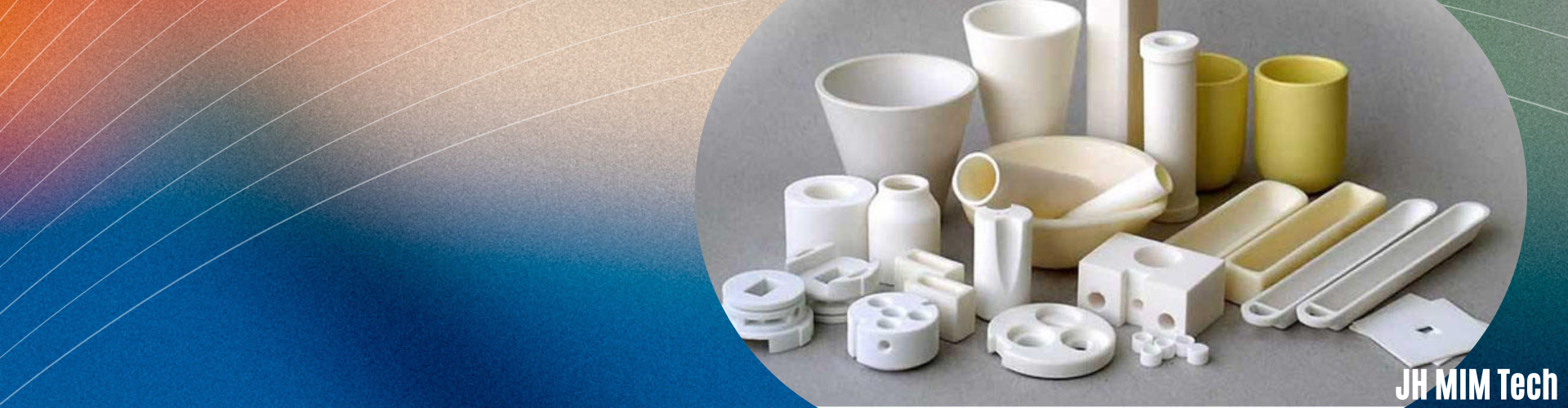
Metal Injection Molding Of Ceramics
Precision technical ceramics play a vital role in high-temperature, high-wear, and electrical insulation environments. Among structural ceramics, Alumina (Al₂O₃) and Zirconia (ZrO₂) represent two of the most versatile materials engineered for demanding industrial applications.
High-Purity Alumina Ceramics (95% vs. 99% Al₂O₃)
95% Alumina Ceramics
95% Alumina (Al₂O₃) is one of the most widely specified structural ceramic grades. It delivers an optimal balance of mechanical strength, thermal endurance, and high-frequency electrical insulation at a cost-effective price point. Featuring low dielectric loss and high volume resistivity, 95% alumina is extensively used in:
- Radio and high-frequency electronic components
- Textile wear guides and yarn tensioners
- Sandblasting and argon arc welding torch nozzles
- Ball mill linings and grinding media
99%+ Alumina Ceramics
99% and 99.5%+ Alumina Ceramics are formulation-engineered for ultra-clean, extreme-wear, and highly corrosive operating environments. Offering higher hardness, superior flexural strength, and reduced alkali wear compared to 95% alumina, these high-purity grades are ideal for:
- High-temperature laboratory crucibles and refractory furnace tubes
- Precision ceramic bearings and high-pressure valve seats
- Mechanical pump seals and fluid control components
Performance Specifications: Alumina vs. Zirconia Ceramics
The table below provides physical, mechanical, thermal, and electrical performance parameters for standard JHMIM alumina (Al₂O₃), Zirconia Toughened Alumina (ZTA), and Yttria-Stabilized Zirconia (Y-TZP) grades:
| Property Specification | Unit | Alumina Ceramics (Al₂O₃) | Zirconia Ceramics (ZrO₂) | ||||
|---|---|---|---|---|---|---|---|
| ≥ 95% | ≥ 99% | ≥ 99.5% | ≥ 99.8% | ZTA | Y-TZP | ||
| Bulk Density | g/cm³ | 3.70 | 3.80 – 3.85 | 3.85 | 3.88 | 3.80 – 4.60 | 6.00 – 6.05 |
| Hardness | HRA | ≥ 86 | ≥ 88 | ≥ 88 | ≥ 89 | 86 – 88 | 88 – 90 |
| Compressive Strength | MPa | ≥ 2500 | ≥ 2500 | ≥ 2500 | ≥ 2800 | 2300 – 2900 | ≥ 2500 |
| Flexural (Bending) Strength | MPa | ≥ 300 | ≥ 350 | ≥ 400 | ≥ 400 | 450 – 700 | ≥ 900 |
| Elastic Modulus | GPa | 300 | 350 | 370 | 380 | 320 | 210 |
| Poisson’s Ratio | — | 0.21 | 0.22 | 0.22 | 0.22 | 0.23 | 0.30 |
| Max Operating Temperature | °C | 1500 | 1500 | 1600 | 1700 | 1450 | 1500 |
| Thermal Conductivity (20°C) | W/(m·K) | 20 | 25 | 30 | 32 | 18 – 27 | 2.2 – 3.0 |
| Coefficient of Thermal Expansion | ×10⁻⁶/°C | 7.5 | 8.2 | 8.2 | 8.3 | 8.0 – 8.5 | 9.6 – 10.5 |
| Dielectric Constant (1 MHz) | εr | 9.0 | 9.2 | 9.5 | 9.8 | 10.0 | 28.0 |
| Dielectric Loss (1 MHz) | tanδ ×10⁻⁴ | ≤ 3 | ≤ 2 | ≤ 1.5 | ≤ 1.0 | ≤ 5 | ≤ 10 |
| Volume Resistivity (20°C) | Ω·cm | 10¹³ | 10¹⁴ | 10¹⁴ | 10¹⁵ | 10¹³ | 10¹² |
| Breakdown Voltage | kV/mm (DC) | ≥ 20 | ≥ 20 | ≥ 22 | ≥ 25 | ≥ 18 | ≥ 15 |
| Acid Resistance | mg/cm² | ≤ 0.7 | ≤ 0.7 | ≤ 0.5 | ≤ 0.2 | ≤ 0.5 | ≤ 0.1 |
| Alkali Resistance | mg/cm² | ≤ 0.2 | ≤ 0.1 | ≤ 0.1 | ≤ 0.05 | ≤ 0.1 | ≤ 0.05 |
Explore Our Technical Ceramic Solutions
Need help choosing the right ceramic formulation for your application? Discover detailed specs across our complete material portfolio:
- Alumina Ceramics (Al₂O₃): High hardness, electrical insulation, and extreme wear resistance.
- Zirconia Ceramics (ZrO₂): Superior fracture toughness, impact resistance, and low thermal conductivity.
- Steatite Ceramics: High-frequency electrical insulators for electronic hardware.
- Mullite Ceramics: Excellent thermal shock resistance for high-temperature furnace structures.
- Cordierite Ceramics: Low thermal expansion ideal for heating elements and catalyst substrates.
- Silicon Carbide Ceramics (SiC): Extreme hardness and wear resistance for mechanical seal faces.
- Silicon Nitride Ceramics (Si₃N₄): Exceptional mechanical strength for high-speed ceramic bearings.
Looking for custom machined or molded technical ceramic components? Contact JHMIM’s engineering team today to request a quote or DFM review.