
Powder Metallurgy Variable Valve Timing Review
 Variable valve timing has become the mainstream technology in modern engines, and powder metallurgy variable valve timing components are revolutionizing how manufacturers achieve precision and performance. VVT systems improve fuel efficiency by adjusting valve timing to match different engine loads and reduce harmful emissions such as nitrogen oxides and carbon monoxide. The powder metallurgy process stands out with a material utilization rate exceeding 95%. This makes it a greener alternative to traditional metal manufacturing. Recent performance testing reveals that PM VVT components achieve friction coefficients from 0.22 to 0.5 and core hardness profiles between 134 HB and 154 HB. This review gets into the engineering specifications, rigorous material testing results, and cost-efficiency advantages that make powder metal valve guides the preferred choice for high-volume automotive production.
Engineering Specifications: Precision PM VVT Components and Working Mechanics

The powder metallurgy process for variable valve timing components begins with metal powder preparation. Iron-based alloys are selected based on desired mechanical properties. Automated presses apply multiple levels of pressure during the compaction phase. This forms the simple shape of VVT gears, rotors and stators. The multi-level approach creates varying density zones within a single component. Engineers can optimize strength in high-stress areas and maintain lighter weight in other regions.
The Multi-Level Compaction and High-Temperature Sintering Process for VVT Components
Metal powders undergo compaction at pressures ranging between 400 to 800 MPa. Final density requirements determine the exact pressure. Green parts enter high-temperature sintering furnaces after compaction, where controlled atmospheres prevent oxidation. The sintering process bonds metal particles at temperatures below their melting point and creates solid components with precise dimensions. Secondary operations like sizing and steam treatment improve dimensional accuracy and surface properties further.
Key VVT Gears: Production of Sintered VVT Sprockets, Rotors, and Stators
Sprockets transfer rotational energy from the timing chain to the VVT system. Rotors control the actual valve timing adjustment through hydraulic actuation. Stators house the rotor assembly and maintain alignment under operational loads. Each component requires different powder compositions and compaction parameters that meet specific performance criteria. Sprocket teeth must withstand continuous contact forces. Rotor vanes need smooth surfaces for hydraulic sealing.
Microstructural Geometries: How High-Density PM VVT Outperforms Traditional Castings
Powder metallurgy variable valve timing components achieve superior dimensional consistency over cast alternatives. The powder metallurgy pdf specifications show that PM parts maintain tighter tolerances without extensive machining. High-density sintering reduces interconnected porosity and creates stronger load-bearing structures. Variable valve timing types utilizing PM components benefit from reproducible microstructures. These deliver consistent performance in production batches.
Rigorous Material Testing Results: Friction, Wear, and Hardness Analysis
Material performance validation determines whether powder metallurgy variable valve timing components meet stringent automotive requirements. Testing protocols review friction behavior, surface durability and structural hardness under conditions that replicate years of engine operation.
Friction Coefficient Optimization: Stabilizing Performance within the 0.22 to 0.5 Range
Steel-on-steel contact surfaces achieve friction coefficients between 0.5 and 0.8 in dry conditions. Lubricated scenarios reduce this range by a lot. The powder metallurgy process creates surface geometries that stabilize friction within the 0.22 to 0.5 operational window when paired with hydraulic fluids. Lubricated steel combinations drop to 0.16 static friction. Tungsten carbide against steel operates between 0.1 and 0.2 under lubrication. These lower values reduce parasitic energy losses during valve timing adjustments.
Wear Resistance and Surface Fatigue Performance Data under Constant Mechanical Stress
Surface fatigue develops when gears experience repeated contact stress. This creates microcracks that propagate into larger failures. Cyclical loading on powder metal valve guides produces discontinuities that require monitoring under accelerated testing. Film thickness decreases at lower speeds and elevated temperatures and intensifies wear rates. Surface inspection reveals micro-cutting patterns and stress concentration points where material removal accelerates.
Brinell Hardness Metrics: Achieving Consistent 134 to 154 HB Core Hardness Profiles
The Brinell test measures indentation hardness using a tungsten carbide ball under controlled force. Mild steel registers 120 HB. PM VVT components achieve core hardness between 134 and 154 HB through optimized sintering parameters. Testing employs 10mm ball indenters with forces up to 3000 kgf and creates indentation diameters between 2.4mm and 6mm. This measurement approach proves especially effective when you have coarse-grained sintered structures to evaluate.
Porosity Minimization Control: Restricting Interconnected Voids to Under 8% for Absolute Hydraulic Sealing
Hydraulic phasers just need effective sealing to control valve timing systems. Interconnected porosity creates leak paths that compromise fluid retention and pressure control. Maintaining porosity below 8% will give hydraulic integrity. Tight tolerance control across each component limits leakage opportunities.
Real-World Performance Validation: Fuel Efficiency and Durability Profiles
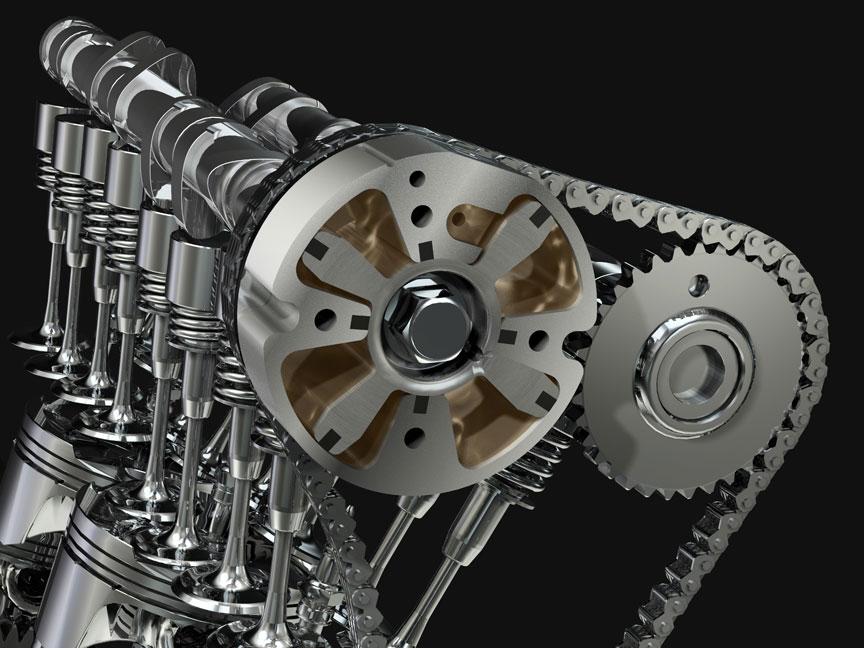
Testing PM VVT components under actual operating conditions confirms whether laboratory results translate into measurable engine benefits. Production engines equipped with powder metallurgy variable valve timing systems provide performance data that demonstrates quantifiable improvements in several operational parameters.
Measurable Fuel Efficiency Improvements through Optimized PM VVT Engine Timing
The powder metallurgy process enables VVT systems to reduce pumping losses by a lot during partial load operation. Late intake valve closing strategies reduce pumping losses by 40% and decrease nitrogen oxide emissions by 24%. Early intake valve closing achieves similar 40% pumping loss reduction and increases fuel economy by 7%. Engines equipped with variable valve timing types show up to 5% improvement in fuel economy under part-load conditions. These conditions represent the majority of typical driving scenarios.
Dynamic Valve Optimization: Managing High Torsional Torque at Low vs. High RPM Ranges
Valve events that advance boost low-end torque at the expense of high-rpm horsepower, while retarding produces the opposite effect. Intake valve closing timing determines how much air enters the cylinders at different engine speeds. Advanced timing prevents air from escaping back into the intake manifold at low RPM and maximizes cylinder filling. Delayed closing exploits air inertia at high RPM to continue filling cylinders even after the piston starts upward compression travel.
Accelerated Long-Term Durability Testing and Temperature-Pressure Threshold Performance
Validation tests prove the durability of powder metal valve guides and related components before production release. Accelerated durability testing employs compressed time testing and load amplification to replicate years of operation within shortened timeframes. Components are assessed under real-life motions and forces to determine expected life and confirm design quality.
Cost-Efficiency Analysis: Powder Metallurgy vs. Traditional CNC Machining
Economic considerations drive manufacturing process selection for high-volume automotive components. Sintered VVT sprockets deliver 20-30% cost savings compared to machined alternatives, while eliminating multiple secondary operations that traditional manufacturing requires.
Manufacturing Cost Reductions: Eliminating High-Cost Gear Hobbing and Broaching
The powder metallurgy process produces near-net-shape components from compaction and sintering. This bypasses expensive gear hobbing and broaching steps. Automated compaction presses achieve production rates between 1,000 and 3,000 parts per hour. This output dwarfs the 20-60 parts hourly typical of CNC machining. The throughput advantage translates into 30-50% cost reductions at high production volumes. CNC machining remains economical only for batches under 40-50 units. Beyond this threshold, powder metallurgy variable valve timing components become budget-friendly.
Sustainable Material Utilization: Leveraging a 95%+ Green Material Utilization Rate
Material efficiency reaches 95% or higher with powder metallurgy. CNC machining wastes 50% of material. This difference affects raw material costs, especially when you have specialized alloys. Energy consumption also favors PM at 1.8-5.0 kWh/kg versus traditional machining’s 8.4-11.4 kWh/kg requirement.
Achieving Strict Sintered Tolerances (±0.01mm) for Extended Lifespan Requirements
Powder metallurgy maintains precision accuracy up to ±0.01mm through controlled sintering parameters. JHMIM, with over 20 years of expertise, delivers zero-defect complex metal components globally while solving tight-tolerance manufacturing challenges.
Partner with JHMIM for Certificated Automotive VVT Production
Selecting a qualified manufacturing partner determines whether powder metallurgy variable valve timing components meet automotive grade standards consistently. IATF 16949 certification will give quality management systems that line up with global automotive requirements. This covers everything from original design through final delivery.
Scaling Mass Production via Advanced Press Infrastructures and IATF 16949 Frameworks
Mass production of VVT components just needs high-capacity pressing equipment and rigorous quality frameworks. IATF 16949 certification extends beyond ISO 9001 standards. It incorporates automotive-specific controls for process validation and production part approval processes. JHMIM operates an 18,000+ square meter manufacturing facility in China with over 20 years of deep expertise in powder metallurgy and metal injection molding (MIM). We deliver high-density, zero-defect complex metal components globally. Our facility is backed by 150+ skilled technicians and advanced high-tonnage sintering and pressing equipment. We streamline your supply chain and solve tight-tolerance manufacturing challenges under one roof.
Submit Your Engine Design Specifications and 3D CAD Files (STEP/IGS) to Get a Free DFM Feasibility Study
Design for manufacturability analysis identifies potential production challenges before tooling investment begins. When you submit 3D models in STEP or IGS formats, engineers can review powder flow characteristics, ejection angles and dimensional tolerances specific to the powder metallurgy process. This feasibility assessment determines whether proposed variable valve timing types can achieve required specifications through PM production methods.
Common indicators include rough engine idle, decreased fuel efficiency, check engine light activation, unusual engine noises during startup, and reduced power output especially at low RPM ranges. These symptoms often result from worn VVT components, hydraulic seal failures, or solenoid malfunctions that prevent proper valve timing adjustments.
PM VVT components stabilize friction performance within the 0.22 to 0.5 range when paired with hydraulic fluids. This optimized friction window reduces parasitic energy losses during valve timing adjustments while maintaining reliable operation across varying engine loads and temperatures.
Powder metallurgy delivers 20-30% cost savings compared to traditional machining methods by eliminating expensive gear hobbing and broaching operations. PM processes achieve material utilization rates exceeding 95% versus CNC’s 50% efficiency, while producing 1,000-3,000 parts per hour compared to machining’s 20-60 parts hourly output.
Powder metallurgy VVT components achieve consistent core hardness profiles between 134 HB and 154 HB through optimized sintering parameters. This hardness range provides the necessary wear resistance and structural integrity to withstand repeated contact stress and cyclical loading throughout the component’s operational life.
Engines equipped with variable valve timing systems demonstrate up to 5-7% improvement in fuel economy under part-load conditions, which represent the majority of typical driving scenarios. Advanced valve timing strategies reduce pumping losses by up to 40% while simultaneously decreasing nitrogen oxide emissions by 24%.