
Metal Nickel Plating for Powder Metallurgy & MIM
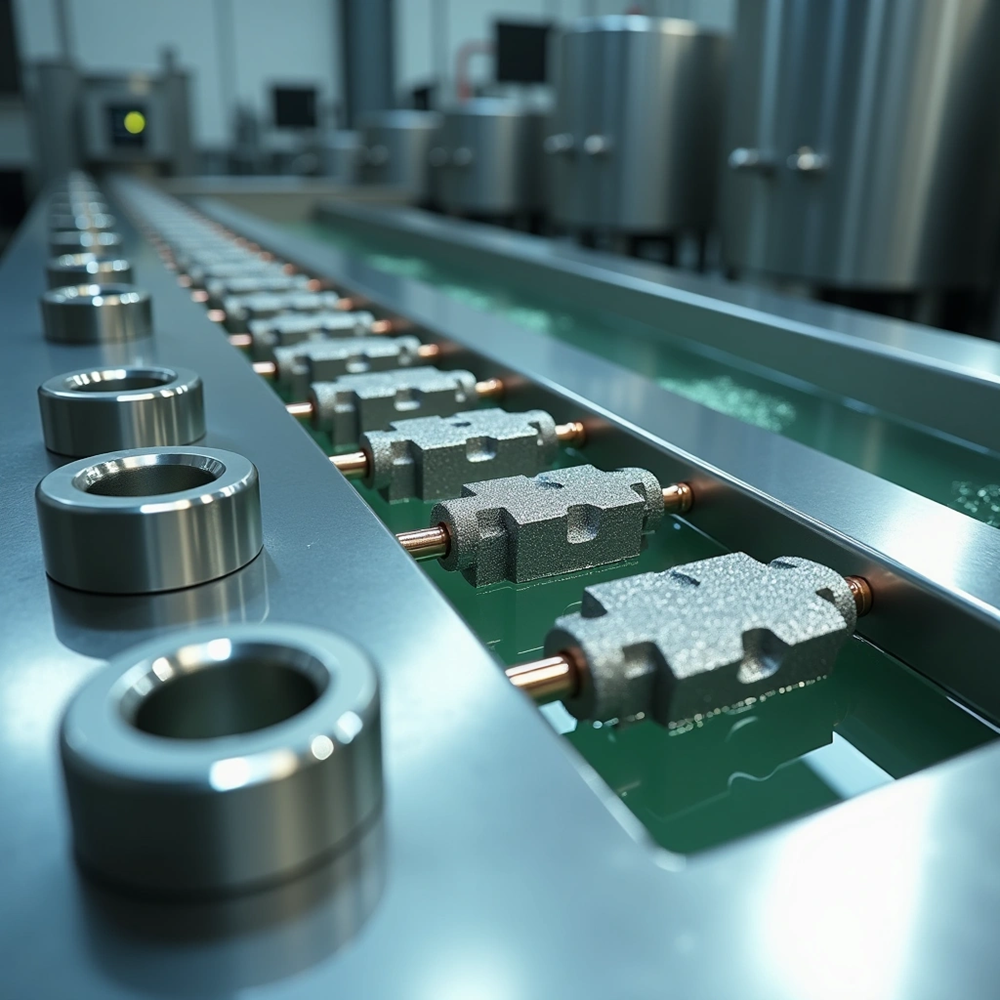
Metal nickel plating represents a USD 2.80 billion market in 2024, with industries depositing 150,000 tons of electroplated nickel annually. Powder metallurgy and MIM manufacturers face unique challenges in achieving defect-free coatings. While high-density MIM components (95–99% theoretical density) feature isolated closed pores, conventional PM components typically retain interconnected surface porosity. These interconnected networks can trap plating chemicals during the nickel deposition process if not properly managed. Engineers must address surface-connected porosity before electroplating with nickel to prevent spotting out defects and delayed corrosion failures. Preparing metal for nickel plating requires specialized workflows, especially when you have to electroplate nickel on copper or steel substrates. We get into the complete nickel plating corrosion resistance framework in this piece, from pre-treatment protocols to quality control metrics that ensure automotive-grade performance in sintered components.
Nickel Electroplating Process for Powder Metallurgy Components
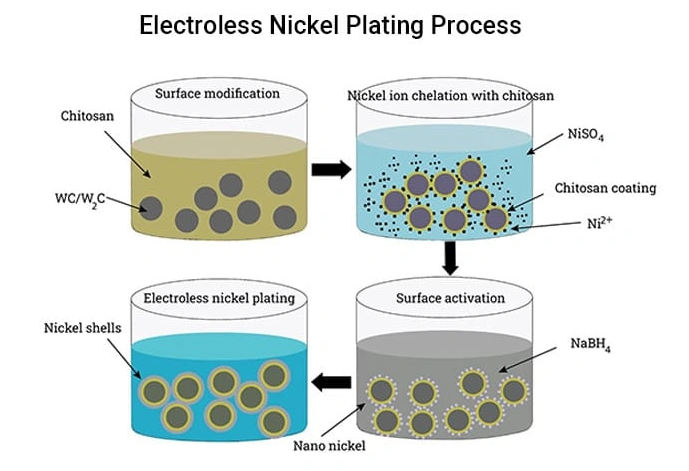
Two distinct deposition methods dominate nickel coating applications for sintered components. Each suits specific engineering requirements.
Understanding Electrolytic vs. Electroless Nickel Deposition
Electrolytic nickel plating requires an external electrical current to transfer nickel ions from an anode to the substrate cathode through an electrolyte solution. The process delivers thicker coatings with precise thickness control but produces uneven distribution on complex geometries due to current density variations at edges and recesses. Electroless nickel deposition relies on a chemical reduction reaction without applied current and produces uniform coatings whatever the part geometry. Electroless processes incorporate phosphorus into the nickel-phosphorus alloy deposit and enhance corrosion resistance and wear properties. Electrolytic methods offer 100% nickel purity and superior electrical conductivity. Electroless coatings excel in coating uniformity and can plate non-conductive substrates.
The Watts Solution Bath for PM Applications
The Watts bath is the foundation for electrolytic nickel plating. It contains nickel sulfate (240-300 g/L) and nickel chloride (30-90 g/L) along with boric acid (30-45 g/L). The solution supports cathode current densities of 2-7 A/dm² and operates at 40-60°C with pH between 3.5-4.5. Nickel sulfate provides the main ion source, while nickel chloride improves anode corrosion and increases solution conductivity. Boric acid functions as a pH buffer and stabilizes deposit appearance and quality throughout the plating cycle.
Sulfamate Nickel Solution for Low-Stress Coatings
Sulfamate nickel baths produce 99.9% pure nickel deposits with minimal internal stress. These baths contain nickel sulfamate (300-450 g/L) and boric acid (30-40 g/L). These solutions accommodate higher current densities of 2-15 A/dm² and operate at 40-60°C and pH 3.5-4.5. The deposits exhibit superior ductility and elongation properties and withstand temperatures up to 2,552°F. Applications that require thick builds, dimensional restoration, or subsequent forming operations benefit from sulfamate’s low-stress characteristics.
Current Density and Deposition Rate Parameters
Current density influences deposit morphology and grain structure. Lower densities (2-3 A/dm²) produce smooth, fine-grained coatings with superior microhardness. Higher densities accelerate deposition but create coarse nodular structures. Deposition rates range from 25-85 µm/h depending on current density and solution chemistry.
Preparing Metal for Nickel Plating: The Porosity Challenge in MIM Parts
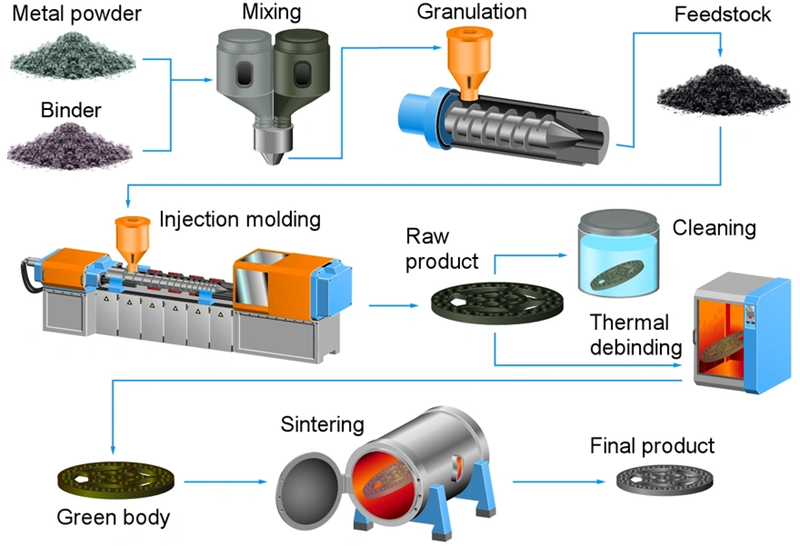
Sintered component architecture determines electroplating success rates. Conventional PM parts reach 92% maximum density using 50-100 micron powders, while MIM components achieve 95-99% density with 2-15 micron metal powder particles. This density differential creates distinct porosity profiles that affect preparing metal for nickel plating protocols.
Surface-Connected Pores in Conventional PM Substrates vs. High-Density MIM Parts
PM substrates with densities below 6.2-7.0 g/cm³ contain interconnected, surface-connected pores that function as capillary networks. These pores absorb liquids during electroplating with nickel and create leak paths that prevent pressure-tight sealing. MIM’s higher sintering temperatures (2350-2500°F versus 1800-2000°F) produce superior corrosion resistance, yet remaining porosity still needs management before nickel electroplating process initiation.
Vacuum Resin Impregnation: Preventing Spotting Out Defects
Vacuum resin impregnation operates at 28-29 inches Hg vacuum, followed by 80-100 psi pressure to force methacrylate or epoxy resins into micropores. The process uses MIL-I-17563C certified resins with thermal stability to 300°F and resistance to sulfuric acid and hydraulic fluids. Impregnation prevents acid penetration during electroplating nickel on copper or steel substrates.
Chemical Entrapment and Delayed Corrosion Failures
Low surface-tension chemicals penetrate pores via capillary action during acid pickling. Water’s high surface tension prevents displacement of trapped salts. These salts later absorb moisture through deliquescence and create spotting defects weeks after plating[12]. This mechanism compromises nickel plating corrosion resistance in automotive applications.
Pre-Treatment Surface Cleaning and Activation Steps
Surface activation removes oxide films through brief acid dips using 10% sulfuric acid or hydrochloric acid[14]. Activation exposes chemically active metal lattices for optimal coating adhesion[15]. Poor activation causes peeling, blistering, and coating delamination[16]. Rinsing after activation prevents flash corrosion before plating bath immersion[14].
Electroplating Nickel on Copper and Steel Substrates: Material-Specific Workflows
Substrate composition dictates activation protocols and strike requirements. Different base materials need distinct surface preparation sequences to achieve reliable metal nickel plating adhesion.
Nickel Plating on Steel Powder Metallurgy Parts
Steel substrates accept nickel deposits over cleaned surfaces. Alkaline cleaning needs adjustment to remove excess resin without opening pores through aggressive electrocleaning. Pickling with stronger acid for shorter duration optimizes activation.
Electroplating Nickel on Copper Components for Improved Conductivity
Copper’s non-catalytic surface requires a nickel strike to establish catalytic sites before electroless deposition. Electroplating nickel on copper improves electrical conductivity in connectors and terminals. The coating provides barrier protection against oxidation and preserves low electrical resistance.
Stainless Steel 316L and 17-4PH Passivation Requirements
Stainless steel’s chromium-rich passive oxide layer blocks nickel adhesion. Wood’s Nickel Strike uses nickel chloride (240 g/L) and hydrochloric acid (125 mL/L) at 6 A/dm² for 30 seconds to strip the barrier. High-strength 17-4PH requires hydrogen relief baking at 190°C within four hours post-plating to prevent embrittlement cracking.
Low Alloy Steel FL-4605: Sinter-Hardening Integration
FL-4605 nickel-molybdenum steel achieves 48 HRC through heat treatment. Sinter-hardening eliminates separate quenching operations and maintains dimensional control.
Substrate Hardening to Prevent Coating Delamination
High residual stress causes coating fracture and delamination. Substrate hardening creates load-bearing support that prevents the nickel layer from crushing under mechanical stress.
Nickel Plating Corrosion Resistance and Quality Control Metrics

Long-term performance in automotive and industrial applications of all types depends on quality validation. Standardized testing protocols verify measurement precision, adhesion integrity and corrosion endurance.
Coating Thickness Measurement: XRF and Magnetic Induction Methods
X-ray fluorescence provides ±0.1 µm accuracy on flat surfaces through non-destructive elemental analysis. Magnetic induction measures non-magnetic coatings on ferromagnetic substrates with ±1 µm precision and works well for nickel on steel applications.
Adhesion Testing for Electroplated Layers
ASTM B571 tape testing removes adhesive at 90-180° angles. Zero peeling is required to pass. Bend tests flex samples 180° over mandrels. Magnification reveals any delamination. Thermal cycling between 150°C and ambient exposes interface failures in 3-5 cycles.
Salt Spray Testing: 100-500 Hour Performance Standards
High-phosphorus electroless nickel at 1.0 mil thickness survives 1,600 hours neutral salt spray. Mid-phosphorus deposits achieve 100-500 hour resistance based on thickness and substrate preparation.
Hydrogen Embrittlement Prevention in High-Strength Alloys
Materials above HRC 31 need hydrogen relief baking at 190-220°C for 3-24 hours within one to three hours post-plating. Steels above HRC 40 are most susceptible.
Phosphorus Content Effects on Corrosion Performance
Amorphous structures in high-phosphorus coatings (11-18 wt-%) eliminate grain boundary attack and deliver superior resistance in acidic environments. Low-phosphorus deposits (3-5 wt-%) provide less corrosion protection.
Visual Defect Detection: Blistering and Pitting Analysis
Blistering indicates poor pre-treatment or interlayer contamination. Pitting results from hydrogen bubbles or inadequate surfactant levels in galvanic baths. Inspection at 10X magnification identifies surface discontinuities.
Work with JHMIM for Certificated Automotive & Industrial Plating
Automotive supply chain integration just needs quality frameworks that extend beyond laboratory testing into mass production environments. IATF 16949 certification establishes these controls through requirements layered onto ISO 9001:2015, addressing automotive manufacturing.
Scaling Mass Production via IATF 16949 Certified Post-Treatment Frameworks
IATF 16949 places emphasis on quality management and continuous improvement. It also focuses on defect prevention across the entire production cycle. The standard incorporates automotive-specific requirements including product traceability and validation of processes to produce and provide service. Global recognition positions certified suppliers to compete in international automotive markets.
JHMIM operates an 18,000+ square meter manufacturing facility in China and brings over 20 years of deep expertise in powder metallurgy and metal injection molding. We deliver high-density, zero-defect complex metal components globally. Our team of 150+ skilled technicians works with advanced high-tonnage sintering and pressing equipment. We streamline your supply chain by solving tight-tolerance manufacturing challenges under one roof.
Conclusion
Metal nickel plating for powder metallurgy and MIM components just needs specific protocols that address porosity challenges. Vacuum resin impregnation prevents spotting defects. Substrate-specific activation protocols ensure reliable adhesion in steel and stainless materials. Standardized testing verifies nickel plating corrosion resistance performance in automotive applications and validates quality control. IATF 16949 certification frameworks enable mass production scalability with zero-defect consistency. Manufacturers who become skilled at these engineering principles deliver high-density sintered components with automotive-grade surface performance and durability.
Electrolytic nickel plating uses an external electrical current to deposit nickel ions onto the substrate, delivering thicker coatings with precise control but uneven distribution on complex shapes. Electroless nickel plating relies on a chemical reduction reaction without applied current, producing uniform coatings regardless of part geometry and incorporating phosphorus for enhanced corrosion resistance and wear properties.
MIM parts emerge from sintering with 95-99% theoretical density, leaving microscopic surface-connected pores that trap chemicals during the plating process. Vacuum resin impregnation fills these pores with specialized resins under 28-29 inches Hg vacuum and 80-100 psi pressure, preventing acid penetration, spotting out defects, and delayed corrosion failures that can occur weeks after plating.
Different base materials require distinct surface preparation sequences. Steel substrates accept nickel deposits directly after proper cleaning, while copper requires a nickel strike to establish catalytic sites. Stainless steel needs its chromium-rich passive oxide layer stripped using Wood’s Nickel Strike before plating, and high-strength alloys like 17-4PH require hydrogen relief baking within four hours post-plating to prevent embrittlement cracking.
Quality validation includes X-ray fluorescence or magnetic induction for coating thickness measurement (±0.1-1 µm accuracy), ASTM B571 tape testing and bend tests for adhesion verification, and salt spray testing for 100-1,600 hours depending on phosphorus content and thickness. Visual inspection at 10X magnification identifies defects like blistering and pitting, while thermal cycling reveals interface failures.
High-phosphorus coatings (11-18 wt-%) create amorphous structures that eliminate grain boundary attack, delivering superior corrosion resistance in acidic environments and achieving up to 1,600 hours in neutral salt spray testing. Low-phosphorus deposits (3-5 wt-%) demonstrate reduced corrosion protection, making phosphorus content a critical factor in selecting the appropriate coating for specific environmental conditions.
Submit Your 3D CAD Files (STEP/IGS) for a Free Plating Feasibility & DFM Review
Design for manufacturability analysis identifies potential manufacturing issues before production begins. Design optimization reduces costs by 15-40% in most cases. STEP format preserves full boundary representation geometry with product manufacturing information including tolerances and GD&T. STEP AP242 supports machining features and composite materials for complex operations. IGS files provide vendor-neutral data exchange across CAD systems.