
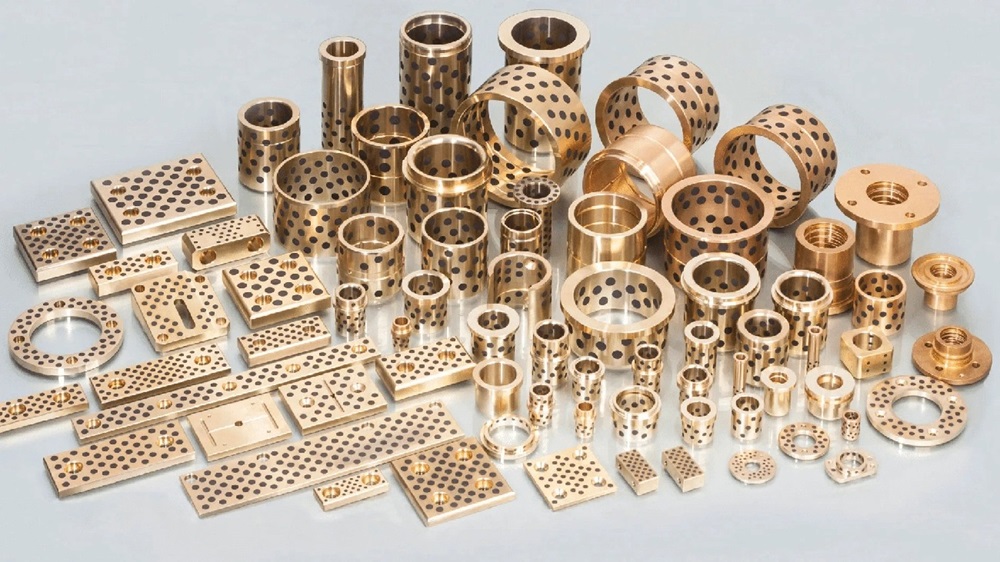
Sintered bearings can last 3 times longer than polymer and 10 times longer than milled metal bearings. These components are also known as self-lubricating plain bearings or oil-impregnated bearings. They achieve oil content of 18-30% by volume, meaning nearly one-third of their structure consists of liquid oil stored within the porous metal matrix. This self-lubricating capability reduces maintenance requirements and extends service life in demanding applications.
To select the right sintered bearing, you need to understand material options such as sintered bronze bearings and sintered iron bearings. You also need to calculate PV rating for sintered bearings to match load and speed requirements. This piece on sintered bearings design covers material properties, PV calculations and critical design parameters. Engineers can use this information to make informed decisions at the time they compare sintered bearings vs ball bearings for their applications.
Understanding Sintered Bearing Fundamentals Before Selection
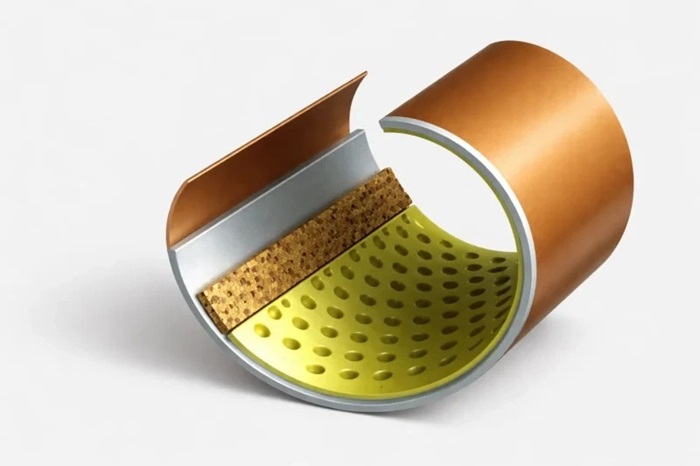
What Are Self-Lubricating Sintered Bearings
Self-lubricating sintered bearings originate from powder metallurgy, where fine metal powders compact under intense pressure before heating below the melting point. This sintering process bonds particles together and creates interconnected pores throughout the structure. The resulting porous metal contains 20-25% porosity by volume, though some designs achieve 15-30% depending on application requirements. Manufacturers fill these microscopic voids with lubricating oil through vacuum impregnation. This establishes an internal reservoir that supplies lubrication throughout the bearing’s service life.
The self-lubricating mechanism operates through capillary action and thermal expansion. Friction generates heat during operation, and the oil expands and flows from the pores onto the bearing surface. This creates a hydrodynamic film between shaft and bushing. The continuous film prevents metal-to-metal contact. The bearing stops and cools, and capillary action draws the lubricant back into the porous structure, ready for the next cycle.
Oil-Impregnated vs Solid Lubricant Mechanisms
Oil-impregnated bearings store liquid lubricant within the porous matrix and remain effective to 120°C with standard mineral oils or 180°C with synthetic formulations. The impregnation degree reaches about 75% of theoretical maximum capacity, providing sufficient oil volume for extended operation. Solid lubricant bearings incorporate graphite or molybdenum disulfide during the sintering process. These solid lubricants function above 300°C, where conventional oils would degrade. Iron-graphite compositions add up to 3.5% graphite, creating a backup lubrication layer even after oil depletes.
Choosing Sintered Bearings vs Ball Bearings
Sintered bearings excel in continuous operation above 500 rpm. They operate silently without rolling element noise and tolerate misalignment up to ±0.5°. They function well in contaminated environments where porous structures trap particles. Ball bearings suit applications requiring start-stop operation, reversed rotation, or vacuum conditions where sintered bearings underperform. Ball bearings also handle broader temperature ranges with appropriate lubrication modifications.
Applications and Operating Environments
Automotive applications include starter motors using FC-0205/FC-0208 materials, windshield wiper mechanisms, and seat adjustment systems. Home appliances like washing machines and vacuum cleaners employ sintered bronze bearings for quiet operation. Power tools use iron-copper compositions for high-load drill bushings, while food processing equipment specifies FDA-compliant bronze for corrosion resistance.
Sintered Bearing Materials: Bronze, Iron, and Composite Options

Sintered Bronze Bearings: Properties and Use Cases (SAE 841)
SAE 841 bronze bearings employ a composition of 90% copper and 10% tin. This material has a friction coefficient around 0.02 at typical working conditions. The powder metallurgy process produces 19% minimum porosity and allows oil storage throughout the structure. These bearings achieve a K strength constant of 26,500 psi. Yield strength in compression reaches 11,000 psi. The material complies with ASTM B-438-05 Grade 1 Type II and Military MIL-B-5687D standards.
Applications span aerospace components, industrial machinery, automotive gears and bushings, and home appliances. Bronze bearings provide superior corrosion resistance. They operate more quietly than iron alternatives.
Sintered Iron Bearings for Heavy-Load Applications (SAE 863)
SAE 863 iron-copper material contains 18-22% copper with iron balance. This composition targets heavy-load, slower-moving applications. You’ll find them in agriculture equipment, construction machinery and earth-moving equipment. The material achieves oil retention of 17-19% by volume. Radial crushing strength exceeds 210 MPa at 19% oil content and 280 MPa at 17% oil content. Maximum PV rating reaches 8 N/mm²·m/s. Linear speed capacity goes up to 15 m/s.
Iron bearings exhibit a friction coefficient of 0.08. This is higher than bronze but the superior load capacity and material strength offset this difference. The alloy complies with ASTM B439 Grade 4 specifications.
Copper-Iron and Hybrid Alloy Compositions
Hybrid materials balance performance and cost. Iron-based composite materials achieve friction coefficients of 0.04-0.06. They position between pure bronze and iron. Copper-coated iron powder formulations provide improved wear resistance. They maintain mechanical strength superior to copper-based materials. High-copper variants (15-25% Cu) offer enhanced thermal conductivity for motor applications. Tensile strength reaches 400 MPa.
Material Comparison Chart: Mechanical Properties and Cost Trade-Offs
| Material | Friction Coefficient | Raw Material Cost | Main Advantage |
|---|---|---|---|
| Bronze (SAE 841) | ~0.02 | $20-40/kg | Corrosion resistance, low friction |
| Iron (SAE 863) | ~0.08 | Much lower | High strength, budget-friendly |
| Iron Composites | 0.04-0.06 | Moderate | Balanced performance |
PV Rating for Sintered Bearings: Calculating Load and Speed Limits

What is PV Rating and Why It Matters
PV rating represents the highest combination of load and speed under which sintered bearings operate properly. The factor measures frictional heat generated per unit bearing surface area. Pressure (P) multiplied by velocity (V) produces an index of thermal stress that determines bearing life. Higher PV values accelerate wear. They reduce operational lifespan inversely.
How to Calculate PV Factor for Your Application
Pressure equals load divided by projected area: P = F / (d × L), where F is bearing load, d is shaft diameter, and L is bearing length. Velocity for rotational applications: V = (π × d × N) / 12 for imperial units (ft/min). So PV = (0.262 × F × N) / L in imperial measurements.
Maximum PV Limits by Material Type
| Material | Max PV (psi·ft/min) | Static P (psi) | Dynamic P (psi) | Max V (ft/min) |
|---|---|---|---|---|
| Bronze | 50,000 | 8,000 | 2,000 | 1,200 |
| Copper-Iron | 35,000 | 20,000 | 4,000 | 225 |
| Iron | 30,000 | 10,000 | 3,000 | 800 |
Limit PV to 20,000 when you run continuous operation without additional lubrication.
Static vs Dynamic Load Capacity Considerations
Static load capacity defines the maximum load bearings withstand without permanent deformation when stationary. Dynamic load capacity determines operational life under continuous movement. Brinelling occurs when you exceed static limits. Fatigue wear accelerates when you exceed dynamic limits.
Sintered Bearings Design Guide: Clearances, Fits, and Installation

Shaft Material and Surface Finish Requirements (8-16 RMS)
Hardened carbon steel shafts rated HRC 45-60 provide optimal wear resistance and oil retention for self-lubricating sintered bearings. Chrome-plated C1137 steel doubles the PV factor compared to cold-rolled mild steel. Surface roughness between 8-16 microinch Ra suits linear applications, while oscillating systems tolerate 16-64 RMS. Shafts that are too smooth cause stick-slip and adhesion. Surfaces that are too rough accelerate abrasive wear.
Running Clearance Specifications by Bearing Size
Sintered metal bearings require 0.01 to 0.05 mm clearance per 25 mm shaft diameter. The oil film gets squeezed out with insufficient clearance and causes metal-to-metal contact. Load capacity reduces and vibration triggers with excessive clearance.
Press Fit Guidelines and Housing Interference
Press fitting compresses sintered bearings and transfers 60-80% of housing interference to the bore diameter. Sizing or reaming after installation restores precise dimensions and consistent porosity. Thin-walled housings require interference pressure calculations to prevent bore distortion.
Break-In Procedures and Temperature Considerations
Break-in at reduced speed stabilizes oil distribution. Temperature should not exceed 60°C at the housing during the first operation. Speed increases in 10% increments allow thermal stabilization gradually.
Common Design Mistakes That Cause Premature Failure
Dropping bearings closes surface pores and damages internal structure. Solvent washing removes impregnated oil, while moisture exposure causes internal rust formation. Storage on absorbent materials wicks oil through capillary action.
Conclusion
Engineers who have material selection criteria, PV rating calculations, and design specifications can confidently select sintered bearings to demanding applications. Understanding the trade-offs between bronze’s low friction and iron’s high load capacity, calculating thermal stress limits through PV factors, and following clearance specifications prevents premature failure. Attention to shaft hardness, surface finish, and installation procedures directly affects bearing performance and service life. These self-lubricating components continue advancing industrial efficiency in automotive, aerospace, and manufacturing sectors.
“Need custom engineered sintered bearings or PV calculation support for your application? Contact our technical sales team today for expert material selection and instant quotes.”
FAQs
Q1. What makes sintered bearings self-lubricating and how does this mechanism work? Sintered bearings contain 20-25% porosity filled with lubricating oil through vacuum impregnation. During operation, friction-generated heat causes the oil to expand and flow from the pores onto the bearing surface, creating a protective film. When the bearing cools, capillary action draws the lubricant back into the porous structure, ready for the next cycle.
Q2. How do I choose between sintered bronze and sintered iron bearings for my application? Bronze bearings (SAE 841) offer lower friction (0.02 coefficient) and superior corrosion resistance, making them ideal for precision applications and corrosive environments. Iron bearings (SAE 863) provide higher load capacity and strength at lower cost, suited for heavy-load, slower-moving applications in construction and agricultural equipment.
Q3. What is PV rating and how do I calculate it for my bearing application? PV rating measures the maximum combination of pressure and velocity a bearing can handle. Calculate it using: P = Load / (shaft diameter × bearing length), and V = (π × shaft diameter × RPM) / 12. Multiply P × V to get your PV factor. Bronze bearings typically handle up to 50,000 psi·ft/min, while iron bearings max out around 30,000 psi·ft/min.
Q4. What shaft surface finish is required for optimal sintered bearing performance? Hardened carbon steel shafts with HRC 45-60 hardness and surface roughness between 8-16 microinch Ra provide optimal performance. Excessively smooth surfaces cause stick-slip problems, while surfaces that are too rough accelerate wear. Chrome-plated shafts can double the PV factor compared to standard cold-rolled steel.
Q5. What are the most common installation mistakes that cause sintered bearing failure? Dropping bearings closes surface pores and damages internal structure. Washing with solvents removes the impregnated oil, while moisture exposure causes internal rust. Storing bearings on absorbent materials wicks oil away through capillary action. Additionally, failing to resize or ream the bore after press-fitting can result in dimensional inaccuracies and premature failure.