
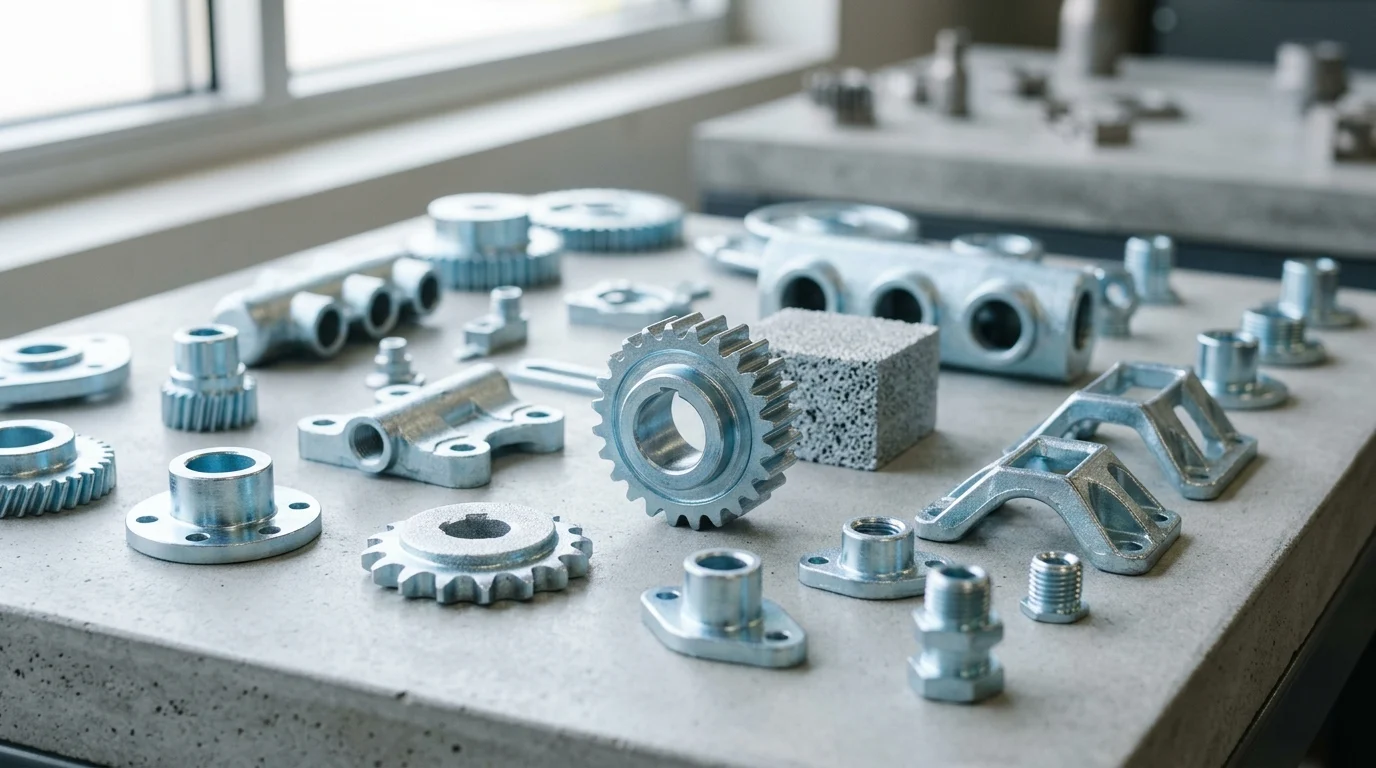
Why Zinc Plating Matters for Powdered Metal Components
Powdered metal (PM) components offer substantial cost advantages (often 20% to 50% over machined equivalents) and net-shape manufacturing capabilities for automotive, industrial, and consumer applications. However, the inherent metallurgical structure of these components presents unique vulnerabilities when exposed to corrosive environments. Zinc plating stands as one of the most effective and economically viable surface finishing methods to protect ferrous PM parts from oxidation. By providing a sacrificial galvanic layer, zinc preferentially corrodes to protect the underlying steel substrate, typically extending service life by 5 to 10 years in mild environments.
Applying a continuous, uniform zinc deposit on PM parts is far more complex than plating standard wrought or cast iron. Engineers and procurement specialists must navigate the intersection of powder metallurgy and electrochemical surface treatments to specify finishes that prevent premature failure, maintain dimensional tolerances, and meet strict lifecycle requirements.
Powdered Metal Porosity and Plating Challenges
The primary challenge in zinc plating PM components stems from their inherent porosity. Standard PM parts typically exhibit a density ranging from 6.4 to 7.2 g/cm³, which correlates to a void volume of 10% to 20%. These microscopic interconnected pores act like a sponge during wet processing, absorbing highly reactive cleaning acids, alkaline solutions, and plating electrolytes.
If these trapped fluids are not thoroughly removed or neutralized, they will aggressively attack the component from the inside out, leading to a phenomenon known as “bleed-out” or “spotting.” This defect occurs when entrapped fluids seep out post-plating, causing internal corrosion that compromises the structural integrity of the part and rapidly deteriorates the external zinc layer. Without impregnation, bleed-out defect rates can easily exceed 15% to 30% of a production batch. To mitigate this, parts with a density below 6.8 g/cm³ generally require resin impregnation—a vacuum process that fills the pores with an anaerobic methacrylate resin—prior to any electroplating operation.
Key Performance and Sourcing Variables
When engineering a zinc-plated PM component, several critical variables dictate both field performance and supply chain stability. Target coating thickness typically falls between 5 µm and 13 µm. Specifying a thickness greater than 15 µm on PM parts can lead to nodular buildup on edges and thread interference, necessitating costly secondary machining.
From a sourcing perspective, the requirement for pre-plating impregnation adds logistical complexity. If the plating facility does not have in-house vacuum impregnation capabilities, parts must be routed through a third-party sealer, adding 3 to 7 days to the overall lead time and increasing total freight and processing costs by 10% to 25%. Buyers must evaluate the total landed cost, factoring in these necessary pre-treatments against the extended lifecycle the zinc finish provides.
Zinc Plating Process for Powdered Metal Components

The electroplating sequence for powdered metal requires stringent modifications compared to standard wrought steel processing. Because PM parts are highly susceptible to chemical entrapment and surface etching, the process line must be meticulously calibrated to ensure adequate adhesion and uniform deposition without degrading the substrate.
Powdered Metal Substrate Types
The chemical composition and final density of the PM substrate heavily influence the plating approach. Common iron-carbon alloys, such as FC-0205 and FC-0208 (copper-infiltrated or admixed), present different electrochemical potentials. Copper-infiltrated parts, which often boast densities exceeding 7.2 g/cm³, exhibit sealed surface pores and can sometimes bypass resin impregnation, processing similarly to wrought steel.
Conversely, low-density structural components rely entirely on mechanical interlocking for plating adhesion. Because of internal porosity, the effective surface area of a PM part can be 2 to 5 times greater than a wrought part of identical dimensions, requiring higher initial current densities (e.g., 2.0 to 4.0 A/dm²) to achieve uniform coverage. The surface condition—whether as-sintered, machined, or tumbled—also dictates the initial conductivity of the part. Heavily tumbled PM parts may suffer from smeared surface pores, which can trap micro-pockets of air and hinder the uniform flow of the electroplating current.
Critical Cleaning and Activation Steps
Surface preparation is the most critical phase in the PM plating lifecycle. Standard aggressive acid pickling, which uses high concentrations of hydrochloric or sulfuric acid, is detrimental to PM parts. It aggressively attacks the porous matrix, expanding the voids and dissolving the iron.
Instead, PM parts require specialized alkaline soaking (typically maintained at 60°C to 80°C and a pH of 11 to 13) combined with anodic electrocleaning to draw soils out of surface pores. Acid activation is restricted to a very mild, inhibited pickle—often a 1% to 3% HCl solution or a dry acid salt—applied for a maximum of 30 to 60 seconds. This brief exposure removes superficial oxides without deeply penetrating the porous structure.
Alkaline Zinc vs. Acid Zinc Processes
The choice between alkaline and acid zinc plating chemistries dictates the functional quality of the finish on PM components. Alkaline zinc is generally preferred for powdered metal due to its superior throwing power, resulting in a more uniform thickness across complex geometries and deep recesses.
| Process Characteristic | Alkaline Zinc Plating | Acid Zinc Plating |
|---|---|---|
| Chemistry Type | Cyanide-free, high pH | Chloride or Sulfate based, low pH |
| Throwing Power | Excellent (uniform distribution) | Fair to Good (tends to build on edges) |
| Bleed-Out Risk | Low (alkaline salts are less corrosive) | High (entrapped chlorides cause rapid rusting) |
| Deposition Rate | Moderate (15-20 µm/hour) | Fast (25-35 µm/hour) |
| Suitability for PM | Highly Recommended | Not Recommended (unless densely impregnated) |
Acid zinc, while offering a faster deposition rate and a brighter cosmetic finish, relies on chloride-based electrolytes. As previously established, if these chlorides migrate into the PM pores, they initiate aggressive internal corrosion. Therefore, alkaline zinc is the industry standard for PM applications, prioritizing structural longevity over aesthetic brilliance. Acid zinc should only be considered for high-density parts if they are fully resin-impregnated and the process is rigorously validated.
Passivation and Sealers for Corrosion Protection
A bare zinc deposit provides excellent cathodic protection, but it will rapidly oxidize into zinc oxide (white rust) when exposed to moisture. To stabilize the zinc layer and dramatically extend the component’s service life, chemical passivation and subsequent sealers are applied immediately after the plating bath.
Common Passivation Options
Passivation involves a chemical conversion coating that transforms the outer surface of the zinc into a protective barrier. Modern industry standards exclusively use trivalent chromium (Cr3+) passivates, which have completely replaced the highly toxic and heavily regulated hexavalent chromium (Cr6+).
Trivalent passivates are available in clear (blue/silver), thick-film iridescent (yellow/green), and black finishes, typically applied via immersion for 45 to 90 seconds at 20°C to 30°C. The passivation layer is incredibly thin, typically ranging from 50 to 200 nanometers. Despite this microscopic thickness, a high-quality thick-film trivalent passivate can delay the onset of white rust by 96 to 120 hours in standardized salt spray environments, though exact performance varies by proprietary chemistry brand and bath maintenance.
Sealers, Topcoats, and Coefficient of Friction
To further fortify the passivate and manipulate the mechanical properties of the surface, sealers or topcoats are applied as the final wet step. These are typically silicate-based or organo-mineral polymer solutions that enhance the barrier properties of the gel-like trivalent conversion film.
For PM fasteners and threaded components, sealers serve a dual purpose: corrosion resistance and friction modification. By incorporating specialized lubricants into the sealer, platers can tightly control the coefficient of friction (CoF). Engineering specifications for automotive fasteners often mandate a thread and bearing surface CoF range of 0.12 to 0.18, ensuring consistent torque-tension relationships (often within a ±10% tolerance) during automated assembly.
Comparing Corrosion Performance and Appearance
The combination of zinc thickness, passivate type, and sealer determines the ultimate environmental endurance of the PM component. Performance is universally validated using the ASTM B117 neutral salt spray test.
| Finish Combination (8 µm Alkaline Zinc Base) | Time to White Rust (ASTM B117) | Time to Red Rust (ASTM B117) |
|---|---|---|
| Clear Trivalent Passivate (No Sealer) | 24 – 48 hours | 96 – 120 hours |
| Thick-Film Yellow Passivate (No Sealer) | 96 – 120 hours | 240 – 360 hours |
| Thick-Film Yellow Passivate + Silicate Sealer | 120 – 168+ hours | 360 – 480+ hours |
As shown above, a standard 8 µm alkaline zinc deposit with a clear trivalent passivate typically yields 24 to 48 hours to white rust and 120 hours to red rust. Upgrading to a thick-film yellow passivate with a high-performance silicate sealer can push white rust resistance beyond 120 hours, and delay red rust (base metal corrosion) to 360 or even 480 hours, depending on the supplier’s specific formulation and application quality. Engineers must align these performance metrics with the expected operating environment to avoid costly over-specification.
Specifications, Testing, and Quality Risks
Procuring zinc-plated powdered metal components requires precise documentation and rigorous quality control. Ambiguous drawing callouts or a failure to account for PM-specific defect modes can lead to catastrophic field failures, assembly line downtime, and compliance violations.
Relevant Standards and Drawing Callouts
Engineers must use recognized international standards to define the plating requirements. The most common standards are ASTM B633 (Standard Specification for Electrodeposited Coatings of Zinc on Iron and Steel) and ISO 2081. A proper engineering drawing callout must specify the standard, the thickness class, and the passivation type.
For example, a callout of “ASTM B633, SC2, Type III” specifies a minimum zinc thickness of 8 µm (Service Condition 2) with a colorless (clear) conversion coating. Alternatively, ISO 2081 uses designations such as “Fe/Zn 8”. Because PM parts are porous, drawings should also explicitly state whether resin impregnation (e.g., MIL-I-17563C) is required prior to plating, removing ambiguity for the manufacturer.
Common Defects: Bleed-Out, Blistering, and Thread Issues
Quality inspections of plated PM parts focus heavily on detecting bleed-out, blistering, and dimensional interference. As previously noted, bleed-out manifests as white or brown crusty deposits emerging from pores days or weeks after plating, signaling entrapped processing fluids. Blistering occurs when trapped gases expand, or when poor activation leads to weak adhesion, causing the zinc to peel. Blistering can drive batch rejection rates up to 100% if pre-plate cleaning lines fail to neutralize trapped acids.
Threaded PM components face significant dimensional risks. Electroplating builds up on surfaces, and on threaded geometries, the pitch diameter increases by a factor of 4 times the plating thickness. A maximum plating thickness of 12 µm will add 48 µm to the pitch diameter, potentially causing GO/NO-GO gauge failures. Furthermore, this risk is compounded for net-shape components if excess resin from the pre-plating impregnation process is not fully washed from the threads, creating a cumulative dimensional tolerance issue. If the PM part is heat-treated to a hardness exceeding 32 HRC (320 HV), it must be baked at 190°C to 220°C for 3 to 4 hours immediately after plating—but crucially, before passivation and sealing, as the heat would destroy the conversion coating—to prevent hydrogen embrittlement.
RoHS and Compliance Requirements
Regulatory compliance is a non-negotiable aspect of surface finishing. The European Union’s RoHS (Restriction of Hazardous Substances) Directive 2011/65/EU strictly limits hexavalent chromium to less than 0.1% by weight in the homogeneous material. Similarly, the ELV (End of Life Vehicles) directive enforces these restrictions in automotive supply chains.
Buyers must mandate that suppliers provide Certificates of Compliance (CoC) explicitly stating that all zinc plating and passivation chemistries are Cr6+-free and compliant with current RoHS and REACH regulations. Routine audits (e.g., annual third-party lab verification) and X-ray fluorescence (XRF) testing may be employed to verify the absence of restricted heavy metals.
How to Select a Zinc Plating Strategy
Selecting the optimal zinc plating strategy for powdered metal components requires balancing corrosion resistance, dimensional tolerances, and unit costs. A successful strategy integrates substrate preparation, plating chemistry, and supplier capabilities into a cohesive procurement plan.
Supplier Selection Criteria
Supplier selection is paramount when dealing with PM components.
Key Takeaways
- Specify zinc plating for ferrous powdered metal components when sacrificial corrosion protection is needed in mild to moderate service environments.
- Evaluate PM part density early, because components below 6.8 g/cm³ typically require vacuum resin impregnation before electroplating.
- Keep zinc coating thickness in the 5 µm to 13 µm range to balance corrosion resistance with dimensional control.
- Avoid specifying zinc layers above 15 µm on PM parts unless thread fit, edge buildup, and secondary machining risks have been reviewed.
- Account for impregnation in sourcing plans, as outsourced sealing can add 3 to 7 days and increase total processing costs by 10% to 25%.
- Control bleed-out risk by using modified cleaning, rinsing, impregnation, and drying steps designed for porous powdered metal substrates.
Frequently Asked Questions
Why is zinc plating used on powdered metal components?
Zinc plating provides a sacrificial corrosion barrier for ferrous powdered metal parts. The zinc corrodes preferentially, protecting the steel substrate and often extending service life by 5 to 10 years in mild environments.
What makes powdered metal parts harder to plate than wrought steel?
Powdered metal parts contain interconnected pores, often 10% to 20% void volume. These pores can trap acids, cleaners, and plating solutions, causing bleed-out, spotting, and internal corrosion after plating.
When is resin impregnation recommended before zinc plating?
Resin impregnation is generally recommended when powdered metal density is below 6.8 g/cm³. Vacuum impregnation seals the pores and helps prevent trapped chemicals from bleeding out after plating.
What zinc coating thickness is typical for PM components?
A common zinc plating thickness range is 5 µm to 13 µm. Thickness above 15 µm can create nodular edge buildup, thread interference, and the need for secondary machining.
How can bleed-out affect plated powdered metal parts?
Bleed-out occurs when trapped process fluids seep from the pores after plating. It can cause spotting, internal corrosion, reduced coating performance, and premature part failure.