
Why Sinter Hardening Matters for PM Gears
Sinter hardening represents a pivotal advancement in powder metallurgy (PM). For the production of PM gears, consolidating the thermal processing steps addresses both economic and metallurgical objectives without compromising dimensional precision.
How it Reduces Secondary Heat-Treatment Costs
By integrating rapid cooling directly within the sintering furnace, manufacturers eliminate the need for secondary quench-and-temper operations. This consolidation can reduce overall manufacturing costs by an estimated 15% to 30% compared to conventional PM processing followed by a separate secondary heat treatment. These are typical industry estimates that vary by supplier, region, and part complexity. Furthermore, avoiding a secondary oil quench drastically reduces the logistical overhead of handling, cleaning, and transferring parts between distinct thermal processing lines, while simultaneously minimizing scrap rates caused by handling damage. While secondary heat treatment is avoided, some PM gears may still undergo post-hardening finishing operations—such as sizing, coining, or shot peening—depending on the final tolerance and fatigue requirements.
Where it Fits in the Powder Metallurgy Process
In the standard PM workflow, powder compaction is followed by sintering in a continuous belt furnace to bond the metal particles. Sinter hardening integrates seamlessly into this existing sequence by modifying the cooling zone of the furnace. Rather than routing parts to a separate facility or batch process after sintering, high-velocity convective gas cooling extracts heat from the gears immediately after they exit the hot zone. This inline transformation streamlines the supply chain, allowing components to move directly from the sintering furnace to final tempering or finishing operations.
What Sinter Hardening Is
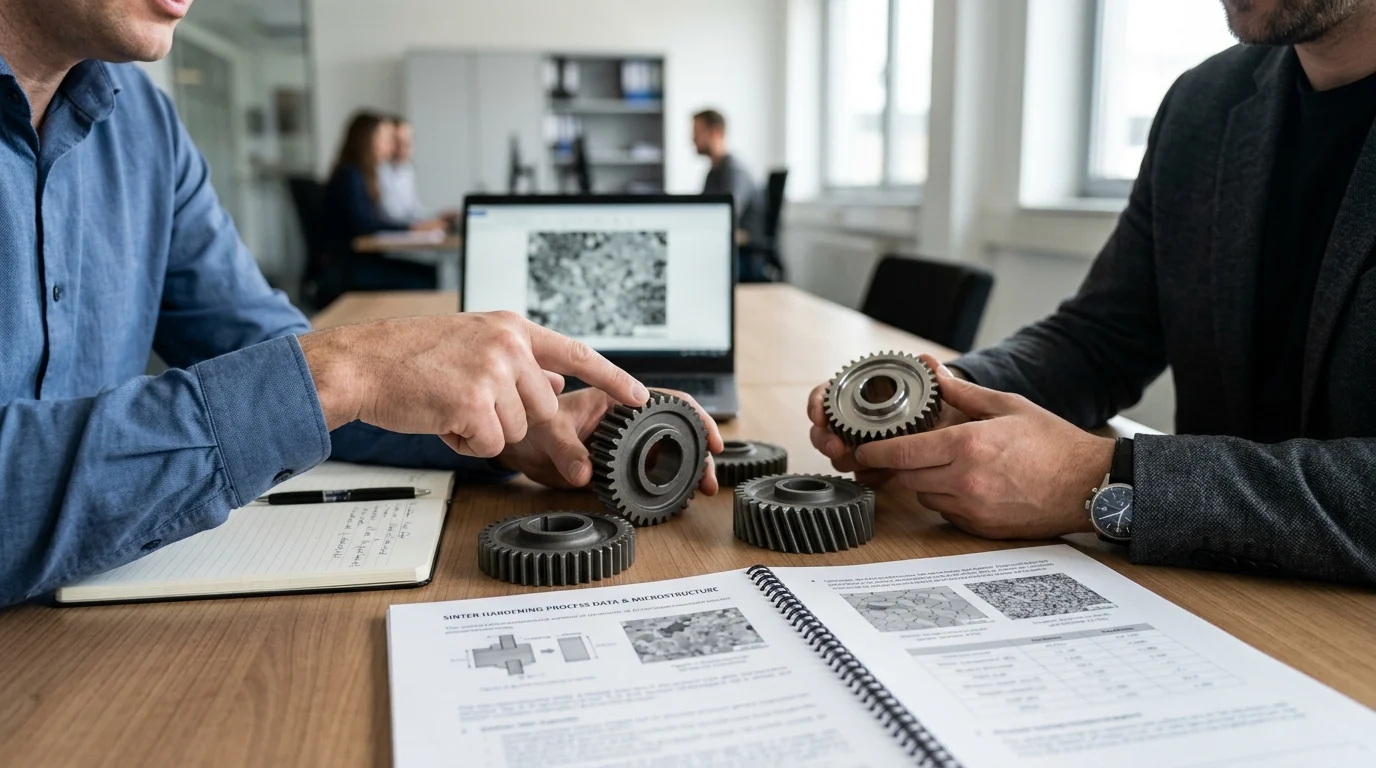
Rather than redefining basic furnace mechanics, it is best to understand sinter hardening as a specialized thermal profile applied to high-hardenability powder metal alloys. It requires precise control over the furnace atmosphere and cooling dynamics to achieve a martensitic transformation without the severe thermal shock characteristic of liquid quenching.
How it Differs from Conventional Sintering
Conventional sintering relies on slow cooling rates, which leaves the component with a relatively soft, machinable microstructure. Achieving high hardness subsequently requires reheating, oil quenching, and tempering. Sinter hardening replaces this slow cooling with forced gas recirculation. Unlike the violent boiling phases and uneven vapor blankets associated with liquid oil quenching, high-velocity gas provides a much more uniform heat extraction rate across the component’s surface. As detailed in the process comparison table below, this uniform fluid dynamic minimizes the severe thermal gradients that cause distortion, resulting in superior dimensional control.
Critical Requirement: Mandatory Tempering
It is crucial to emphasize that the as-quenched martensite produced by sinter hardening is too brittle for direct gear service. A low-temperature tempering step is non-negotiable to restore the necessary toughness and prevent premature failure. This essential temper is either integrated into a subsequent heating zone of the continuous furnace or performed as a separate secondary operation.
| Process Feature | Conventional Sintering + Heat Treat | Sinter Hardening |
|---|---|---|
| Cooling Medium | Slow furnace gas, followed by secondary oil quench | High-velocity gas (N2/H2 mix) |
| Typical Cooling Rate | Furnace: ~0.5 °C/s; Secondary oil quench: >50 °C/s | 2 to 8 °C/s (continuous) |
| Dimensional Distortion | Moderate to High | Low |
| Microstructure | Pearlite/Ferrite (initial), Martensite (final) | Martensite/Bainite |
Which Alloys, Carbon Levels, and Cooling Rates Enable It
The success of this process relies heavily on the hardenability of the base powder. Ferrous alloys must be alloyed with elements that delay the formation of pearlite during the cooling phase. Common pre-alloyed powders include additions of molybdenum (0.5% to 1.5%), nickel (1.0% to 4.0%), and copper (1.0% to 2.0%). Admixed graphite is also critical, with final combined carbon levels typically maintained between 0.6% and 0.9% to ensure sufficient martensitic hardness upon cooling. However, this reliance on carbon necessitates strict atmosphere control; improper gas mixtures during high-temperature sintering can cause surface decarburization, depleting the very carbon needed to achieve high surface hardness and fatigue life in the gear teeth.
Which Process Variables Control Repeatability
Achieving uniform hardness across a production run requires strict regulation of several furnace parameters. Belt speed dictates the time spent in the rapid cooling zone, while gas blower frequency and atmospheric pressure (often maintained between 1 and 2 bar using a nitrogen-hydrogen blend) control the heat transfer coefficient. Additionally, part loading density on the furnace belt must be optimized; overloading restricts gas flow, leading to localized cooling rates below the critical threshold required for full martensite formation.
It is also crucial to account for section-size limitations. Thick gear teeth or large modules may not achieve sufficient cooling rates internally, resulting in a softer, non-martensitic core. To verify that adequate core martensite content has been achieved, cut-up or destructive testing is highly recommended during the validation phase.
Sinter-Hardened PM Gears vs Carburized Gears
While sinter hardening offers substantial cost and dimensional benefits, engineers must carefully weigh its mechanical output against traditional carburized steel gears. The choice between the two processes dictates the gear’s final load-bearing capacity and fatigue life.
How Hardness, Density, and Distortion Compare
Carburized wrought gears typically exhibit a distinct case-core microstructure, achieving macroscopic surface hardness levels of 55 to 60 HRC. In contrast, sinter-hardened PM gears generally yield a lower apparent hardness (as detailed in the properties table below), even though their individual particle micro-hardness reaches equivalently high levels. It is important to clarify that high particle micro-hardness does not equate to high macroscopic surface hardness, which has practical wear implications for designers; the softer porous network between hard particles can deform under extreme contact pressures.
However, sinter hardening excels in dimensional stability. Because it utilizes gas quenching rather than a violent oil quench, dimensional change is often held below 0.05%, drastically reducing or eliminating the need for post-process hard machining or grinding. It should be noted that while wrought carburized gears can achieve higher AGMA precision grades (10–12+) after hard finishing, sinter-hardened PM gears are generally limited to AGMA 6–8 unless they undergo secondary machining.
| Property | Typical Value Range for Sinter-Hardened PM Gears |
|---|---|
| Density | 6.8 – 7.2 g/cm³ |
| Apparent Hardness | 30 – 42 HRC |
| Micro-hardness (Particle) | 600 – 750 HV0.1 |
| Ultimate Tensile Strength | 600 – 900 MPa |
| Impact Energy (Unnotched) | 10 – 25 J |
Key Trade-offs in Toughness and Wear Resistance
The fundamental trade-off lies in the balance of toughness and wear resistance. Carburizing produces compressive residual surface stresses and a ductile core, yielding excellent impact toughness. Sinter-hardened components tend to be through-hardened or possess a mixed martensitic/bainitic microstructure throughout the cross-section. Consequently, their unnotched impact energy is typically lower. While wear resistance is highly competitive for mid-load applications due to the hard martensitic particles resisting abrasion, the overall macroscopic toughness cannot match a dense, carburized wrought steel gear.
When Carburizing is Still Required
Carburizing remains the mandatory choice for highly stressed power transmission applications. As a general industry rule of thumb, when gear tooth contact stresses exceed approximately 1,000 MPa, or when the application involves severe shock loading—such as in heavy-duty automotive transmissions or hypoid differential gears—the deep, highly compressed hardened case provided by carburizing is indispensable to prevent pitting and tooth root fatigue.
Mechanical Properties That Determine Suitability
The mechanical viability of a sinter-hardened PM gear is not determined by thermal processing alone. The inherent characteristics of the powder metal matrix—specifically its density and structural integrity—play a dominant role in final performance.
Effects of Density, Porosity, and Microstructure
Density is the primary driver of mechanical strength in any PM component. Because internal porosity acts as a network of stress concentrators, increasing the density exponentially improves both the tensile strength and the rolling contact fatigue limit. Furthermore, higher density improves the material’s thermal conductivity. This enhanced heat transfer is critical during rapid gas cooling, as it directly increases the core hardenability of thicker gear sections. It is important to note that achieving upper-range densities near 7.2 g/cm³ typically requires advanced compaction techniques—such as warm compaction or a double-press/double-sinter process—rather than standard single-press processing. When these densities are reached, interconnected porosity is minimized, allowing the martensitic microstructure to effectively distribute applied loads across the gear teeth.
Testing Methods for Hardness and Strength Validation
Validating the strength of these gears requires understanding the critical difference between apparent and particle hardness. Apparent hardness (measured on the macro scale, e.g., Rockwell C) incorporates the void spaces, artificially lowering the reading. Particle hardness (measured via micro-indentation, e.g., HV0.1) reflects the true hardness of the martensitic structure. Ultimate tensile strength and impact energy for high-density, sinter-hardened gears will vary depending on the specific alloy system, making standardized destructive testing essential for validating batch performance.
How to Specify Acceptable Performance Variation
To guarantee reliable operation, engineering drawings must specify acceptable metallurgical variations. This includes mandating a minimum percentage of martensite at the surface—typically 90% or greater—to ensure adequate wear resistance. Specifications should also detail the maximum allowable retained austenite (usually capped at 5% to 10%) to prevent dimensional instability over time, and outline statistical process control parameters (such as a Cpk > 1.33) for dimensional tolerances across high-volume batches.
How to Decide if Sinter Hardening is the Right Choice
Determining whether to specify sinter hardening requires a holistic evaluation of the gear’s operating environment, production volume, and supply chain constraints. When applied correctly, it is a highly efficient manufacturing route.
Material Selection and Process Planning Steps
The first step is evaluating the required gear precision against the AGMA (American Gear Manufacturers Association) quality classification. Sinter hardening can reliably produce gears in the AGMA 6 to 8 range without secondary machining, whereas higher precision requirements (AGMA 10+) typically necessitate wrought steel and hard finishing. Next, engineers must select an appropriate pre-alloyed powder—such as the FL-5305 or FLNC-4408 series—that aligns with the required cooling rate of the chosen manufacturer’s furnace, ensuring full transformation to martensite.
Cost, Sourcing, and Quality Questions to Resolve
Economic feasibility hinges on production volume. Because PM tooling is expensive and optimizing the continuous furnace profile requires setup time, Minimum Order Quantities (MOQs) typically need to exceed approximate benchmarks of 10,000 to 15,000 pieces annually to justify the investment, though this rule of thumb varies heavily by supplier and part complexity. Buyers must also audit potential suppliers to verify their furnace cooling capacities; older sintering furnaces may lack the high-velocity blowers required to achieve the critical minimum cooling rates for modern alloys.
Best-fit Applications for Sinter-Hardened PM Gears
The ideal applications for sinter-hardened gears are those requiring moderate to high strength, excellent wear resistance, and high production volumes, but which do not experience extreme shock loads. Best-fit applications include power tool planetary gears, lawn and garden tractor transmissions, automotive oil pump gears, and balancing shaft drives. In these environments, the cost savings and dimensional consistency of sinter hardening provide a distinct competitive advantage over traditional manufacturing methods.
Key Takeaways
- Use sinter hardening for high-hardenability PM alloys when you need martensitic or bainitic strength with lower distortion than secondary oil quenching.
- Target gas cooling rates around 2 to 8 °C/s to transform suitable ferrous PM alloys without the severe thermal shock associated with oil quenching.
- Specify alloy systems with molybdenum, nickel, copper, and about 0.6% to 0.9% final carbon when high hardness and gear fatigue resistance are required.
- Always include low-temperature tempering after sinter hardening because as-quenched martensite is too brittle for reliable gear service.
- Control belt speed, gas flow, furnace pressure, atmosphere, and loading density to prevent uneven cooling and inconsistent hardness across production batches.
Frequently Asked Questions
What is sinter hardening in powder metallurgy?
Sinter hardening is a PM process that uses controlled, rapid gas cooling after sintering to form martensite or bainite directly in high-hardenability ferrous parts, reducing the need for separate oil quenching.
How is sinter hardening different from conventional sintering?
Conventional sintering cools slowly and often needs later reheating, oil quenching, and tempering. Sinter hardening uses high-velocity gas cooling in the furnace, improving dimensional control and reducing distortion.
Does sinter hardening still require tempering?
Yes. As-quenched martensite is too brittle for gear service, so low-temperature tempering is essential to improve toughness and reduce premature failure risk.
What cooling rate is typical for sinter hardening?
Sinter hardening commonly uses continuous gas cooling rates of about 2 to 8 °C/s, compared with slow furnace cooling near 0.5 °C/s and much faster oil quenching above 50 °C/s.
Which alloying elements support sinter hardening?
Common PM alloy systems use molybdenum, nickel, and copper to delay pearlite formation and improve hardenability. Final carbon levels are often maintained around 0.6% to 0.9%.