
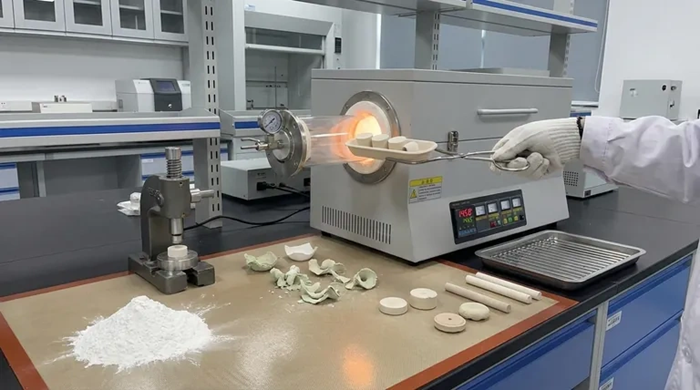
From ancient Paleolithic earthenware to today’s high-tech microelectronics, sintering remains the core foundational process of ceramic manufacturing. Technical ceramic sintering densifies green compacts through thermal diffusion at temperatures typically around two-thirds of the material’s melting point. This solid-state atomic diffusion eliminates interparticle voids, dramatically boosting mechanical strength, wear resistance, dielectric isolation, and thermal conductivity without requiring glass phase binders.
For modern industrial applications—including aerospace turbine nozzles, automotive wear bearings, biocompatible implants, and high-power electronic substrates—mastering the end-to-end ceramic sintering workflow is key to achieving predictable net-shape tolerances and superior physical properties.
1. Powder Selection & Preprocessing Engineering
The structural integrity of sintered ceramic parts directly depends on initial powder characteristics. Powder engineering establishes the critical particle contacts necessary for complete thermal diffusion.
Particle Size Distribution (PSD) & Surface Area Control
Submicron powders (<1 µm) are essential for high-performance technical ceramics. Fine particle sizing increases the specific surface area (BET surface area between 20–25 m²/g), providing a higher thermodynamic driving force that lowers the required activation energy during sintering. However, excessive surface area can form hard agglomerates that hinder mass transport. A narrow particle size distribution ensures uniform green packing density and predictable linear shrinkage.
Organic & Inorganic Binder Formulations
Temporary binder systems provide mechanical cohesion to green bodies prior to thermal debinding:
- Inorganic Binders: Materials such as bentonite (0.5%–3.0%) or magnesium aluminum silicates offer high temperature resistance and eliminate black coring defects during preliminary firing.
- Organic Binders: Polymers such as Polyvinyl Alcohol (PVA), starches, and Carboxymethylcellulose (CMC) form three-dimensional hydrogen bonding networks that enhance green body handling strength by up to 30%.
Spray Drying Granulation
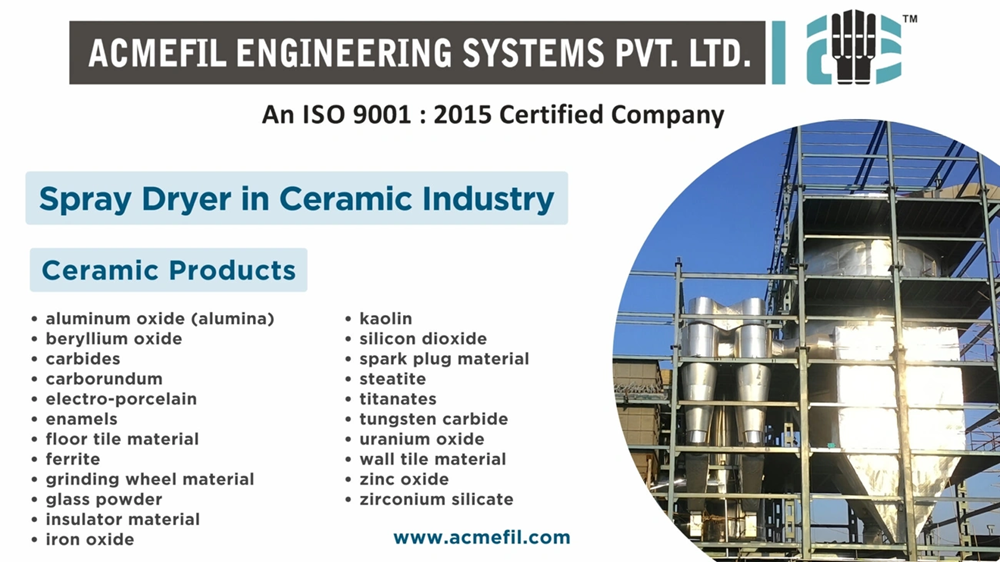
Fine ceramic slurries are atomized into free-flowing spherical granules (100–300 µm) via spray drying. These engineered granules collapse under press forces to eliminate inter-granular voids, preventing structural micro-cracks while reducing atmospheric dust in industrial production.
2. Green Body Shaping & Compaction Techniques
Selecting the optimal compaction method determines microstructural uniformity and net-shape precision prior to kiln entrance.
Uniaxial Pressing vs. Cold Isostatic Pressing (CIP)
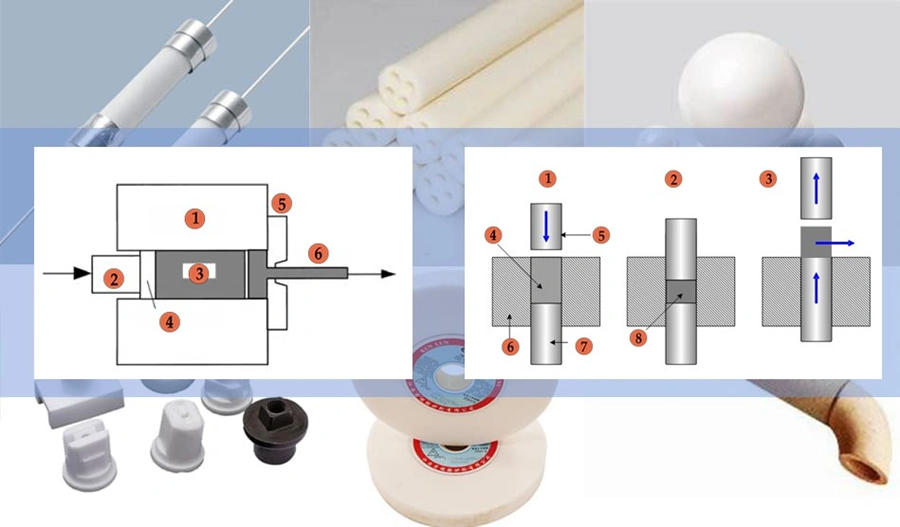
Uniaxial pressing uses top and bottom dies to consolidate powders along a single axis. While highly cost-effective for simple geometric discs and plates, tool-wall friction creates internal density gradients. In contrast, Cold Isostatic Pressing (CIP) applies hydrostatic fluid pressure (100–400 MPa) uniformly from all directions inside elastomeric molds, eliminating density variation, boosting green strength, and allowing for complex aspect ratios.
Ceramic Injection Molding (CIM) Feedstock Optimization
For high-volume, highly intricate 3D components, Ceramic Injection Molding (CIM) provides exceptional shape freedom. CIM feedstock blends fine ceramic powder (typically ~50 vol%) with multi-component thermoplastic binders (polyethylene, paraffin wax, surfactants). Highly filled feedstocks maximize green density and minimize shrinkage, while optimized binder viscosity ensures precise mold filling without jetting or segregation.
| Forming Method | Pressure Range | Green Density Range | Geometric Capability |
|---|---|---|---|
| Uniaxial Pressing | 50 – 250 MPa | 50% – 60% | Simple planar geometries (Discs, Rings) |
| Cold Isostatic Pressing (CIP) | 100 – 400 MPa | 60% – 68% | Elongated tubes, rods, uniform blocks |
| Ceramic Injection Molding (CIM) | 50 – 150 MPa (Hydraulic) | 55% – 65% | Complex 3D net-shapes with undercuts & threads |
3. Kiln Architecture & Thermal Profile Engineering
The thermal firing cycle governs organic debinding, atomic lattice diffusion, and final phase development.
Tunnel Kilns vs. Periodic Kilns
Continuous tunnel kilns maintain stationary temperature zones while parts travel on cars, offering extreme thermal stability (±5°C) ideal for high-volume OEM manufacturing. Periodic kilns allow custom heating and cooling ramps, making them ideal for specialized low-volume runs or complex thermal profiles.
Thermal Profile Phases
- Preheat & Debinding Zone: Slow thermal ramping volatilizes organic binders and moisture without generating internal gas pressure that could induce micro-cracking.
- Sintering Zone: Soaking temperatures (1,000°C to 2,000°C) drive solid-state diffusion, collapsing inter-granular porosity and achieving near-theoretical density.
- Controlled Cooling Zone: Controlled ramp-down prevents thermal shock cracking, residual stress accumulation, and adverse phase transitions.
4. Advanced High-Performance Sintering Technologies
When conventional pressureless sintering cannot meet density or grain-size requirements, advanced sintering techniques offer enhanced capabilities:
| Technology | Operating Mechanism | Key Advantage |
|---|---|---|
| Hot Isostatic Pressing (HIP) | Inert gas pressure up to 400 MPa at 2,000°C | Achieves >99.99% theoretical density; eliminates internal micro-voids |
| Spark Plasma Sintering (SPS) | Pulsed DC electric current with uniaxial pressure | Rapid heating rates (1,000°C/min) preserve submicron nanostructures |
| Flash & Microwave Sintering | Direct electric fields or electromagnetic volumetric heating | Densification achieved in under 10 seconds with 90% energy savings |
5. Microstructure Evolution & Mechanical Properties
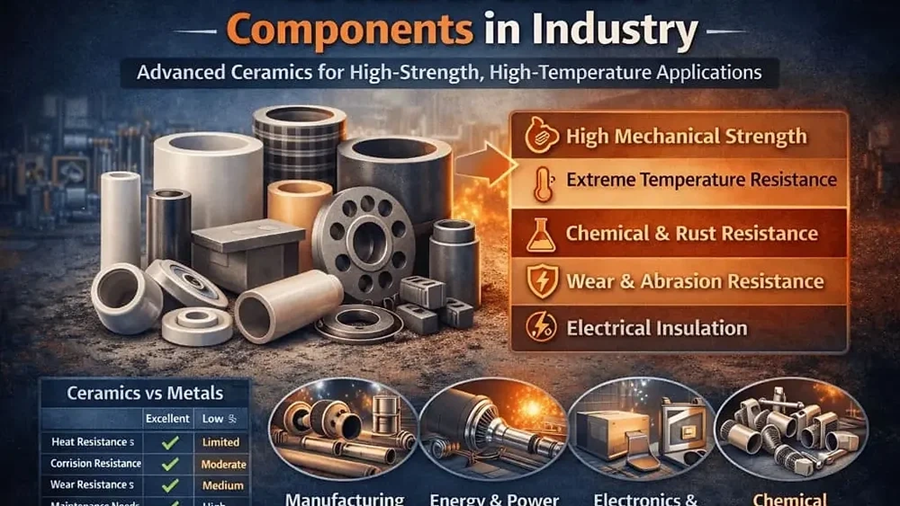
The macroscopic mechanical strength and thermal characteristics of ceramics are direct outcomes of their microstructural evolution during firing.
Grain Boundary Strengthening (Hall-Petch Effect)
Fine-grained microstructures restrict dislocation movement across grain boundaries. Suppressing excessive grain growth during final-stage sintering increases Vickers hardness significantly (e.g., grain size reduction from 60 nm to 10 nm increases hardness from 18.2 to 22.5 GPa in oxide systems).
Pore Elimination & Mechanical Reliability
Isolated rounded micro-pores (<5 µm) act as minor stress concentration points, whereas large interconnected pores (>10 µm) drastically diminish fracture toughness and thermal conductivity. Precision shrinkage control during sintering guarantees superior mechanical stability in severe-duty environments.
Industrial Applications of Technical Sintered Ceramics
- Aerospace & Defense: High-temperature brake discs, turbine rotor blades, radomes, and corrosion-resistant seals.
- Medical & Bio-engineering: Yttria-stabilized Zirconia (YSZ) hip implants, dental crowns, and porous osteoconductive bone scaffolds.
- Electronics & Semiconductor: Aluminum Nitride (AlN) high-power LED substrates, semiconductor wafer chucks, and insulating nozzles.
Partner with JH MIM for Precision Sintered Ceramic Components
JH MIM specializes in precision Ceramic Injection Molding (CIM) and advanced sintering technologies. Certified to ISO 9001:2015 and IATF 16949:2016 standards, our engineering team assists global OEMs with raw powder selection, tooling DFM, high-density sintering, and ultra-fine secondary diamond machining.
👉 Contact JH MIM Engineers Today to Get a Custom DFM Analysis & Quote →