
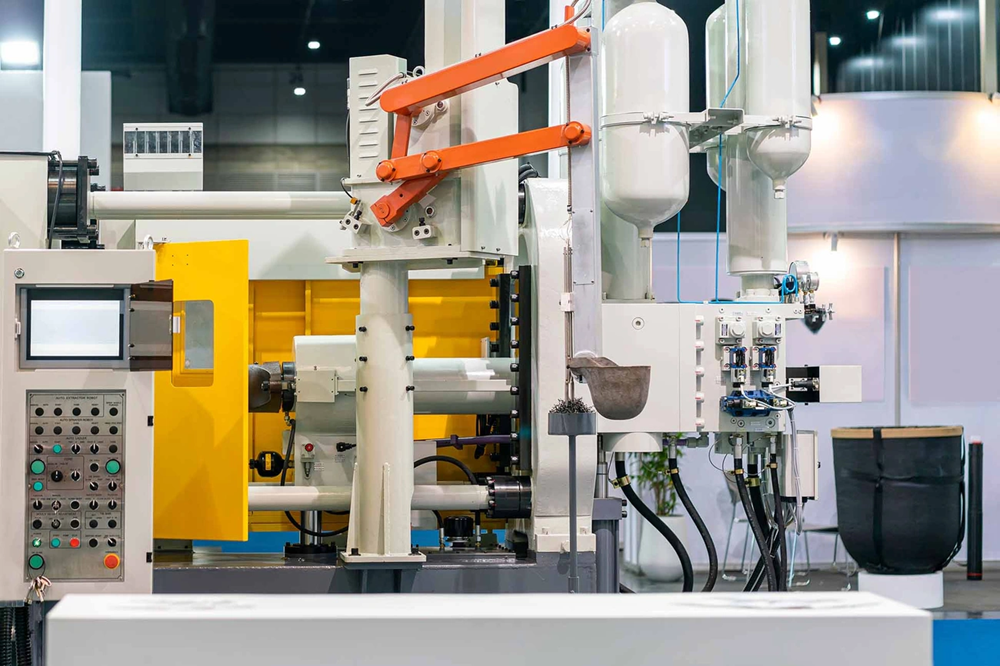
The choice between die casting vs injection molding can determine whether a metal component is economical or prohibitively expensive to manufacture. Die casting forces molten metal under high pressure into reusble steel molds, while metal injection molding uses powder feedstock with traditional injection molding equipment to create intricate parts. The differences extend beyond process mechanics. Die casting molds can produce up to a million parts compared to MIM molds which make a couple hundred thousand. Cost structures, tolerances and part geometry constraints vary dramatically between these processes. This piece breaks down the engineering trade-offs between casting vs molding and covers everything from injection molding vs die casting cost economics to MIM vs die casting break even volume considerations. Engineers can select the optimal manufacturing route.
Process Fundamentals: Die Casting vs Metal Injection Molding
How Die Casting Works: Molten Metal Under High Injection Pressure
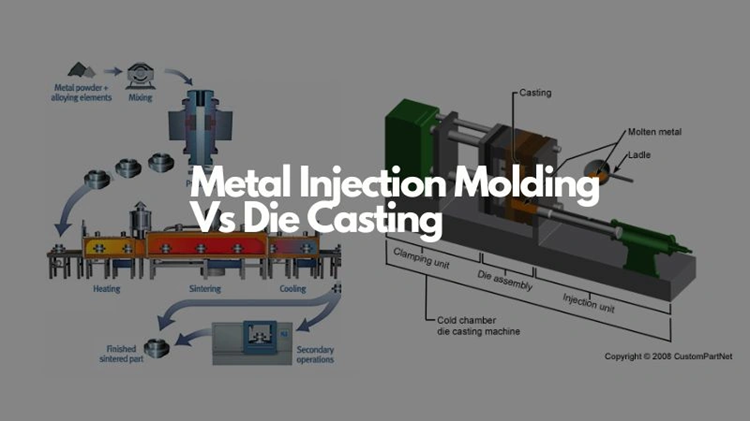
Die casting begins with solid metal ingots melted in a furnace. The material is injected into hardened steel dies under pressures ranging from 140 MPa to 215 MPa once molten. Aluminum enters the mold at 600-700°C, whereas zinc and magnesium inject at 400-500°C. The metal solidifies faster upon contact with the water-cooled die surfaces. Cycle times span seconds to minutes per shot. The part cools, solidifies, and ejects without further processing stages.
How Metal Injection Molding (MIM) Works: Powder Feedstock to Sintered Component
MIM relies on feedstock created by blending fine metal powders with polymer binders. This mixture is injection molded at around 200°C and produces a “green part” that contains about 90% metal powder and 10% binder. The green part measures about 20% larger than the final component to accommodate shrinkage. The part then undergoes debinding through catalytic or solvent processes to remove the binder and leaves a porous “brown part.” Sintering occurs at 1200-1400°C and fuses metal particles together. Parts shrink 16-18% during this stage and achieve near-theoretical density.
Process Temperature and Thermal History: Solidification vs. High-Temperature Sintering
The core difference lies in thermal processing. Die casting injects molten metal that solidifies directly in the mold. MIM injects powder-binder feedstock at plastic-molding temperatures and defers high-temperature exposure until sintering. This fundamental difference determines material compatibility. Die casting limits selection to lower-melting-point alloys, while MIM’s sintering approach makes stainless steels and superalloys possible.
Multi-Stage Processing Constraints: Debinding and Sintering Lead Times vs. Direct Casting
Die casting delivers finished parts in minutes. MIM requires days owing to batch furnace debinding and sintering cycles. This multi-stage constraint affects production planning but makes geometric complexity unattainable through direct metal solidification possible.
Material Capabilities and Part Geometry Constraints
Material Comparison Matrix: Aluminum, Zinc, Magnesium vs. Stainless Steels and High-Performance Alloys
Material selection represents a fundamental dividing line in the metal injection molding vs die casting decision. Die casting works exclusively with non-ferrous, low-melting-point alloys: aluminum (melting at 660°C), zinc (380-420°C), and magnesium (650°C). These alloys cast well but have limited mechanical properties. MIM accommodates stainless steels, titanium alloys, tool steels, and tungsten alongside nickel-based superalloys. MIM parts exhibit superior surface hardness, wear performance, and fatigue strength because they can access high-performance materials. They also show better corrosion resistance than die casting materials.
Wall Thickness Guidelines: Micro-Molding Capabilities vs. Flow and Solidification Limits
Wall thickness dictates process feasibility. MIM handles sections as thin as 0.25 mm. Optimal thickness sits between 1.0-6.35 mm. Die casting requires minimum sections of 0.89 mm for aluminum and 0.63 mm for zinc. Magnesium needs 1.27 mm. Features below 2 mm are exclusive to MIM. Thicker MIM sections beyond 6-10 mm face debinding problems as trapped binder creates internal defects.
Part Weight and Envelope Limits: Grams vs. Kilograms
MIM works best between 0.1-200 grams. Economics favor components under 100 grams. Die casting handles 200 grams to 5 kilograms well. Modern presses produce aluminum chassis components that exceed 100 kilograms.
Feature Feasibility: Internal Channels, Undercuts, and Complex External Geometry
MIM produces internal channels, cross-holes, and undercuts in single molding cycles. It also creates fine threads. Die casting doesn’t deal very well with intricate details. It needs simpler 2.5D geometries and often requires secondary machining for complex features.
Tolerances, Surface Finish, and Defect Prevention
Dimensional Accuracy Limits: Sintering Shrinkage Control vs. Tooling Wear
MIM achieves tight dimensional tolerances, typically maintaining ±0.3% to ±0.5% of nominal dimensions without secondary machining. Managing the uniform 16-18% shrinkage during sintering relies heavily on precise feedstock binder ratios and oversized mold cavity design. In contrast, die casting dimensional variations stem primarily from thermal expansion of the steel dies and mechanical parting line shifts, typically yielding tolerances around ±0.005 in/in (±0.13 mm per 25 mm).
Defect Profiles: Porosity Control, Gas Entrapment, and Blistering Risks
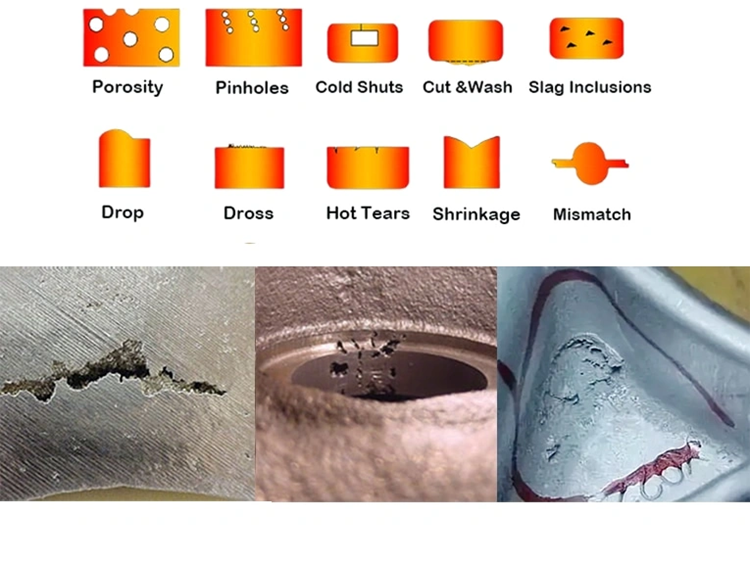
Die casting is uniquely prone to internal gas porosity caused by high-velocity turbulent mold filling, which traps air inside the molten metal. This can restrict subsequent heat treatment due to blistering risks. Conversely, MIM components undergo full solid-state diffusion during sintering, eliminating gas entrapment and resulting in a uniform, highly dense microstructure (typically 96-99% theoretical density) suitable for heat treating and plating.
Surface Roughness Standards: As-Cast Finish vs. As-Sintered Smoothness
MIM yields smooth, uniform surface finishes as-sintered (typically 1.0–1.6 µm Ra / 40–63 µin), driven by the fine particle size of metal powders used in the feedstock. Die casting produces comparable as-cast finishes (1.6–3.2 µm Ra), but surface quality can degrade over tool lifecycle due to thermal fatigue and die crazing.
Economics, Tooling Costs, and Volume Break-Even Analysis
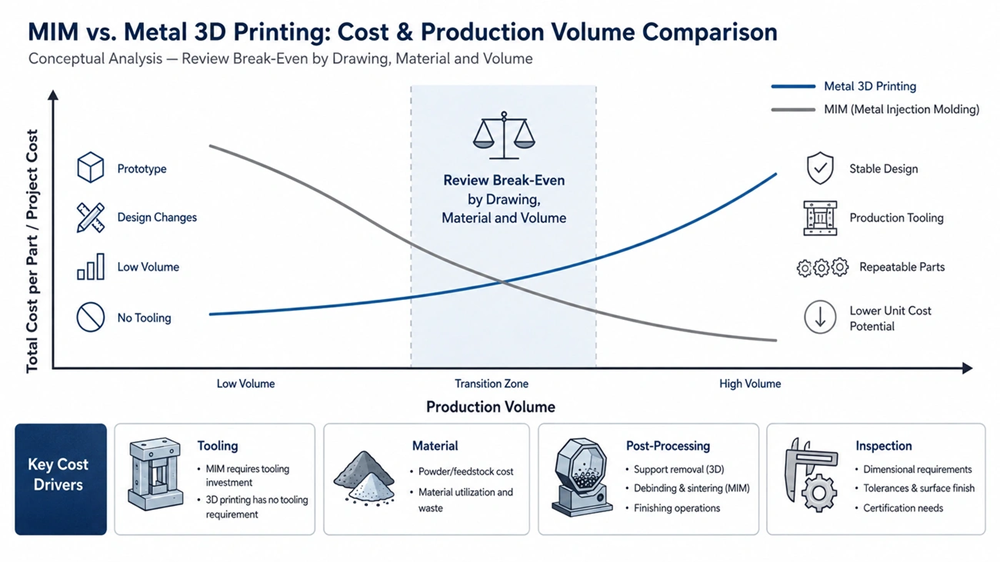
Tooling Investment Comparison: Hardened Steel Dies vs. Multi-Cavity MIM Molds
Both processes require high upfront tooling investment. Die casting dies range from $3,000 for simple single-cavity configurations to $100,000+ for complex multi-cavity tooling with slides and thermal management channels. MIM molds cost $5,000-$50,000 depending on cavity count and part complexity. Die lifespan is different: hardened steel dies endure up to 1,000,000 cycles, whereas MIM molds achieve 250,000-300,000 shots before replacement due to abrasive powder feedstock.
Volume Economics: Unit Cost Trajectories from 5,000 to 500,000+ Parts/Year
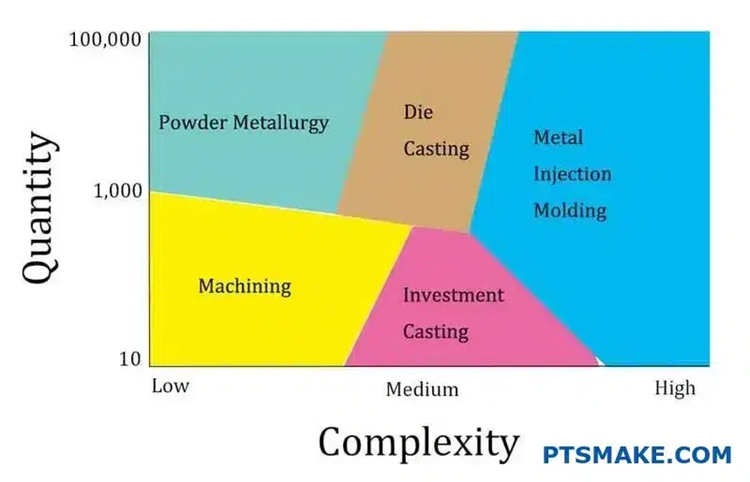
MIM becomes economical around 10,000 annual units. Per-part costs decrease as tooling amortizes across higher volumes. Die casting reaches optimal economics at 50,000+ units, where faster cycle times and lower raw material costs produce unit cost advantages. Die casting remains around 30% less expensive than MIM at equivalent high volumes due to getting rid of multi-stage post-processing.
The Role of Secondary Operations: Getting Rid of Machining vs. Post-Sintering Coining
Die casting requires trimming to remove flash, runners and overflow material. MIM’s near-net-shape accuracy minimizes secondary machining, though post-sintering coining may address ultra-tight tolerances. This difference affects total manufacturing cost at volume.
Total Cost of Ownership: Material Utilization, Energy Input, and Scrap Rates
Material efficiency favors MIM at 95-98% utilization. Die casting generates higher scrap from runners and gates. Die casting uses less expensive metal ingots compared to engineered powder feedstock, offsetting waste disadvantages at high production volumes.
Engineering Selection Framework: When to Choose Which Process
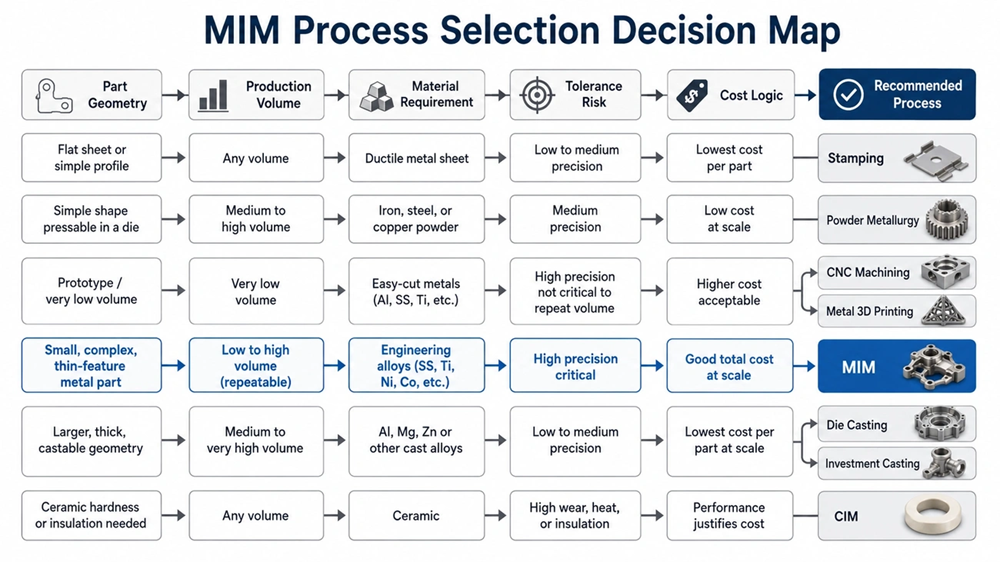
When Die Casting is the Better Economic Choice
Die casting economics favor production volumes that exceed 50,000 units per year. Larger components ranging from 200 grams to multiple kilograms justify the die tooling investment. Simple housings, brackets, covers and structural elements with straightforward 2.5D geometry work better with die casting capabilities. Die casting delivers about 30% lower unit costs than MIM at equivalent volumes when aluminum or zinc alloys satisfy mechanical requirements. Parts that need minimal post-processing benefit from the direct solidification path die casting offers.
When MIM is the Ideal Process for Complex Geometry
Small precision components under 100 grams with intricate three-dimensional features represent ideal MIM candidates. Tooling expenses become justified with annual production exceeding 20,000 parts. MIM excels when multiple machined features unite into single near-net-shape components. Components weighing under 40 grams achieve maximum competitiveness. Applications that need stainless steel, titanium alloys or specialty metals require the high-temperature sintering route MIM provides. Internal threads, cross-holes, undercuts, gear teeth and fine surface details that would require extensive machining operations become viable through MIM economically.
When Should You NOT Choose MIM? (Process Limitations & Red Flags)
Prototyping applications face prohibitive tooling costs without production volume amortization. Long flat geometries encounter warpage during sintering. Components exceeding 200 grams experience debinding difficulties and furnace support challenges. Simple two-dimensional shapes prove more economical through stamping or conventional powder metallurgy. Frequent design modifications incur expensive mold rework. Projects below 10,000 annual units cannot justify the multi-stage processing overhead MIM requires.
Comparison Table: Die Casting vs. Metal Injection Molding (MIM)
| Attribute | Die Casting | Metal Injection Molding (MIM) |
|---|---|---|
| Process Temperature | 400-700°C (Aluminum: 600-700°C; Zinc/Magnesium: 400-500°C) | Injection: ~200°C; Sintering: 1200-1400°C |
| Injection Pressure | 140-215 MPa | Not mentioned |
| Process Stages | Single stage (direct solidification) | Multi-stage (injection → debinding → sintering) |
| Cycle Time | Seconds to minutes per shot | Days (due to batch furnace cycles) |
| Materials | Non-ferrous low-melting alloys: Aluminum, Zinc, Magnesium | Stainless steels, titanium alloys, tool steels, tungsten, nickel-based superalloys |
| Minimum Wall Thickness | 0.63-1.27 mm (Zinc: 0.63mm; Aluminum: 0.89mm; Magnesium: 1.27mm) | 0.25 mm |
| Optimal Wall Thickness | Not mentioned | 1.0-6.35 mm |
| Part Weight Range | 200 grams to 5+ kilograms (up to 100+ kg possible) | 0.1-200 grams (optimal: under 100 grams) |
| Feature Complexity | Simple 2.5D geometries; don’t deal very well with intricate details | Internal channels, cross-holes, undercuts, fine threads in single cycle |
| Tooling Cost | $3,000-$100,000+ | $5,000-$50,000 |
| Tool Lifespan | Up to 1,000,000 cycles | 250,000-300,000 shots |
| Material Utilization | Lower (higher scrap from runners/gates) | 95-98% |
| Economic Volume Threshold | 50,000+ units/year optimal | 10,000+ units/year competitive; 20,000+ ideal |
| Part Shrinkage | Minimal | 16-18% during sintering (green part ~20% larger) |
| Secondary Operations | Requires trimming (flash, runners, overflow) in most cases | Minimal machining; post-sintering coining is optional |
| Cost Advantage | ~30% less expensive than MIM at high volumes | More expensive at equivalent high volumes |
| Best Applications | Large components (200g-5kg+), simple housings and brackets, structural elements | Small precision components (<100g), complex 3D features, combined multi-feature parts |
| Material Properties | Limited mechanical properties | Superior surface hardness and wear performance, fatigue strength, corrosion resistance |
Conclusion & Custom DFM Feasibility Assessment
Both processes deliver advantages and make the die casting vs MIM decision heavily context-dependent. Part weight serves as a starting filter: components under 100 grams with complex features favor MIM, while larger brackets and housings exceeding 200 grams justify die casting economics. Material requirements matter just as much. Aluminum or zinc applications lean toward die casting, whereas stainless steel demands MIM’s sintering route. Production volume above 50,000 units then tips economics toward die casting’s lower unit costs.
Unsure Which Process Fits Your Component?
Submit your 2D/3D CAD drawings for a free DFM analysis and direct cost comparison between MIM and Die Casting.