
Custom Sintered Shock Absorber Valves
Custom sintered valves play a critical role in shock absorber performance, where minor variations in tolerance can compromise damping stability and ride comfort. Sintered parts determine the operational lifespan and reliability of shock absorbers. Precision manufacturing is essential. These components must meet exacting standards for the automotive and motorcycle industries. Powder metallurgy shock absorber valves, such as sintered valve disks and sintered shock absorber pistons, use FC-0208 sintered parts with tolerances as tight as ±0.01mm and hardness levels ranging from HRB65-90. This piece explores the specifications, manufacturing processes, quality control standards, and custom OEM development options for high-precision custom sintered shock absorber valves.
Key Specifications & Technical Capabilities
Material Standards: FC-0208 Iron-Copper Alloy
Custom sintered valves play a critical roleFC-0208 serves as the main material for custom powder metallurgy automotive components in shock absorber applications.
| Specification Item | Engineering Capability / Standard |
| Primary Material | FC-0208 Iron-Copper Alloy / Custom PM Steels |
| Density Range | 6.5–7.1 g/cm³ |
| Hardness Standard | HRB 65–95 (Post Steam Treatment) |
| Dimensional Tolerance | ±0.01 mm (Critical Dimensions) |
| Surface Treatment | Steam Treatment (Fe₃O₄ Magnetite Layer, 0.004–0.005 mm) |
| Surface Roughness | Ra 0.8 µm to Ra 1.6 µm |
| Quality Certification | ISO 9001:2015 & IATF 16949 Standards |
| MOQ & Lead Time | 1,000 pcs (Standard); 25 Days for Tooling + Samples |
Density, Hardness (HRB65-90), and Tolerance (±0.01mm)
Custom sintered shock absorber valves achieve density ranges between 6.8-7.1 g/cm³ through controlled compaction parameters. Higher density variants reach 6.3-6.9 g/cm³ for applications that just need improved mechanical properties. Hardness specifications fall within HRB 65-90, controlled through sintering temperature profiles and post-treatment processes. This hardness range balances wear resistance against the need for secondary machining operations.
Dimensional precision represents a defining capability of powder metallurgy OEM manufacturers producing sintered shock absorber pistons and valve components. Parts maintain tolerances of ±0.01mm across critical dimensions, which are vital for consistent damping performance. Surface finish specifications range from Ra 0.8μm to Ra 1.6μm and ensure proper sealing and minimal friction during valve operation.
Steam Treatment for Surface Sealing and Wear Resistance
Steam treatment applies a controlled oxidation process that forms a 0.004-0.005mm Fe₃O₄ (magnetite) layer on sintered valve surfaces. The process involves holding parts at elevated temperature in dry steam for approximately 2 hours. This oxide layer seals surface porosity, increases corrosion resistance, and improves surface hardness without compromising dimensional accuracy. Degree of oxidation measures 2-4% and provides wear protection while maintaining the self-lubricating characteristics inherent to sintered components.
MOQ, Lead Time, and Sample Availability
Standard minimum order quantities start at 1,000 pieces for powder metallurgy shock absorber valve production, though specific suppliers accommodate 500-piece orders. Lead times vary according to tooling status. New custom sintered valves that just need mold development demand 25 working days. Repeat orders with existing tooling ship within 15-20 working days depending on volume. Standard parts in stock can fulfill orders within 3-5 days. Manufacturers provide free sample evaluation, up to 5 pieces, with customers covering international shipping costs.
Shock Absorber Valve Components & Assemblies
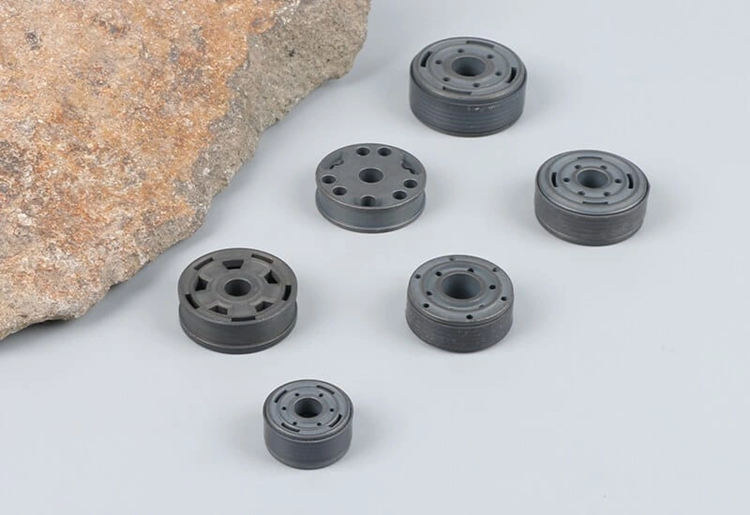
Sintered Valve Disks and Rebound/Compression Pistons
The piston represents the component with the most importance in shock absorber assemblies. Periodic modifications within acceptable dimensional ranges can cause changes with the most impact in damping characteristics and production line performance. Two-piece piston assemblies provide independent valving between rebound and compression cycles. This allows improved tunability and more consistent performance over conventional designs. These assemblies replace more expensive cross-drilled configurations while delivering digressive flow characteristics.
Valve disks function as metal plates covering the piston’s channels. They deform under pressure and create highly restricted flow paths. Shaping damping force characteristics occurs through selection of disk number, diameter and thickness on both valve sides. Manufacturers conduct functional testing at powder metallurgy facilities to verify performance consistency. Independent expert organizations are available for additional validation upon customer request.
Base Valve and Cylinder End Components
Base valves control liquid flow between inner and outer cylinders in double-tube shock absorbers. They play the biggest role in establishing running characteristics. Damping forces on the piston valve remain minimal during compression strokes in double-tube designs. The base valve generates main resistance. Automated one-piece-flow production lines handle complex shapes and geometries across size ranges of all types. Quality assurance systems incorporate process robustness, automated in-process measurement and in-line vision systems.
Rod Guide Design and Precision Geometry
Rod guides exhibit complex geometries that new shock absorber designs just need. Modern applications require sintered parts with intricate shapes while maintaining high density during pressing. Additional machining processes apply when pressing alone cannot achieve finished geometry. Production capabilities span sizes from scooters to bus and truck applications. Bushing and PTFE ring insertion are available for complete rod guide subassemblies.
Powder Metallurgy Manufacturing & Quality Control
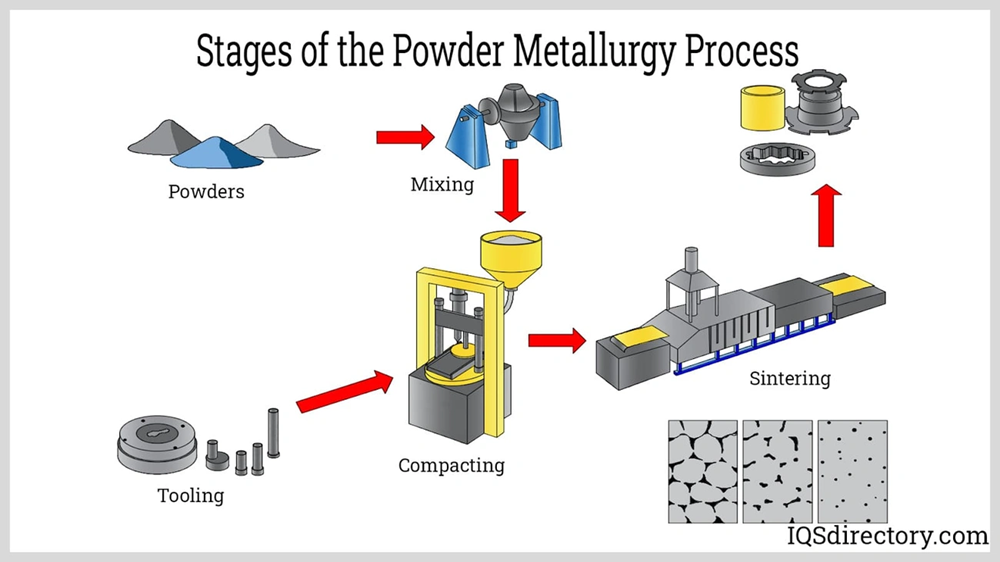
High-Precision Die Compaction and Sintering Temperature Control
Metal powders undergo compaction under high pressure to form precise “green” parts before sintering creates high-density components without melting. Compaction pressure ranges from 400 to 800 MPa for harder metals such as steel and ensures uniform density in custom sintered shock absorber valves. Die design incorporates tight tolerances. Pressed products with radial dimensions of 25mm achieve tolerance of 0.13% (32.5μm) to 0.20% (50μm), falling within ISO standard tolerance IT8-IT9.
Controlled atmosphere heating below the melting point fuses metal particles together at the time of sintering. Iron-based FC-0208 sintered parts undergo presintering between 600°C and 900°C with minimal shrinkage. Intermediate sintering follows and parts reach about 92% density. Final sintering stages continue densification while temperatures are monitored closely to control grain growth. Batch-to-batch consistency remains high as mold tolerance, compacting pressure and sintering temperature can be controlled with precision.
Secondary Finishing: Sizing, Machining, and Steam Treatment
Sizing re-presses sintered components to achieve higher accuracy after thermal expansion and contraction occur. This secondary operation improves tolerance from 0.05% (12.5μm) to 0.08% (20μm), consistent with ISO standard tolerances IT6-IT7. Shock absorber applications requiring 0.01mm precision benefit from sizing that reduces dimensional variation range.
Steam treatment modifies sintered valve surfaces by adding a controlled magnetite (Fe₃O₄) oxide layer. Furnaces heat parts to about 1000°F for predetermined time and create the protective black oxide layer as cooling occurs. This process increases hardness and boosts compressive strength through pore closure while improving corrosion resistance.
Functional Testing for Damping Performance & Batch Consistency
Magneto-inductive test instruments control quality by placing sintered shock absorber pistons in encircling coils. Electric current induces a magnetic field into the material and eddy currents shift if specified quality is not met due to material mix-up or incorrect sintering. Parts failing quality parameters are rejected.
Quality Control under ISO 9001 & IATF 16949 Standards
Powder metallurgy OEM manufacturers maintain ISO 9001 and IATF 16949 certificates. IATF 16949:2016 replaced ISO/TS 16949 in October 2016 and created stronger customer orientation with emphasis on defect prevention and variation reduction.
Custom OEM Development & RFQ Process
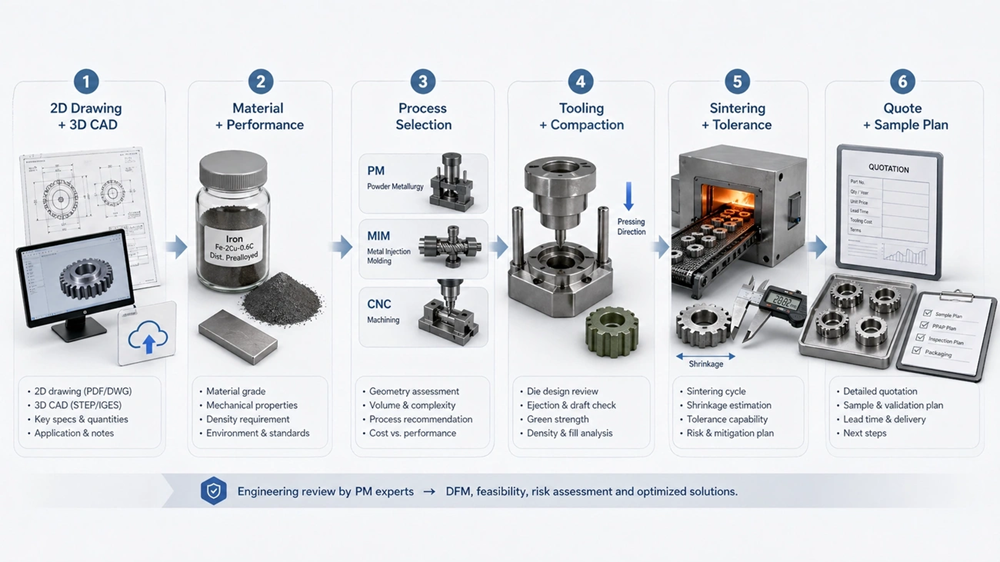
Technical Information Required for Quotation (2D/3D Drawings: STEP, DWG)
To source custom sintered valves, submit 2D or 3D CAD drawings in STEP, DWG, or PDF formats. Engineering teams review submitted designs for sintering feasibility and optimize parameters such as density, tolerances, and tool design. Suppliers provide detailed manufacturing quotations, tool development feedback, and estimated production lead times within 24-48 hours. Companies learning about powder metallurgy for the first time benefit from engineering collaboration that evaluates part geometry, material selection, and production volume to determine suitability. Buyers should confirm supported materials, tooling lead times, production capacity, and secondary processing capabilities before finalizing supplier selection.
Rapid Prototyping and Custom Tooling Support
Rapid powder metal prototyping enables manufacturers to verify parts early in development. This shortens development cycles and transitions more confidently into production. Prototype tooling programs yield production-intent samples quickly and provide adequate time for testing, evaluation, and engineering feedback. This approach proves practical for moving from design to ground testing while meeting compressed time-to-market schedules.
Partnering with an Experienced Powder Metallurgy OEM Manufacturer
Suppliers bring engineering support needed to transform concepts into production-ready sintered shock absorber valves. Manufacturers offer flexibility across specialized short runs and high-volume production, with detailed services that eliminate vendor coordination challenges.
Conclusion & Request a Quote
Custom sintered shock absorber valves deliver exceptional precision at ±0.01mm tolerances. This makes them ideal for automotive and motorcycle manufacturers who just need consistent damping performance. The FC-0208 material combined with steam treatment provides the durability shock absorbers need without high cost.
Complete quality control under IATF 16949 standards will give production lines the batch consistency they ask for. Powder metallurgy manufacturers are a great way to get the engineering collaboration that OEM developers need. They offer reliable valve components with rapid prototyping support to bring shock absorber designs from concept to high-volume production.
Need Custom Sintered Shock Absorber Valves for Your Suspension Project?
We provide free sample evaluation and DFM analysis for custom engineering drawings.
-
✅ Free DFM Review for 2D/3D Drawings (STEP/DWG) within 24 Hours
-
✅ IATF 16949 & ISO 9001 Certified Quality Assurance
-
✅ Free Samples Available with Rapid Prototyping Support