
OEM Custom Powder Metallurgy Self-Lubricating Bearings | Sintered Bushings
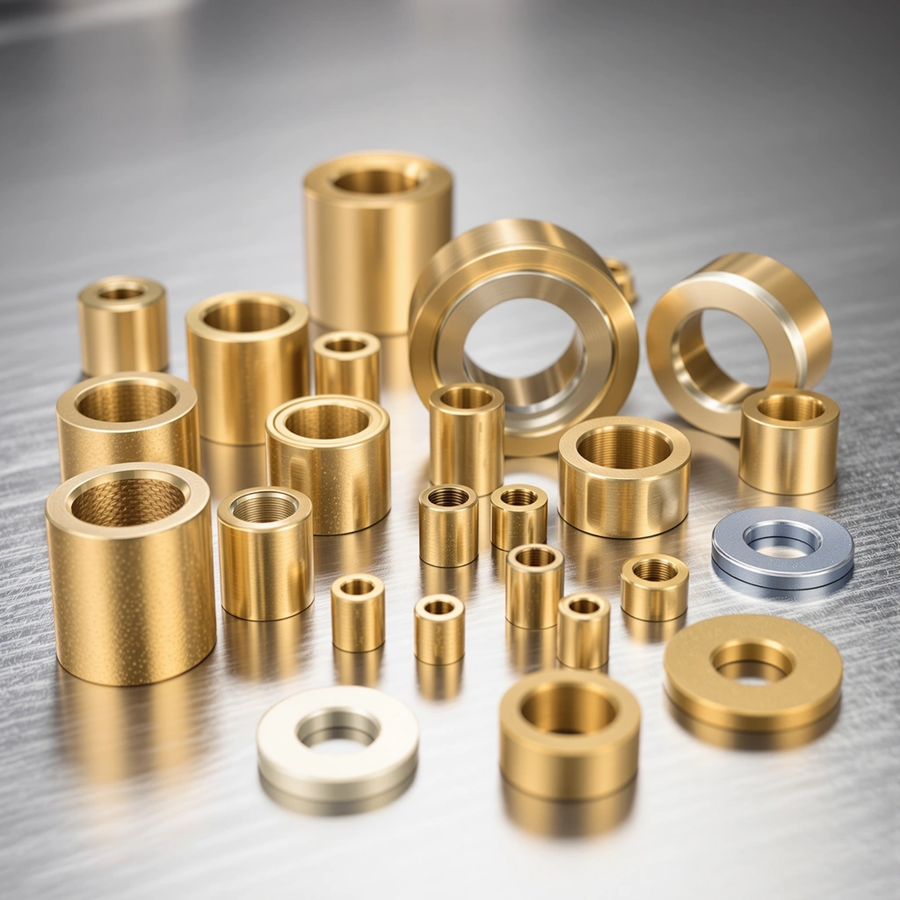
Powder metallurgy manufactures self-lubricating bearings through precision compaction and sintering processes that engineer controlled, interconnected porosity throughout the component matrix. These sintered plain bearings operate without external grease fittings or oil recirculation lines. Interconnected microscopic pores retain and continuously supply lubricating oil directly to the rotating shaft interface, offering a lifetime maintenance-free solution for sealed assemblies and hard-to-reach industrial mechanisms.
Sintered bronze self-lubricating bearings and iron-copper bushings are widely adopted across OEM applications due to their exceptional load capacity, smooth sliding performance, and wear resistance. Custom bearing manufacturers press metal powders into net-shape configurations—including cylindrical sleeve bushings, flanged bearings, thrust washers, and spherical bushings—before vacuum impregnating the porous matrix with high-performance lubricants tailored to specific operating speeds and temperature ranges.
Compared to traditional solid bronze bar stock machining, powder metallurgy oil-impregnated bearings achieve over 97% material utilization, drastically lowering production costs for high-volume automotive, electric tool, and home appliance programs.
How Sintered Self-Lubricating Bearings Work (Controlled Porosity & Oil Impregnation)
Interconnected Porosity (10%–20%) for Lifetime Capillary Lubrication
Self-lubricating bearings feature an interconnected pore network occupying 10% to 25% of total component volume. During press-and-sinter powder metallurgy, precise compaction pressure and sintering thermal profiling ensure these microscopic pores form open, continuous capillary channels rather than isolated voids.
Vacuum oil impregnation forces lubricating oil deep into the porous network, filling up to 90%–95% of available pore volume (representing 18%–22% total oil content by volume). Capillary forces retain the oil within the bearing matrix during storage and idle states, preventing leakage and dry start-ups.
Hydrodynamic Oil Release During Operation & Re-absorption Upon Shutdown
When shaft rotation begins, frictional heat creates subtle thermal expansion while reducing oil viscosity. Capillary action and rotational drag pull oil from the internal pores onto the bearing-shaft journal surface, forming a continuous hydrodynamic oil film. This dynamic lubrication cycle functions automatically:
- Active Operation: Frictional heat drives oil out of the pores to maintain a smooth lubricating barrier.
- Cooling & Shutdown: As the shaft stops and temperature drops, capillary forces pull the excess oil back into the porous reservoir.
- Service Life: The self-contained reservoir maintains effective hydrodynamic lubrication until oil saturation drops below critical levels (typically ~60% of initial capacity).
High PV Value Ratings & Operating Limits for Maintenance-Free Performance
The PV factor (Pressure × Velocity) dictates bearing load capacity and thermal dissipation boundaries:
- Sintered Bronze (SAE 841): Supports PV ratings up to 50,000 psi-fpm (1.75 MPa·m/s).
- Iron-Copper Alloys (SAE 863): Sustains PV values up to 35,000 psi-fpm under heavy static loads.
- Hardenable Iron Steels: Reaches PV ratings exceeding 75,000 psi-fpm for high-impact applications.
- Temperature Limits: Standard oil-impregnated bronze operates reliably from -50°C to +200°C.
Material Selection: Sintered Bronze (SAE 841) vs. Iron-Copper (SAE 863)
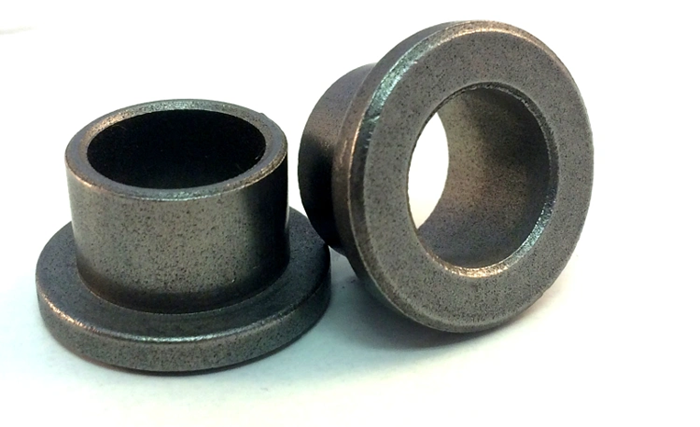
Selecting the optimal sintered bearing material depends on operating speed, load magnitude, and environmental exposure:
SAE 841 Bronze (90-10 Cu-Sn): High Speed, Low Noise & Corrosion Resistance
SAE 841 oilite bronze consists of 90% copper and 10% tin, achieving sintered densities between 6.4 and 6.8 g/cm³ with a minimum 19% oil saturation by volume. It provides a radial crushing strength (K-factor) of 26,500 psi, supporting static loads up to 8,000 psi and surface speeds up to 500 fpm (2.5 m/s).
SAE 841 bronze is the preferred choice for fractional-horsepower motors, precision appliances, and power tools requiring quiet running, low friction coefficients, and excellent atmospheric corrosion resistance.
SAE 863 Iron-Copper & Heat-Treated Alloys: Heavy Loads & High Impact Strength
SAE 863 sintered iron-copper features a dense iron matrix enriched with copper (5.8–6.2 g/cm³ density). It increases radial crushing strength to 40,000 psi and doubles static load capacity up to 20,000 psi.
This material delivers superior compressive strength and shock resistance for off-road equipment, agricultural machinery, and heavy industrial gearboxes where bronze bushings might deform under impact loading.
Stainless Steel & Solid Lubricant Additives for Extreme Environments
316L stainless steel powder metallurgy bearings provide enhanced chemical and saltwater corrosion resistance. For high-temperature oven conveyors or vacuum systems where liquid oils carbonize, solid lubricant additives such as molybdenum disulfide (MoS₂) or graphite are integrated directly into the metal matrix to ensure dry, self-lubricating performance.
Key Custom Bearing Types & Industrial Applications
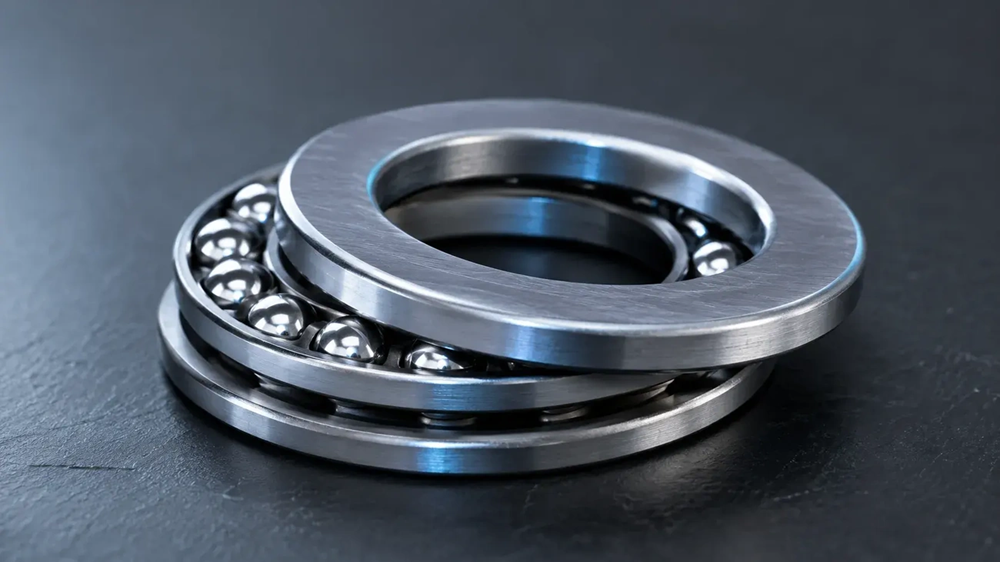
Cylindrical Sleeve Bushings, Flanged Bearings & Thrust Washers
JHMIM manufactures custom self-lubricating plain bearings in four standard structural geometries:
- Cylindrical Sleeve Bushings: Standard radial load bearings for rotating or oscillating shafts.
- Flanged Sintered Bronze Bearings: Feature an integrated flange to handle combined radial and axial thrust loads while simplifying housing positioning.
- Thrust Washers: Flat annular rings designed specifically to absorb high axial forces in space-constrained assemblies.
- Spherical Self-Aligning Bushings: Convex outer diameter profiles that compensate for shaft misalignment in stamped housings and motor end-plates.
Applications in Micro Motors, Automotive Systems, Power Tools & Appliances
Modern passenger vehicles contain over 30 sintered self-lubricating bushings across starter motors, windshield wipers, HVAC blower motors, power seat actuators, and cooling fan drives. Home appliance manufacturers use SAE 841 bronze bushings in blenders, washing machine agitators, and food processors to deliver whisper-quiet operation and long service life.
OEM Custom Manufacturing Capabilities & Quality Assurance
Up to 40% Cost Savings vs. Machined Solid Bronze Bar Stock
Press-and-sinter powder metallurgy achieves net-shape precision with over 97% raw material utilization. By eliminating the multi-pass lathe turning, boring, and chip waste associated with machined solid bronze, JHMIM delivers production cost savings up to 40% for OEM high-volume bushing programs.
Sizing, Sintering & Vacuum Oil Impregnation to Precision Tolerances (IT7–IT8)
Post-sintering sizing operations recalibrate inner bore and outer diameter dimensions to IT6–IT8 tolerance grades (holding inner diameters within ±0.010 mm to ±0.025 mm). Computer-controlled vacuum impregnation chambers evacuate air before forcing synthetic or petroleum oils into the pore structure under atmospheric pressure, ensuring uniform oil saturation.
Free DFM Engineering Review & Fast Quote Processing within 24 Hours
Our engineering team performs complete Design for Manufacturability (DFM) reviews to optimize wall thickness, chamfers, and density distribution prior to tooling setup. Submit your 3D CAD models to receive a detailed quote and technical analysis within 24 hours.
Q5. How is lubricant held inside the bearing without leaking during storage?
Microscopic pore size distribution creates strong capillary forces that trap and retain the oil within the metal matrix during non-operation. Oil is only drawn to the surface when frictional heating occurs during shaft rotation.
Conclusion
Powder metallurgy self-lubricating bearings offer a proven, cost-effective solution for maintenance-free rotary and linear motion. By balancing controlled porosity, alloy selection, and precision vacuum oil impregnation, JHMIM manufactures custom sintered bushings tailored to your exact load, speed, and environmental requirements. Contact JHMIM today for a free DFM engineering review and fast quotation.
Standard sintered bronze self-lubricating bearings maintain 18% to 25% interconnected porosity by volume. This open pore network acts as an internal reservoir holding approximately 20% to 25% lubricant by volume for lifetime capillary oiling.
SAE 841 bronze supports static loads up to 8,000 psi and excels in high-speed, low-noise environments. SAE 863 iron-copper handles static loads up to 20,000 psi with a higher radial crushing strength (40,000 psi), making it ideal for heavy shock loads.
Powder metallurgy reduces unit costs by up to 40% compared to machining solid bronze bar stock. Net-shape press-and-sintering utilizes over 97% of starting metal powder, completely eliminating machining scrap.
Through secondary coin-sizing operations, inner bore tolerances are held to ±0.010 mm to ±0.025 mm (IT6–IT8 tolerance grades), ensuring precise press-fit housing alignment and running clearances.
Microscopic pore size distribution creates strong capillary forces that trap and retain the oil within the metal matrix during non-operation. Oil is only drawn to the surface when frictional heating occurs during shaft rotation.