
Custom MIM & Powder Metallurgy Jaw Coupling Hubs | Precision OEM Manufacturer
Looking for high-strength, precision-engineered jaw coupling hubs for high-volume OEM drive systems? JHMIM specializes in manufacturing custom metal injection molded (MIM) and sintered powder metallurgy coupling hubs. By replacing labor-intensive CNC machining with advanced powder metallurgy, we deliver high-density, near-net-shape components with complex jaw geometries, reducing piece-part costs by 30% to 50% without compromising mechanical performance.
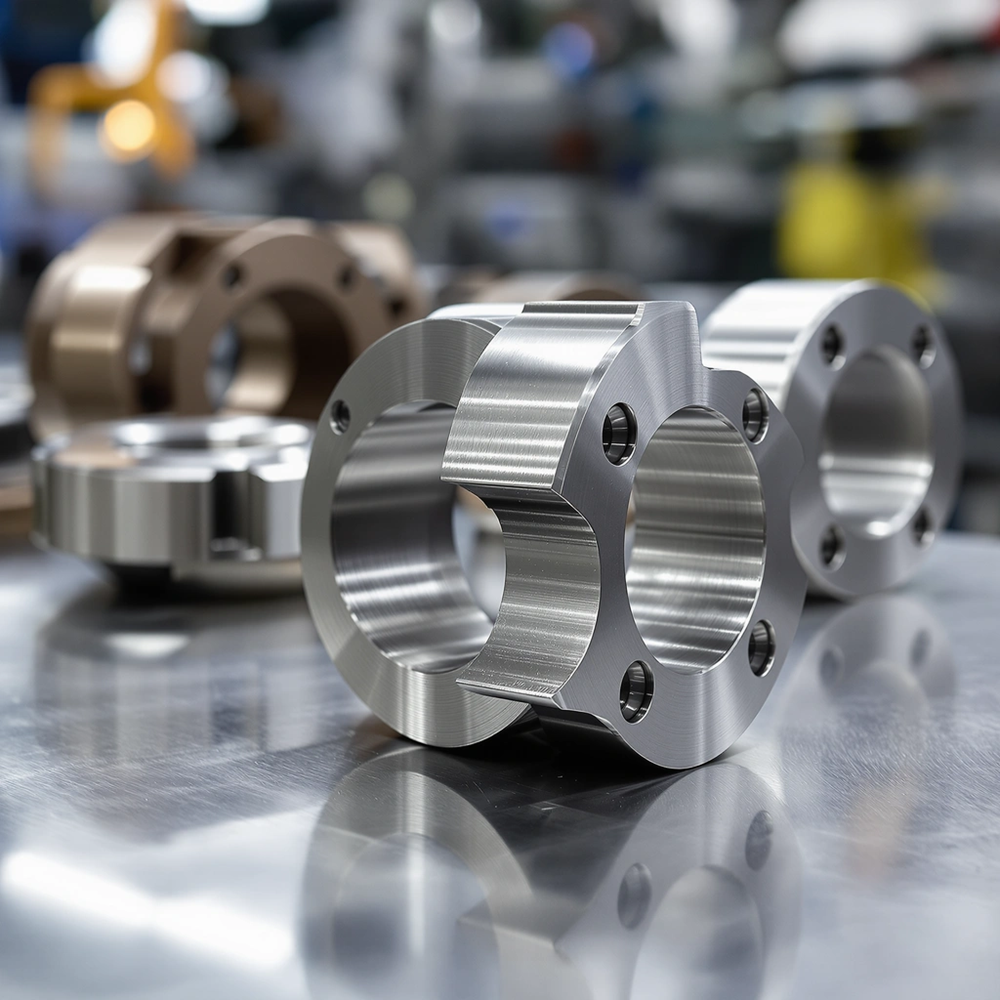
What is a Jaw Coupling Hub and Why Choose MIM Technology?
Simple Function and Working Principle
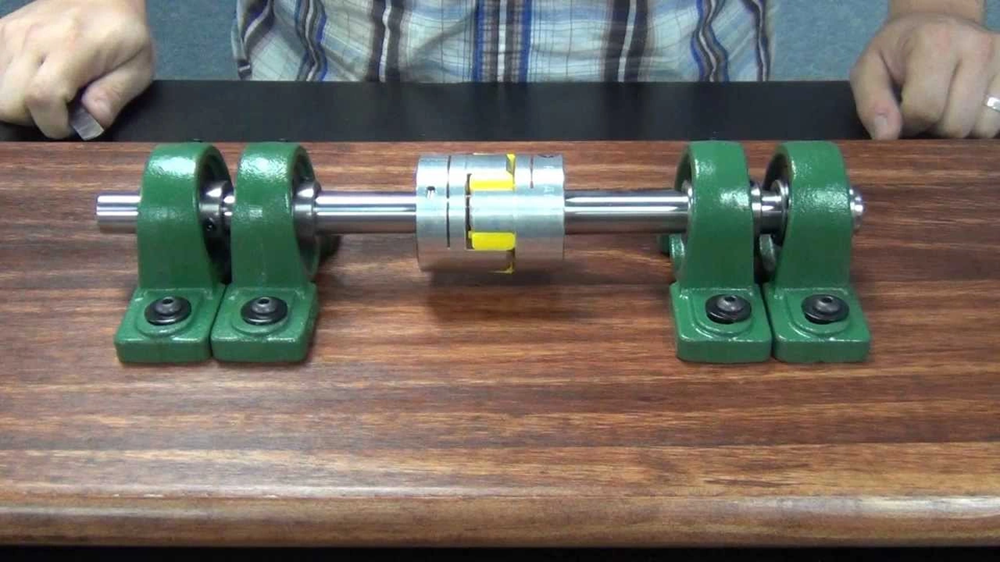
A jaw coupling hub forms one half of a three-piece flexible coupling assembly that transmits torque between rotating shafts. The mechanism operates through compression rather than shear. Two metal hubs with protruding jaws interleave without direct contact. An elastomeric spider insert separates them and fills the gaps between them. The driving hub rotates and its jaws compress the spider legs. These legs then push against the driven hub’s jaws to transfer power.
This compression-based design delivers higher load capacity compared to shear-type couplings. Heavy-duty models handle torque ranges up to 170,000 lb-in. The spider absorbs vibration and accommodates angular misalignment up to 1° and parallel misalignment up to 0.015 inches. The fail-safe characteristic distinguishes jaw couplings from other flexible designs. The metal jaws interlock if the spider fails. They maintain power transmission and prevent complete system shutdown.
Main Industrial Applications (Motor Drives, Pumps, Automation)
Jaw coupling hubs connect continuous-duty electric motors to pumps, gearboxes, compressors and conveyors in industrial facilities. Centrifugal pump applications benefit from the elastomeric damping that protects mechanical seals from hydraulic shock. Automation systems employ curved jaw coupling hub designs for servo motors and positioning equipment where zero-backlash performance matters.
The components accommodate both horizontal and vertical shaft configurations in environmental test chambers. These chambers operate between -70°C to 260°C when paired with appropriate spider materials.
MIM vs. CNC Machining: Why Engineers Choose Powder Metallurgy for Coupling Hubs
Metal injection molding produces jaw coupling hubs with 95-99% of theoretical density. The process achieves mechanical properties comparable to wrought materials. CNC machining removes 70-90% of raw material as waste during complex geometry production.
MIM becomes economical at production volumes approaching 5,000-10,000 pieces per year. Machining maintains advantages for prototype quantities. The process creates intricate features like internal threads and precise jaw profiles without secondary operations. Tolerances of ±0.3% are standard in MIM components and meet the dimensional requirements for sintered jaw coupling hub manufacturing.
| Manufacturing Feature | Metal Injection Molding (MIM) | Traditional CNC Machining |
|---|---|---|
| Material Utilization | Up to 98% (Minimal Scrap) | Low (70–90% Material Wasted) |
| Jaw Geometry Complexity | High (Curved jaws molded in 1 step) | Requires multi-axis milling setups |
| Mass Production Cost | 30%–50% Lower for >5,000 pcs | High per-piece labor/machining cost |
| Density & Strength | 95%–99% Theoretical Density | 100% Wrought Bar Stock |
The MIM & Powder Metallurgy Manufacturing Process for Hubs
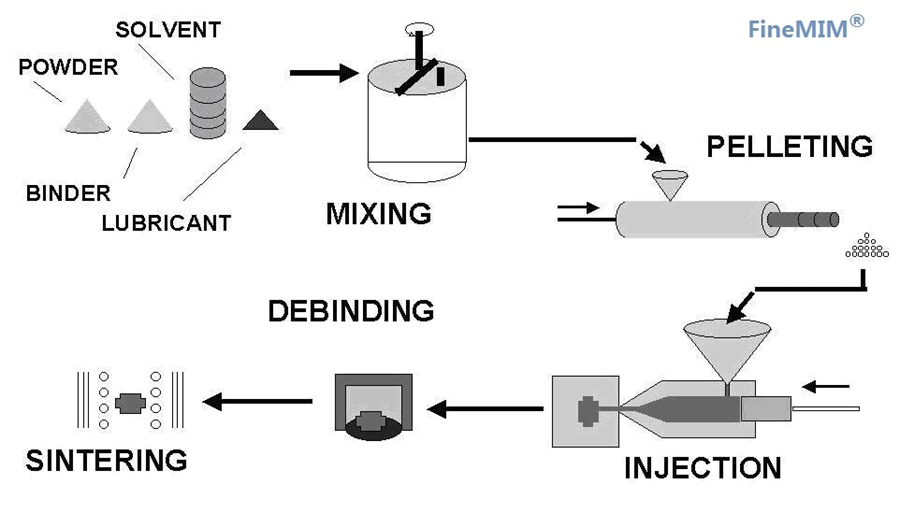
High-Density Metal Powder Selection & Feedstock Preparation
Metal powder characterization marks the starting point for manufacturing a sintered jaw coupling hub. Fine elemental or prealloyed powders below 20 micrometers are the foundations of high-density components. Stainless steel grades like 316L and 17-4PH dominate custom jaw coupling hub applications. Their corrosion resistance and mechanical properties make them ideal.
Feedstock preparation blends metal powder with a multi-component binder system under controlled thermal conditions. The mixture contains 40% binder by volume. Thermoplastic polymers combine with waxes and surfactants that enable flow during injection. Powder loading ranges between 50-65 vol% depending on particle morphology and target density. The heated mixture achieves uniform coating of each metal particle. Granulation into pellets for injection molding machines follows.
Precision Injection Molding of Complex Green Parts
Barrel heaters bring the feedstock to a toothpaste-like consistency as it enters conventional injection molding equipment. A reciprocating screw forces the molten feedstock through gates into precision molds that form the 4 jaw coupling hub geometry. The cooled green part emerges about 20% larger in all dimensions than the finished MIM jaw coupling hub. This accounts for subsequent shrinkage during sintering.
Debinding and Sintering: Achieving Near-Theoretical Density
Catalytic, solvent, or thermal methods remove the binder system through debinding. Catalytic debinding completes in 2-4 hours, whereas thermal cycles require 12-24 hours. The brown part then enters controlled-atmosphere furnaces where temperatures reach about 85% of the metal’s melting point. Sintering occurs at 1350-1400°C for stainless steel jaw coupling hub production. The component shrinks 16-18% as metal particles fuse and achieves 96-99% of theoretical density.
Strict Quality Control and Dimensional Testing
Precision jaw coupling hub manufacturers verify final dimensions against design tolerances. They measure sintered density through Archimedes’ method to confirm structural integrity.
Custom Jaw Coupling Hub Design & Configuration Options
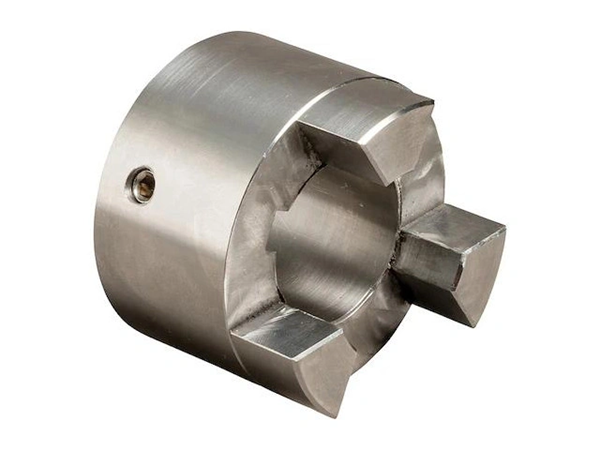
4 Jaw Coupling Hub Configurations
Standard jaw coupling hub designs come in 24 sizes and span bore capacities from 0.125 inches to 7 inches. Torque ratings extend from 3.5 in-lbs for miniature applications to 170,004 in-lbs for heavy-duty industrial drives. Hub materials include sintered metal for smaller sizes and cast iron for larger assemblies. Aluminum serves lightweight applications while ductile iron handles maximum strength requirements.
Curved Jaw Coupling Hub Designs for Zero-Backlash
Curved jaw profiles employ convex jaw geometries that press-fit with the spider element and concentrate forces on the spider’s limbs. This design achieves zero-backlash performance at speeds up to 8,000 RPM. The curved interface distributes contact stress better than straight-jaw alternatives and extends service life under angular misalignment conditions.
Material Selection: Stainless Steel (316L, 17-4PH) and Low-Alloy Steels
Stainless steel jaw coupling hub options include 316 and 316L grades for corrosion resistance. Type 2024-T351 aluminum serves high-speed servo applications where reduced rotational inertia matters. Steel and ductile iron variants accommodate harsh operating environments and elevated torque transmission.
Tight Tolerances and Surface Finish Specifications
Hub bore surface finish specifications require 32 microinch RMS or better. Shaft surfaces should match similar finish standards to prevent fretting and ensure proper torque transmission through keyway connections.
Production Capabilities, Lead Times & OEM Cost Factors
Prototype Development (3D Printing / Soft Tooling) to Mass Production
Bringing a custom jaw coupling hub from concept to production follows a structured development pathway. PrintAlloy binder jet 3D printing offers the fastest route to functional metal prototypes without tooling investment. ProtoMIM soft tooling delivers first samples within 4-6 weeks using simplified molds machined from pre-hardened steel for original validation runs under 1,000 pieces.
Production molds require 6-10 weeks for single-cavity configurations and 8-14 weeks for multi-cavity designs. These hardened steel tools withstand hundreds of thousands of cycles. They produce precision jaw coupling hub components with dimensional stability across extended production runs.
Minimum Order Quantities (MOQ) and Flexible Lead Times
MIM economics favor annual volumes exceeding 10,000-20,000 units. Production batches between 5,000-25,000 parts justify aluminum tooling investments. Higher volumes warrant hardened steel molds for tighter tolerances. Strategic use of bridge tooling during production mold fabrication compresses lead times and maintains supply continuity.
Cost Analysis: Tooling Investment vs. Piece-Part Savings
Tooling expenses range from $10,000 for simple configurations to over $100,000 for complex multi-cavity molds at the outset. But sintered jaw coupling hub piece-part costs decrease 30-50% compared to CNC machining at production volumes. This offsets upfront investments within 12-18 months for programs that are well-established.
Partner with JHMIM for Custom Coupling Hub Manufacturing
Why Choose JHMIM as Your China MIM Supplier?
Selecting the right precision jaw coupling hub manufacturer requires reviewing manufacturing infrastructure, technical capabilities and quality systems. JHMIM operates an 18,000-square-meter facility with German-imported injection molding equipment and vacuum sintering furnaces. The company’s 150-person workforce brings nearly 20 years of specialized MIM experience to custom jaw coupling hub development.
Quality certifications verify process control. JHMIM holds ISO14001 environmental certification, IATF16949 automotive qualification and ISO13485 medical device approval. These systems ensure stainless steel jaw coupling hub components meet industry-specific requirements. The company’s eight material development patents reduce raw material costs through in-house feedstock formulation.
Coupling performance depends on manufacturing precision. JHMIM achieves surface roughness between Ra 0.2 and 1.6 μm with dimensional tolerances of 0.1 mm on stainless steel products under 5 mm. Internal mold production capabilities built over 10+ years minimize tooling expenses and reduce part deformation.
Request a Fast DFM Analysis & Free Quote Today
Design for manufacturability (DFM) review identifies potential engineering risks before tooling investment begins. JHMIM’s technical team will review wall thickness uniformity, draft angles, gate placement, and sintering support requirements tailored specifically to your 4 jaw coupling hub geometries.
👉 Upload Your 2D/3D CAD Drawings (STEP, IGES, DWG) to JHMIM Engineers Now →
Global Quality & Supply Assurance for OEM Coupling Hubs
Jaw coupling hub specifications require precision matching between application requirements and manufacturing capabilities. Engineers evaluating suppliers should assess production flexibility across all volume ranges, from prototype validation batches through million-piece production runs. Material certifications verify that feedstock composition meets specification requirements for stainless steel jaw coupling hub applications in corrosive environments or high-temperature installations.
Technical documentation packages include dimensional inspection reports, density measurements and material test certificates for each production lot. Quality assurance protocols protect against field failures in critical pump and motor drive assemblies. Supplier capacity audits should cover injection molding press tonnage, sintering furnace atmosphere control systems and secondary finishing equipment availability for surface treatments.
Custom jaw coupling hub projects succeed when manufacturers understand both metallurgical properties and end-use torque transmission requirements. Responsive project management throughout tooling development and production ramp-up phases is essential.
MIM (Metal Injection Molding) produces jaw coupling hubs with 95-99% theoretical density, achieving mechanical properties comparable to wrought materials while generating significantly less waste than CNC machining. The process creates complex features like internal threads and precise jaw profiles without secondary operations, maintaining tolerances of ±0.3%. MIM becomes cost-effective at production volumes of 5,000-10,000 pieces annually, with piece-part costs decreasing 30-50% compared to CNC machining at higher volumes.
A jaw coupling hub operates through compression rather than shear. Two metal hubs with protruding jaws interleave without direct contact, separated by an elastomeric spider insert. When the driving hub rotates, its jaws compress the spider legs, which then push against the driven hub’s jaws to transfer power. This compression-based design delivers higher load capacity, with heavy-duty models handling torque ranges up to 170,000 lb-in while simultaneously absorbing vibration and accommodating misalignment.
Common materials include stainless steel grades like 316L and 17-4PH for corrosion resistance and mechanical strength, low-alloy steels for general industrial applications, cast iron and ductile iron for larger assemblies requiring maximum strength, and aluminum (Type 2024-T351) for high-speed servo applications where reduced rotational inertia is important. Material selection depends on the specific operating environment, torque requirements, and speed conditions.
Lead times vary based on the development stage. Binder jet 3D printing offers the fastest prototyping without tooling investment. Soft tooling delivers first samples within 4-6 weeks for initial validation runs. Production molds require 6-10 weeks for single-cavity configurations and 8-14 weeks for multi-cavity designs. Bridge tooling strategies can maintain supply continuity during production mold fabrication.
Quality manufacturers should hold relevant certifications such as ISO14001, IATF16949 for automotive applications, and ISO13485 for medical devices. Expect surface roughness between Ra 0.2 and 1.6 μm with dimensional tolerances of 0.1 mm on components under 5 mm. Each production lot should include dimensional inspection reports, density measurements, and material test certificates to ensure consistent performance in critical applications.