
Compressor Valve Plate Manufacturing: Selecting Materials for Maximum Durability and Performance
The compressor valve plate sits at the heart of reciprocating compressor systems and directly influences operational efficiency and reliability. Selecting the appropriate compressor valve plate material can significantly reduce gas leakage, lower pressure losses, and extend maintenance intervals. The industry continuously targets a mean time between failures (MTBF) exceeding 8,760 hours for critical fluid control components. Consequently, material selection decisions carry critical engineering and economic implications for semi hermetic compressor valve plate and refrigeration compressor valve plate applications.
This technical guide delves into the core factors that optimize compressor valve plate manufacturing. Key aspects include precision surface requirements, mechanical material properties, and common compressor valve plate failure modes. Industrial buyers and design engineers will find detailed performance comparisons between metallic alloys and high-performance thermoplastics, along with advanced manufacturing techniques such as Metal Injection Molding (MIM) and Powder Metallurgy (PM) for custom compressor valve plate production.
Understanding Compressor Valve Plate Manufacturing Requirements
Reciprocating compressors operate under aggressive cyclic conditions that place severe physical demands on valve plate components. During standard operation, the valve plate continuously impacts the lift limiter and valve seat at high speeds. Service life depends heavily on stress amplitude, dynamic cycle frequency, stress distribution, and material fatigue resistance. Industry studies indicate that valve failures account for more than 60% of all unplanned compressor downtime in process industries, making robust design and precise material selection essential for long-term operational uptime.
Operating Environment and Dynamic Load Parameters
Valve plates experience high-frequency cyclic loading, undergoing thousands of opening and closing cycles per minute. To prevent premature mechanical destruction, the valve plate’s impact velocity on the guard should not exceed 3 to 4 m/s, depending on the specific plate material and physical geometry. Higher impact velocities drastically accelerate fatigue crack initiation and micro-crack propagation. Furthermore, operating temperatures vary significantly across industrial applications: PEEK materials can withstand temperatures up to 300°C, while discharge valves in transcritical CO2 compressors endure exceptionally high fatigue loads due to elevated working pressures and dense gas media.
Precision Manufacturing Tolerances: Flatness, Parallelism, and Surface Finish
Geometric tolerances directly dictate sealing performance and zero-leakage capability. Flatness controls the form of an individual surface without requiring a datum reference, whereas parallelism controls the orientation of a surface relative to a specified datum. A valve plate surface can be perfectly flat yet fail parallelism requirements if it is tilted relative to the mounting face. Precise flatness prevents rocking, bowing, or excessive form variation that compromises seal integrity. Surface finish requirements complement these geometric tolerances: sealing surfaces require fine surface roughness levels (Ra/Rz) to ensure uniform contact distribution across the valve seat.
Material Properties Critical to High-Sealing Performance
High-performance valve plate materials must combine dimensional stability, chemical inertness, and exceptional mechanical strength. Thermoplastics like PEEK exhibit a semi-crystalline structure that maintains dimensional stability even after years of continuous operation, featuring a water absorption rate of only 0.06% (compared to 1% in standard nylons). Advanced variants like PowerPEEK offer 4 to 6 times higher impact resistance than virgin PEEK through optimized fiber orientation. Selected materials must resist aggressive lubricants and corrosive gases while retaining structural integrity under elevated pressure differentials.
Common Compressor Valve Plate Failure Modes and Mitigation Strategies
Impact fatigue, loss of spring force, deposit buildup, and thermal overload represent the four dominant failure mechanisms in industrial compressors. Metallic steel valve plates in natural gas compressors often experience impact fatigue fracture within a month, whereas optimized polymer or MIM plates can operate continuously for up to twelve months. Mechanical wear from repeated friction between the valve plate, seat, and guide surfaces causes progressive material loss. Additionally, polymerized oil residues and carbon buildup on valve seats restrict lift height and reduce valve service life by 30% to 50%. Proper material selection and operating within strict velocity thresholds effectively mitigate these failure modes.
Metallic Materials for Compressor Valve Plate Manufacturing
Metallic alloys remain the primary choice for heavy-duty, high-pressure, and high-temperature compressor applications. Selecting the optimal metallic material requires balancing mechanical strength, fatigue limits, and environmental corrosion resistance against total manufacturing cost.
Stainless Steel Alloys: 17-4PH and 316L Performance Characteristics
17-4PH stainless steel delivers yield strength up to four times higher than 316L through precipitation hardening heat treatment. This two-step process involves solution annealing followed by aging at temperatures between 482°C and 621°C, forming fine copper-rich precipitates that obstruct dislocation movement. Standard heat treatment conditions include H900 for maximum tensile strength and H1025 for balanced toughness. Condition H1150 significantly improves stress corrosion cracking resistance. This martensitic alloy is magnetic and serves heavy-duty pressure systems subject to severe pressure surges.
Conversely, 316L austenitic stainless steel provides superior corrosion resistance due to its 2–3% molybdenum content, which resists pitting in chloride-rich environments. Its ultra-low carbon content (maximum 0.03%) prevents intergranular corrosion during thermal processing and resists hydrogen embrittlement. Chemical processing plants and compressors handling hydrogen or sour gases rely on 316L in environments where 17-4PH would succumb to chemical attack. 316L remains non-magnetic and provides high ductility for specialized forming operations.
Tool Steel Selection for Heavy-Duty High-Pressure Applications
Tool steels offer extreme hardness and wear resistance but present a higher risk of cracking during heat treatment due to high hardenability. Sharp internal corners, thin web sections, and abrupt wall thickness transitions act as severe stress raisers where quench cracking can originate. DFM (Design for Manufacturability) modifications reduce crack formation, including specifying a minimum inside fillet radius of 0.6 mm and maintaining a minimum wall thickness between flow ports exceeding 1.0 mm.
Alloy Steel Options for Refrigeration Compressor Valve Plates
High-strength alloy steels like 42CrMo provide an ideal balance of core toughness and surface wear resistance, achieving HRC 48–52 after proper quenching and tempering. Applying specialized gas nitriding combined with secondary precision polishing generates an ultra-hard, wear-resistant surface layer. This process is extensively utilized in semi hermetic compressor valve plate assemblies and commercial refrigeration systems.
Heat Treatment and Surface Finishing for Micro-Crack Elimination
Quench cracking occurs when rapid thermal cooling introduces severe internal stresses during martensitic phase transformation. Immediate tempering within 15 minutes of quenching helps relieve internal stress and prevents catastrophic cracking in high-hardenability steels. Surface defects such as microscopic laps, seams, and inclusions can propagate into fatigue cracks once they reach a critical flaw size. Performing stress-relief annealing after rough machining eliminates nucleation sites before final heat treatment and precision grinding.
Thermoplastic and High-Performance Polymer Options
High-performance engineering polymers have emerged as viable alternatives to traditional metals in specialized compressor environments. They offer distinct advantages in weight reduction, low impact noise, chemical immunity, and dry-running performance.
PEEK Valve Plates for Chemical and Light-Duty Applications
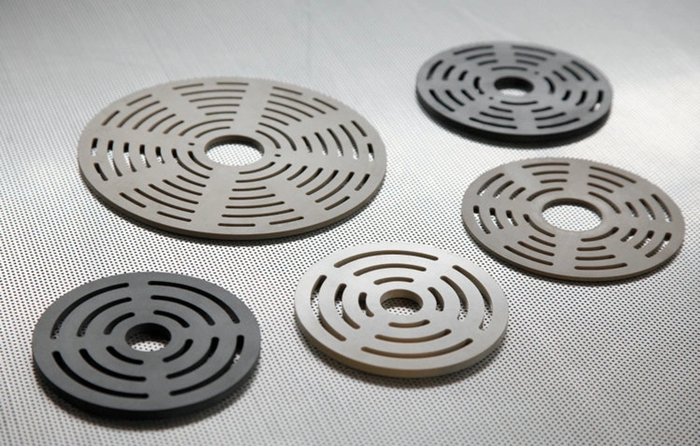
Polyether Ether Ketone (PEEK) maintains high mechanical strength at continuous operating temperatures up to 260°C, with specialized grades resisting short-term spikes up to 300°C. Unfilled (virgin) PEEK provides inherent chemical resistance and impact toughness. Carbon-fiber-filled PEEK variants exhibit enhanced flexural modulus and superior wear resistance compared to unfilled grades. Glass-fiber-reinforced PEEK offers higher stiffness and dimensional stability with reduced thermal expansion. In sour natural gas compressors, glass-filled PEEK plates have demonstrated up to twelve months of continuous operational life, outperforming traditional steel plates that fractured rapidly under identical conditions.
Polyamide-Imide (PAI) and Polyetherimide (PEI) Thermal Resistance
Polyamide-imide (PAI) maintains structural rigidity approaching its glass transition temperature of 280°C, retaining higher compressive strength at 205°C than most engineering polymers display at ambient room temperature. Its compressive strength reaches 260 to 300 MPa. Polyetherimide (PEI) performs well in continuous-use environments up to 170°C; however, PEI is more susceptible to dimensional instability under heavy mechanical loads due to its amorphous molecular structure.
Material Selection Trade-offs: Polymer vs Metal Valve Plates
Choosing between polymer and metal valve plates involves tradeoffs among operating temperature, impact fatigue, corrosion resistance, and unit cost. Engineering polymers outperform metals in corrosion immunity, mass reduction (lowering impact energy on valve seats), and sealing flexibility. However, metals remain the mandatory specification for sustained operating temperatures above 260°C or under extreme high-pressure differential requirements.
Manufacturing Methods and Material Processing Techniques
Manufacturing methods directly impact both the structural integrity and production cost of compressor valve plates. Advanced near-net-shape technologies like Metal Injection Molding (MIM) and Powder Metallurgy (PM) provide cost-effective solutions for mass-producing high-precision valve components.
Metal Injection Molding (MIM) for Complex Valve Plate Geometries
Metal Injection Molding combines the design freedom of plastic injection molding with the material properties of high-strength metals. MIM achieves intricate geometric features—such as multi-radius port profiles, internal weight-reduction voids, and thin walls down to 1.0 mm—that are cost-prohibitive to machine via conventional CNC. Fine metal powders are mixed with thermoplastic binders to form feedstock, which is molded into precision cavities. After solvent and thermal debinding, sintering shrinks the component by 16% to 18%, achieving 96% to 99% of theoretical density. MIM is well suited for small-to-medium-sized valve plates requiring complex flow geometries and tight dimensional tolerances.
Powder Metallurgy (PM) for Custom High-Volume Sintered Valve Plates
Conventional Powder Metallurgy (press-and-sinter) achieves 95% to 97% material utilization compared to only 50% to 70% in conventional CNC machining from bar stock. Near-net-shape PM processing minimizes secondary machining operations while maintaining strict dimensional tolerances (±0.1% to ±0.3%). Powder metallurgy excels in medium-to-high volume production runs, with cost break-even points typically between 800 and 1,200 pieces. High-density sintered valve plates yield 90% to 95% of wrought material mechanical properties at a significantly lower unit cost.
Secondary Precision Operations: Grinding, Lapping, and Edge Deburring
To meet zero-leakage requirements, sintered and molded valve plates undergo secondary surface finishing. Precision double-disc grinding eliminates thickness variations and establishes parallel datum faces. Subsequent diamond lapping yields dense, mirror-flat seating surfaces with roughness values below 0.4 µm Ra. Micro-deburring removes sharp edges along flow ports, eliminating stress concentration points where micro-cracks could initiate.
Quality Control and Leakage Verification in Reed Valve Plate Assemblies
Quality assurance protocols for reed valve plate assemblies involve rigorous dimensional inspections and pressure decay testing. Automated differential pressure sensors measure pressure drops across the valve seal against calibrated reference standards. High-sensitivity flow meters detect minute gas bypass, verifying that micro-flatness and sealing integrity satisfy OEM specifications prior to assembly.
DFM and Design Optimization for Semi-Hermetic Compressor Valve Plates
Applying Design for Manufacturability (DFM) principles ensures consistent quality in mass production. Maintaining uniform wall thickness throughout the valve plate promotes even material flow during injection and prevents warping during high-temperature sintering. Incorporating generous transition radii on flow ports minimizes gas turbulence while reducing internal stress concentrations under dynamic flexure.
Conclusion
Material selection directly determines valve plate service life and overall system performance. Engineered polymers like PEEK can extend operational life from one month to twelve months compared to traditional carbon steel in corrosive natural gas applications. Meanwhile, advanced metal forming processes like Metal Injection Molding and Powder Metallurgy outperform conventional CNC machining by achieving over 95% material utilization and enabling complex 3D geometries. Achieving precise geometric tolerances—specifically flatness, parallelism, and surface finish—remains vital for leak-tight seating. Design engineers must carefully balance mechanical strength, fatigue resistance, chemical compatibility, and unit manufacturing costs when specifying custom compressor valve plate solutions for demanding industrial environments.
FAQs
Q1. What materials are most commonly used in compressor valve plate manufacturing?
Compressor valve plates are typically manufactured from metallic materials like 17-4PH stainless steel, 316L stainless steel, tool steels, and 42CrMo alloy steel for heavy-duty applications. High-performance polymers such as PEEK (Polyether Ether Ketone), PAI (Polyamide-Imide), and PEI (Polyetherimide) are also used, particularly in chemical processing and light-duty applications where corrosion resistance and weight reduction are priorities.
Q2. Why are valve plates essential components in reciprocating compressors?
Valve plates are critical because they directly influence compressor efficiency, reliability, operating temperature, and service life. They control the flow of refrigerant or gas through the compressor by opening and closing thousands of times per minute. Proper valve plate design and material selection can reduce leakage, lower pressure losses, extend maintenance intervals, and prevent the valve failures that account for over 60% of unplanned compressor downtime.
Q3. What are the main advantages of using PEEK material for valve plates?
PEEK valve plates offer exceptional chemical resistance, dimensional stability with only 0.06% water absorption, and the ability to withstand temperatures up to 300°C. In natural gas compressor applications, PEEK plates have demonstrated twelve-month continuous operation compared to steel plates that typically fracture after just one month, making them ideal for corrosive environments and applications requiring extended service life.
Q4. How do Metal Injection Molding and Powder Metallurgy compare for valve plate production?
Metal Injection Molding excels at producing complex geometries with intricate features like undercuts and thin walls as low as 1.0 mm, ideal for small to medium-sized valve plates requiring tight tolerances. Powder Metallurgy offers superior material utilization of 95% to 97% and suits medium to high-volume production with break-even typically at 800 to 1,200 pieces. Both processes achieve near-theoretical density with mechanical properties comparable to wrought materials.
Q5. What precision requirements are critical for compressor valve plate performance?
Flatness and parallelism tolerances are essential for leak-tight sealing performance. Flatness prevents rocking, bowing, or form variation that compromises seal integrity, while parallelism ensures proper orientation relative to mounting surfaces. Surface finish requirements must be appropriate for gasket compatibility while maintaining precise flatness for even contact distribution. These geometric tolerances directly affect sealing performance and operational reliability.