
Custom Sintered Brass Powder Parts & Precision Components
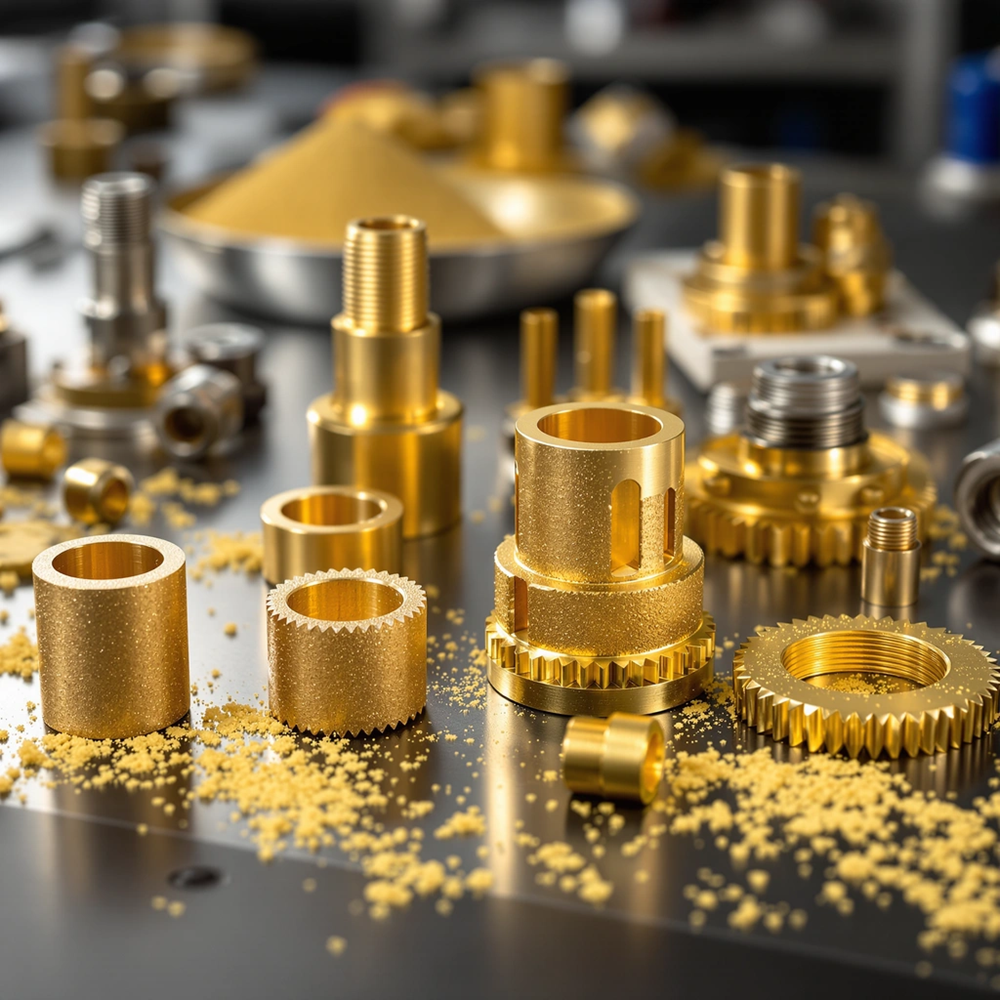
Brass is renowned across industrial engineering sectors for its exceptional corrosion resistance, excellent wear characteristics, low friction coefficient, and superior electrical conductivity. When manufactured via high-density powder metallurgy (PM), custom sintered brass parts deliver unbeatable dimensional repeatability and cost efficiency for medium-to-high volume production.
As an ISO 9001:2015 and IATF 16949 certified powder metallurgy company, JHMIM specializes in custom-engineered brass powdered metal components—including self-lubricating sintered bushings, high-precision gears, lock security mechanisms, and heavy-duty electrical terminals.
What Are Sintered Brass Parts and How Are They Made?
Sintered brass parts are precision components manufactured through powder metallurgy, where brass powder is compressed and heated below its melting point to create strong, net-shape parts. This process builds components from copper-zinc alloy powders rather than removing material from solid stock.
The Powder Metallurgy Process for Brass Components
The conventional powder metallurgy process follows three fundamental stages:
- Powder Blending: Brass powder mixes with lubricants and functional additives to achieve homogeneous distribution and reduce friction during compaction.
- Compaction: High-precision dies compact the mixture at pressures ranging from 138 MPa to 965 MPa, depending on desired component density. The compressed “green” compact maintains sufficient mechanical strength for handling.
- Atmospheric Sintering: Green compacts enter controlled-atmosphere continuous furnaces where sintering takes place at temperatures between 1600°F and 1700°F (870°C to 925°C) for brass. Particles bond through solid-state diffusion without melting, creating structural integrity.
Brass Powder Types: Atomized vs. Pre-Alloyed Powders
Brass powders are produced through distinct methods, each offering specific technical advantages:
- Atomized Powders: High-pressure gas or water jets break molten brass into fine droplets to produce atomized powders. These deliver uniform particle size and excellent flow characteristics, performing best for 90-10 brass compositions.
- Pre-Alloyed Powders: Pre-alloyed powders contain copper and zinc blended before powder formation, ensuring homogeneous alloy distribution throughout every particle during sintering.
- Elemental & Diffused Powders: Diffused brass powders form through heating copper-zinc mixtures to promote micro-alloying while maintaining powder form. Diffused powders suit 70-30 brass ratios due to superior ductility.
Sintering vs. Traditional Brass Machining
Sintering offers massive material efficiency advantages over subtractive machining. Powder metallurgy achieves material scrap rates around 3%, whereas CNC machining generates up to 50% waste. Sintered components reach net-shape or near-net-shape dimensions directly out of the furnace, eliminating secondary machining setups and drastically lowering piece-part costs.
Material Properties of Sintered Brass
Sintered brass parts exhibit an inherent 7% to 10% controlled porosity. This unique structure enables oil impregnation for maintenance-free self-lubricating applications. Achievable density ranges from 95% to 98% of solid wrought brass depending on compaction pressure, producing components with tailored tensile strength and hardness for heavy-duty structural applications.
Advantages of Custom Brass Powder Metallurgy
Net-Shape Manufacturing with Minimal Waste
By compacting metal powders directly into precision tooling dies, powder metallurgy captures complex multi-level geometry, chamfers, and non-circular features in a single stroke, requiring minimal to no finish machining.
Affordable Production for Complex Geometries
For medium-to-high volume production runs (tens of thousands to millions of units), PM tooling offers rapid stroke speeds and minimal labor overhead, dramatically reducing per-part costs compared to multi-axis CNC milling.
Self-Lubricating Performance via Vacuum Oil Impregnation
The controlled micro-porosity of sintered brass allows for vacuum oil impregnation. Under dynamic mechanical friction, stored lubricant migrates to the surface to form a protective oil film, drastically extending the service life of rotating gears and bushings.
Superior Material Utilization Rates
Raw brass alloys carry high material costs. Powder metallurgy achieves up to 97% raw material utilization, offering an environmentally sustainable and cost-effective manufacturing process that insulates budgets from copper and zinc market price volatility.
Tight Tolerances and Dimensional Accuracy
Through carbide tool dies and secondary repressing (sizing) operations, JHMIM maintains tight radial tolerances within ISO IT6 to IT8 standards, ensuring seamless automated assembly line integration.
Common Applications of Sintered Brass Bushings and Gears
Brass powder parts serve critical functions in industries where corrosion resistance, self-lubrication, and precise tolerances define performance requirements. These sintered brass components replace traditionally machined parts in applications that demand economical mass production without sacrificing dimensional accuracy.
- Plumbing Fixtures and Valve Components: Faucet housings, valve stops, and connector fittings dominate water distribution systems due to inherent corrosion resistance. Sintered brass bushings and gears make leak-proof sealing surfaces possible under continuous pressure and temperature fluctuations.
- Lock Hardware and Security Mechanisms: Powder metallurgy makes complex lock components possible, including latches, bolts, tumbler pins, and structural cams. Door lock systems benefit from intricate net-shape geometries with consistent batch-to-batch uniformity.
- Electrical Connectors & Terminal Blocks: High-conductivity brass terminal blocks provide secure connections in power distribution systems. These precision components handle wire cross-sections from 0.34 mm² to 25 mm², maintaining low contact resistance and mechanical stability under load.
- Power Tool Bearings and Bushings: Self-lubricating bronze and brass bushings support rotating shafts in power tools where oil impregnation eliminates external lubrication requirements, handling maximum PV values of 50,000 at speeds up to 1,200 SFM.
- Medical Device Components: Brass and bronze components undergo rigorous testing for biological responses, ensuring safe long-term operation in surgical instruments, diagnostic equipment, and fluid management systems.
- Industrial Fasteners and Fittings: Custom brass PM produces threaded inserts, nuts, and precision fasteners for industrial assemblies that require non-magnetic properties and corrosion resistance.
Design Considerations for Custom Brass Powder Parts
Material selection and geometric specifications determine the functional performance and manufacturing feasibility of custom brass powder metallurgy components. Engineers must review composition requirements, structural limitations, surface treatments, and tolerance capabilities during the design phase.
Material Grade Selection (Lead-Free vs. Leaded Brass)
Regulatory frameworks mandate lead-free formulations for potable water contact applications. NSF/ANSI/CAN 372 standards require brass components to contain no more than 0.25% lead by weight. Lead-free alternatives incorporate silicon, bismuth, or phosphorus (such as Silicon Brass CuZn21Si3P) to maintain machinability while meeting Safe Drinking Water Act compliance.
Wall Thickness and Structural Requirements
Powder metallurgy imposes minimum wall thickness constraints to ensure adequate die filling and green compact integrity. Standard specifications require a 1.5 mm minimum wall thickness, though 0.8 mm is achievable in specialized small-part geometries. Thin walls below these thresholds increase tooling fragility and density variations.
Surface Finishing Options (Plating, Polishing, Passivation)
Nickel plating delivers corrosion protection at 5–15 micron thicknesses, withstanding 96–120 hours in ASTM B117 salt spray testing. Chrome plating provides high surface hardness for sanitary applications, while tin plating provides excellent solderability for electrical terminals.
Thread Design and Tolerance Specifications
External threads can be pressed directly or secondary-machined to 2A / 6g tolerance classes. Coarse threads prove more economical to produce than fine threads in powder metallurgy operations, and thread lengths should remain short to prevent tooling stress.
Quality Assurance, Environmental Compliance & Testing (ISO 9001 / RoHS)
Quality management certification anchors production reliability in powder metallurgy operations. JHMIM’s ISO 9001:2015 and IATF 16949 certified manufacturing facilities implement complete quality systems ensuring traceable production from prototype through mass production.
RoHS Directive 2011/65/EU restricts hazardous substances in electrical and electronic equipment (EEE), capping lead at 0.1% by weight. Standard CW617N brass contains 2–3% lead; however, Annex III exemption 6(c) permits lead up to 4% by weight in copper alloys used in EEE (extended through June 2027).
Full material traceability systems link every shipment of powdered metal components back to raw powder batches. Material certifications include chemical composition analysis (via XRF spectroscopy) and density/tensile strength verification.
Conclusion & Call to Action (DFM Analysis & Fast Quote)
Sintered brass powder parts deliver optimal material efficiency, self-lubricating capabilities, and high precision across plumbing, electrical, and industrial applications. By partnering with an experienced powder metallurgy manufacturer, you can reduce manufacturing costs for complex geometries while meeting strict ISO 9001 quality and RoHS environmental compliance standards.
👉 Upload Your 2D/3D CAD Drawings (STEP/IGES) to JHMIM Engineers for a Free DFM Analysis & Fast Quote →
Sintered components are precision parts manufactured through powder metallurgy, where metal powder is compressed in precision dies and heated below its melting point in controlled-atmosphere furnaces. For brass parts, the process involves compacting powder at pressures between 138 MPa and 965 MPa, then sintering at temperatures between 1600°F and 1700°F to form dense, strong parts through solid-state diffusion.
Key design considerations include minimum wall thickness constraints (typically 1.5 mm, down to 0.8 mm for micro parts), an inherent porosity of 7–10% (unless repressed or resin-impregnated), and avoiding undercuts or sharp radial threads that cannot be extracted vertically from the compaction die.
Sintered brass offers far superior material utilization (up to 97%) with scrap rates around 3%, compared to up to 50% scrap waste in CNC machining. Sintering creates net-shape parts in a single pressing stroke, eliminating multi-axis machining and significantly reducing cycle times and unit costs for high-volume orders.
Yes. For drinking water applications, NSF/ANSI/CAN 372 limits lead content to a maximum of 0.25% by weight. For electrical and electronic equipment, RoHS Directive 2011/65/EU restricts lead to 0.1%, with Annex III exemption 6(c) allowing up to 4% lead in copper alloys through June 2027.
Sintered brass components are widely utilized in plumbing fixtures, valve bodies, security lock hardware, electrical terminals, self-lubricating power tool bushings, medical diagnostic equipment, and industrial threaded fasteners.