
Key Takeaways
- Hardened Steel Strength vs. Soft Castings: Metal Injection Molding (MIM) produces lock internals in 17-4PH, 4140, and FN02 steels reaching 1,100–1,300 MPa tensile strength and up to 70 HRC surface hardness—far outperforming Zamak zinc (283–328 MPa, ~5 HRC) and aluminum die castings.
- Zero Draft Angles & Part Consolidation: Unlike die casting (which requires 0.5°–3° draft tapers), MIM holds ±0.3% dimensional tolerances without draft and merges cylinder cams, slots, and pin channels into one monolithic steel part.
- Certified High-Security Compliance: Hardened MIM lock components pass UL 437 anti-drill resistance (>25 minutes) and exceed ANSI/BHMA Grade 1 durability standards (800,000+ cycles vs. the 40,000-cycle minimum).
- Optimal Hybrid Assembly Strategy: For volumes above 10,000 units/year, manufacturers achieve the best ROI by pairing cost-effective die-cast zinc outer housings with high-security steel MIM internals.
High-security lock assemblies demand tight geometric tolerances, case-hardened surfaces, and resistance to drilling or forced-torque attacks that non-ferrous castings cannot provide. While die casting remains standard for outer hardware housings, internal lock cylinders, deadbolt cams, and sidebar pins require hardened steel performance alongside intricate 3D features. Metal Injection Molding (MIM) bridges this gap—combining plastic-molding design freedom with wrought-steel mechanical integrity for custom MIM lock cylinder assemblies and deadbolt mechanisms.
MIM vs. Die Casting for Lock Parts: Processes and Alloy Choices
Process Fundamentals: Powder Sintering vs. Molten Metal Casting
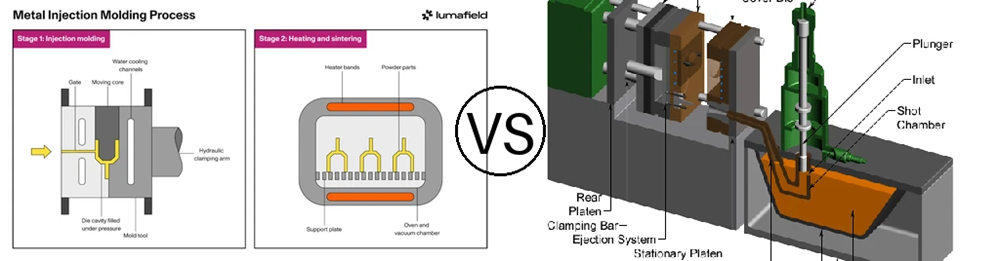
Metal injection molding blends fine metal powders with a thermoplastic and wax binder to form a uniform feedstock, which is injected into a mold cavity at moderate pressures (50–100 MPa). After molding, the binder is extracted via catalytic or thermal debinding, and the porous brown part is sintered just below its melting point. During sintering, the part shrinks uniformly by 15% to 22% to reach >96% theoretical density. Because MIM never melts the metal completely, it processes high-melting-point stainless and tool steels without thermal die erosion.
Die casting forces molten non-ferrous metal into hardened steel dies at 140 to 215 MPa, solidifying within 1 to 30 seconds. While dies can run over one million cycles, high melting temperatures restrict commercial die casting to zinc, aluminum, and m
High-Security Lock Cylinders and Deadbolt Components: Why MIM Outperforms Die Casting
Key Takeaways
- Hardened Steel Strength vs. Soft Castings: Metal Injection Molding (MIM) produces lock internals in 17-4PH, 4140, and FN02 steels reaching 1,100–1,300 MPa tensile strength and up to 70 HRC surface hardness—far outperforming Zamak zinc (283–328 MPa, ~5 HRC) and aluminum die castings.
- Zero Draft Angles & Part Consolidation: Unlike die casting (which requires 0.5°–3° draft tapers), MIM holds ±0.3% dimensional tolerances without draft and merges cylinder cams, slots, and pin channels into one monolithic steel part.
- Certified High-Security Compliance: Hardened MIM lock components pass UL 437 anti-drill resistance (>25 minutes) and exceed ANSI/BHMA Grade 1 durability standards (800,000+ cycles vs. the 40,000-cycle minimum).
- Optimal Hybrid Assembly Strategy: For volumes above 10,000 units/year, manufacturers achieve the best ROI by pairing cost-effective die-cast zinc outer housings with high-security steel MIM internals.
High-security lock assemblies demand tight geometric tolerances, case-hardened surfaces, and resistance to drilling or forced-torque attacks that non-ferrous castings cannot provide. While die casting remains standard for outer hardware housings, internal lock cylinders, deadbolt cams, and sidebar pins require hardened steel performance alongside intricate 3D features. Metal Injection Molding (MIM) bridges this gap—combining plastic-molding design freedom with wrought-steel mechanical integrity for custom MIM lock cylinder assemblies and deadbolt mechanisms.
MIM vs. Die Casting for Lock Parts: Processes and Alloy Choices
Process Fundamentals: Powder Sintering vs. Molten Metal Casting
Metal injection molding blends fine metal powders with a thermoplastic and wax binder to form a uniform feedstock, which is injected into a mold cavity at moderate pressures (50–100 MPa). After molding, the binder is extracted via catalytic or thermal debinding, and the porous brown part is sintered just below its melting point. During sintering, the part shrinks uniformly by 15% to 22% to reach >96% theoretical density. Because MIM never melts the metal completely, it processes high-melting-point stainless and tool steels without thermal die erosion.
Die casting forces molten non-ferrous metal into hardened steel dies at 140 to 215 MPa, solidifying within 1 to 30 seconds. While dies can run over one million cycles, high melting temperatures restrict commercial die casting to zinc, aluminum, and magnesium. Furthermore, rapid turbulent filling can trap air pockets, creating internal porosity that limits structural strength and prevents effective heat treatment.
Hardened Steel MIM (17-4PH, 4140, FN02) vs. Zinc (Zamak) and Aluminum Die Castings
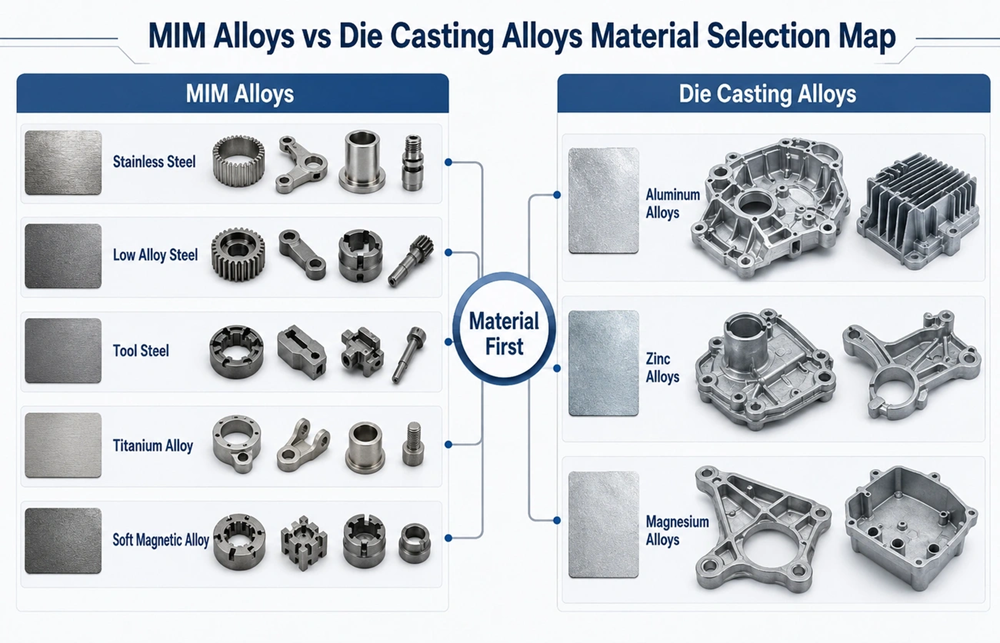
High-security MIM lock components rely on 17-4PH precipitation-hardening stainless steel, 4140 chromoly steel, or FN02 nickel-iron steel. Heat-treated 17-4PH achieves 1,100 to 1,300 MPa tensile strength, 950 to 1,050 MPa yield strength, and 28 to 38 HRC core hardness—while carburized 4140 or FN02 reaches even higher surface hardness for anti-drill protection.
By contrast, zinc die-cast housings use Zamak 3 (283 MPa tensile strength), Zamak 5 (310 MPa), or Zamak 2 (328 MPa, ~100 HB / 5 HRC). Aluminum die castings reduce part weight (2.7 g/cm³ vs. zinc’s 6.6 g/cm³ and steel’s 7.8 g/cm³), but neither zinc nor aluminum can resist carbide drill bits or high shear loads without steel reinforcement.
MIM Lock Cylinder Precision: Small Features, Consolidation, and Close Fits
Fine Slots, Cam Profiles, and Part Consolidation Without Secondary Machining
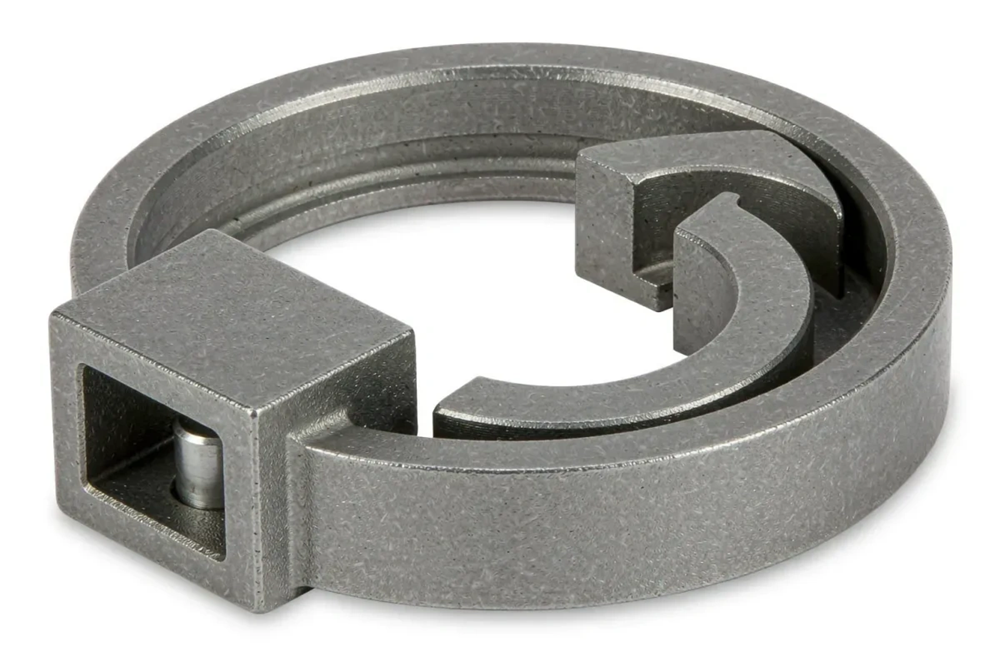
MIM lock cylinder components routinely integrate cam profiles, fine keyway slots, blind holes, and sidebar channels into a single sintered steel part. Standard die-cast lock designs must use a Zamak housing fitted with separately machined steel pins, cams, and anti-drill plates. MIM deadbolt components consolidate multi-piece subassemblies into one monolithic unit—eliminating tolerance stack-up, rivet joints, and secondary assembly labor.
Sintering Shrinkage vs. Casting Shrinkage: Dimensional Control (±0.3% vs. Draft Angles)
Die casting requires draft angles to eject parts from steel dies: typically 1°–2° on external aluminum walls (1°–3° internal) and 0.5°–1° on zinc walls. On a 30 mm-deep cylinder bore, a 1° draft introduces a 0.52 mm taper per side, forcing secondary boring or reaming to establish straight bearing fits. Because MIM green parts shrink isotropically inside the sintering furnace, features require zero draft angles and maintain ±0.3% to ±0.5% as-sintered dimensional consistency across tight cylinder-to-housing clearances.
Critical Fits and Surface Finish: When Grinding, Reaming, or Coining Is Needed
Regardless of the primary forming route, press-fit bearing journals, seal grooves, and tolerances tighter than ±0.03 mm require secondary finishing. While die castings need milling across drafted surfaces, MIM lock components start near net print dimensions—requiring only light reaming on precision pin bores or coining on flat locking faces.
Security and Service Life: Where Steel MIM Parts Outperform Die Casting
Drill and Pry Resistance: Case-Hardened MIM Steel vs. Soft Die-Cast Alloys
Forced-entry attacks frequently target the cylinder core and shear line with hardened drill bits. Case-hardened MIM steel components (4140, FN02, or surface-treated stainless grades) achieve 45 to 70 HRC surface hardness—deflecting drill bits compared to Zamak 2’s ~5 HRC. Hardened MIM cylinder cores routinely withstand continuous drilling attacks for over 25 minutes, whereas soft zinc bodies require pressed-in hardened steel pins or faceplates to pass security audits.
Forced Torque Strength in Cylinder Cams, Tailpieces, and Deadbolt Links
Under ANSI/BHMA Grade 1 testing, cylinder plugs must withstand 300 lbf-in (34 Nm) of rotational torque without cam failure, while cylinder bodies must resist 120 lbf-ft (160 Nm) of wrench torque without bolt retraction or extraction. With tensile strengths around 1,190 MPa, 17-4PH MIM tailpieces, cams, and deadbolt links absorb sudden shock torque without shearing or twisting—a common failure mode in cast zinc linkages.
Wear Resistance and Corrosion Protection: Stainless MIM vs. Coated Castings
As-sintered MIM components exhibit a smooth surface finish around Ra 0.8–1.6 μm, compared to ~3.2–10 μm on raw die castings. Lower friction reduces key-insertion and cam-sliding wear over years of operation. Furthermore, while zinc castings oxidize and pit in coastal or humid climates unless plated, stainless steel MIM lock assemblies provide inherent through-thickness corrosion resistance without coatings that can chip or wear off.
Meeting UL 437 and ANSI/BHMA Grade 1 Durability Standards
Sintered stainless and hardened alloy MIM lock mechanisms routinely surpass ANSI/BHMA A156.2 / A156.36 Grade 1 endurance thresholds, completing over 800,000 operational cycles without excessive lash—twenty times the 40,000-cycle baseline—while meeting UL 437 physical attack resistance criteria.
Upgrading Lock Cylinders or Deadbolt Internals to Hardened Steel MIM?
Our engineering team helps commercial and smart-lock manufacturers consolidate multi-part assemblies, hit UL 437 hardness targets, and cut machining costs by over 40%.
Send Your 3D CAD Drawings to JHMIM for a Free DFM & Tooling Quote →
Production Cost and Part Selection: When MIM Justifies the Tooling
Total Cost per Part: Tooling Amortization, Speed, and Volume Break-Even
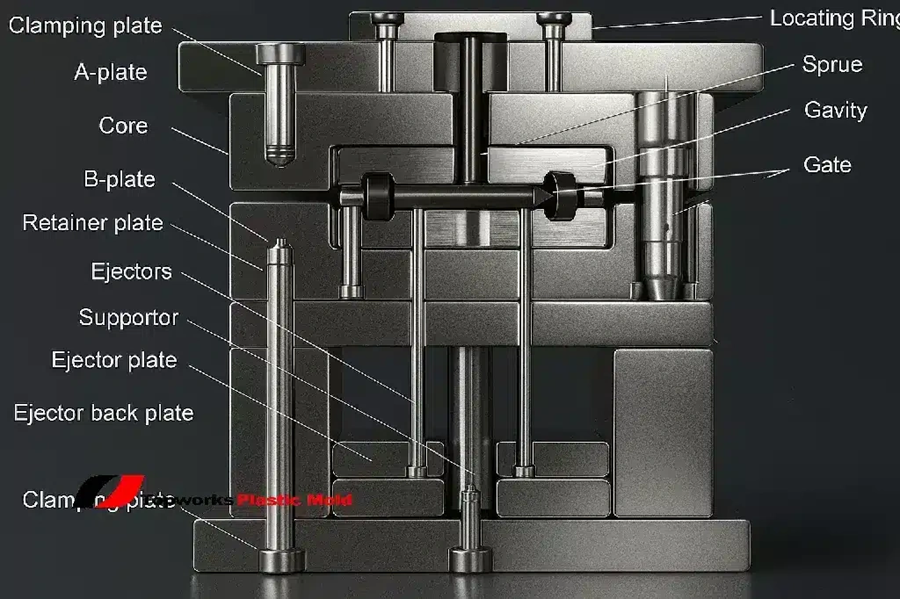
MIM tooling typically costs USD 3,000 to USD 20,000 depending on cavity count and side-action complexity, compared to USD 8,000 to USD 50,000+ for multi-slide die-casting dies. MIM reaches cost parity and strong ROI starting around 10,000 to 15,000 units per year for complex steel parts under 50 grams. While die casting achieves lower unit prices above 50,000 units for large non-ferrous housings, MIM utilizes 95%–98% of its feedstock and eliminates multi-axis CNC machining—cutting total part cost by over 40% compared to machined steel lock components.
Hybrid Assembly Strategy: Small Steel MIM Internals + Die-Cast Outer Housings
The most cost-effective commercial and smart lock platforms combine both processes: using die-cast zinc or aluminum housings for large, decorative exterior escutcheons and chassis bodies, while deploying hardened steel MIM for compact, high-stress internals such as cylinder plugs, cams, deadbolt throwers, and clutch gears.
RFQ Checklist for Lock Components: Drawings, Load Specs, Heat Treatment, and Inspection
To receive an accurate MIM tooling and unit-price quote, engineering RFQ packages should specify:
- 3D CAD & 2D Tolerance Drawings: STEP/IGES files with clearly flagged critical-to-function (CTF) dimensions and datum surfaces.
- Alloy & Heat-Treatment Targets: Required grade (e.g., 17-4PH H900, carburized 4140, or 316L) and target core/surface HRC hardness.
- Mechanical & Security Standards: Applicable UL 437 or ANSI/BHMA Grade 1/2 torque, cycle-life, and salt-spray corrosion requirements.
- Annual Volume & Secondary Finishing: Projected annual order quantities, batch sizes, and required surface finishes (PVD, tumbling, passivation, or CNC bore reaming).
Comparison Table: MIM vs. Die Casting for Lock Components
| Attribute | MIM (Metal Injection Molding) | Die Casting (Zinc / Aluminum) |
|---|---|---|
| Primary Alloys | 17-4PH, 316L stainless; 4140, FN02 low-alloy hardened steels | Zamak 2, 3, 5 zinc alloys; A380 / ADC12 aluminum alloys |
| Tensile Strength | 1,100 – 1,300 MPa (heat-treated 17-4PH) | 283 – 328 MPa (Zamak); ~310 MPa (A380 aluminum) |
| Hardness Range | 28 – 38 HRC core; up to 45 – 70 HRC case-hardened surface | ~100 HB (~5 HRC) for Zamak 2; softer for aluminum |
| Dimensional Control | ±0.3% – ±0.5% as-sintered; uniform 15%–22% shrinkage | ±0.5% – ±1.0%; requires post-machining for tight bores |
| Draft Angle Needs | 0° (no draft angles required on most features) | 0.5° – 1° (zinc); 1° – 3° (aluminum) |
| Surface Roughness | Ra 0.8 – 1.6 μm as-sintered | Ra 3.2 – 10 μm as-cast |
| Part Consolidation | High; merges cams, key slots, and pin channels into 1 steel part | Moderate; requires separate machined steel inserts/pins |
| Drill & Torque Security | Passes UL 437 (>25 min drill resistance) & ANSI Grade 1 torque | Low drill/shear resistance without steel reinforcement |
| Corrosion Resistance | Inherent in 316L / 17-4PH stainless; optional PVD plating | Requires electroplating or powder coating to prevent oxidation |
| Tooling Investment | USD 3,000 – 20,000 | USD 8,000 – 50,000+ |
| Economic Volume | 10,000+ pcs/year (optimal for parts <50 g) | 50,000+ pcs/year (optimal for larger housings) |
| Ideal Lock Role | Cylinder cores, cams, deadbolt links, sidebars, clutch gears | Exterior lock cases, escutcheons, handles, non-load covers |
Conclusion: Partner with JHMIM for High-Security Lock Component Manufacturing
Choosing between MIM and die casting comes down to balancing mechanical security against part size and production volume. When lock assemblies must pass ANSI/BHMA Grade 1 cycle life or UL 437 forced-entry standards, hardened steel MIM delivers the drill resistance, shear strength, and zero-draft dimensional precision that zinc and aluminum castings cannot achieve. For cost-sensitive commercial and smart locks, pairing die-cast housings with hardened MIM internals captures the strengths of both processes.
At JHMIM, we manufacture precision stainless and low-alloy steel MIM components for commercial mortise locks, smart deadbolts, and high-security cylinder systems—backed by in-house tooling, vacuum sintering, heat treatment, and CMM quality inspection.
Developing a new high-security or smart lock mechanism? Contact JHMIM’s engineering team today or upload your 3D CAD models for a DFM review and volume quote within 24 hours.
Frequently Asked Questions (FAQs)
Q1. Which steel alloys are most commonly used for MIM lock components?
17-4PH precipitation-hardening stainless steel is the most widely used alloy for lock cams, deadbolt links, and clutch parts due to its 1,100–1,300 MPa tensile strength and corrosion resistance. For extreme anti-drill cylinders and pins, carburized low-alloy steels like 4140 and FN02 are selected to achieve 55–70 HRC surface hardness.
Q2. Can MIM lock components meet UL 437 and ANSI/BHMA Grade 1 requirements?
Yes. Case-hardened MIM steel cylinder cores and anti-drill inserts withstand over 25 minutes of drill attack under UL 437 testing, while 17-4PH MIM linkages routinely exceed ANSI/BHMA Grade 1 rotational torque (300 lbf-in) and 800,000-cycle durability thresholds.
Q3. Why does MIM eliminate the draft angles required in die casting?
Die casting injects molten metal that shrinks onto core pins, requiring 0.5° to 3° draft tapers for ejection. MIM injects a polymer-metal feedstock that ejects cleanly with zero draft on most features and then shrinks uniformly (15%–22%) during sintering, preserving straight cylinder walls and close fits.
Q4. What annual volume makes MIM lock parts cost-effective compared to CNC machining?
For intricate steel lock components weighing under 50 grams, MIM typically becomes more economical than multi-axis CNC machining starting around 10,000 to 15,000 pieces per year—often reducing per-part costs by more than 40% while eliminating material scrap.
Q5. Can MIM lock parts receive decorative finishes like PVD or chrome plating?
Yes. Because sintered MIM parts achieve >96% closed-pore density and a smooth ~1 μm surface finish, they can undergo PVD coating (black, brass, satin nickel), electroplating, tumbling, or passivation without requiring the resin impregnation needed for conventional pressed powder metal parts.