
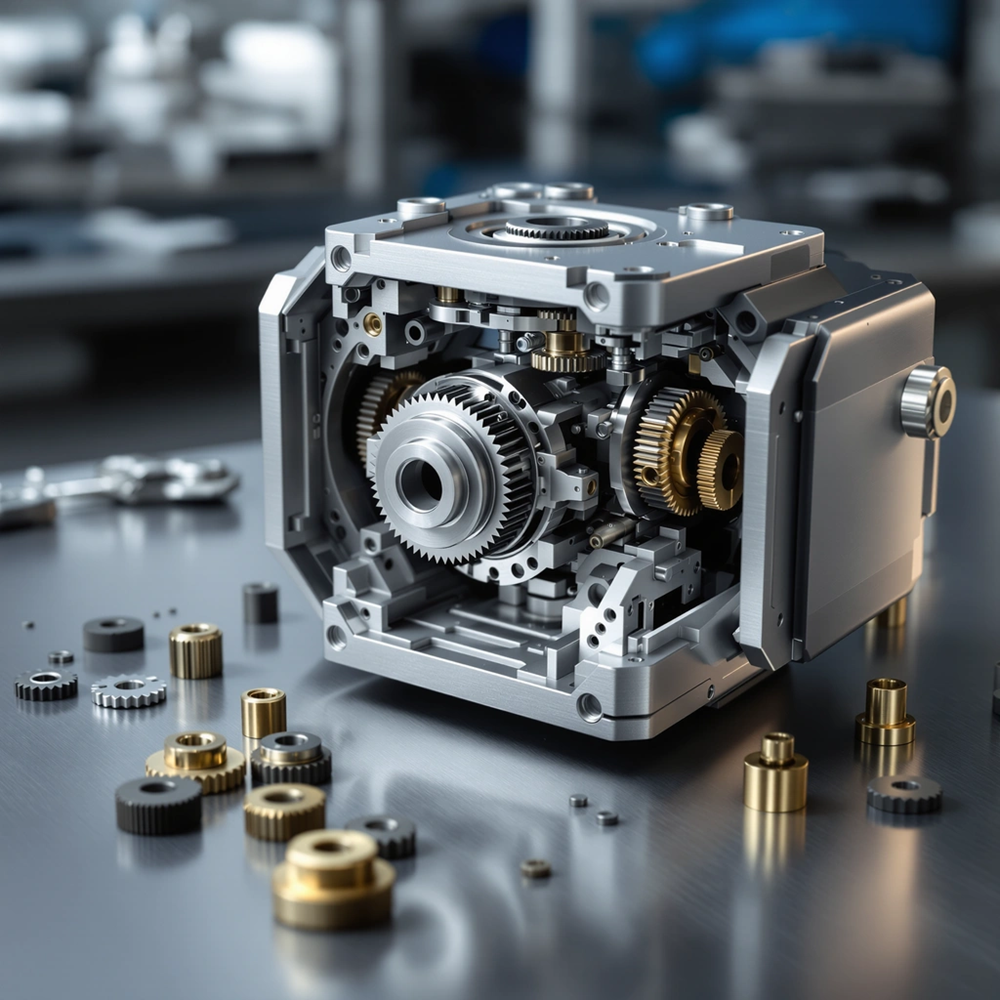
The rapid evolution of humanoid robotics demands compact, high-torque, and lightweight joint assemblies capable of enduring millions of dynamic cycles. Designing efficient joint actuators requires balancing mechanical strength against strict mass limits and high-volume production economics. Advanced powder-based manufacturing technologies—specifically Metal Injection Molding (MIM) and conventional Press-and-Sinter Powder Metallurgy (PM)—are rapidly replacing traditional multi-axis CNC machining. By delivering near-net-shape geometries, superior material utilization, and high batch-to-batch repeatability, MIM and PM enable robot OEMs to scale joint production while cutting component costs by 30% to 50%.
Which Humanoid Robot Joint Components Can Use MIM and PM?
Humanoid robot joint assemblies feature diverse functional requirements, requiring engineers to select MIM or press-and-sinter PM based on component geometry, mechanical load, physical envelope, and annual production volume. MIM excels in producing small, highly intricate 3D parts with complex contours, whereas conventional PM suits larger, 2.5D structural shapes that require high press compaction. Both processes drastically reduce material waste compared to subtractive machining, leveraging powdered metals to form net-shape parts prior to final thermal consolidation.
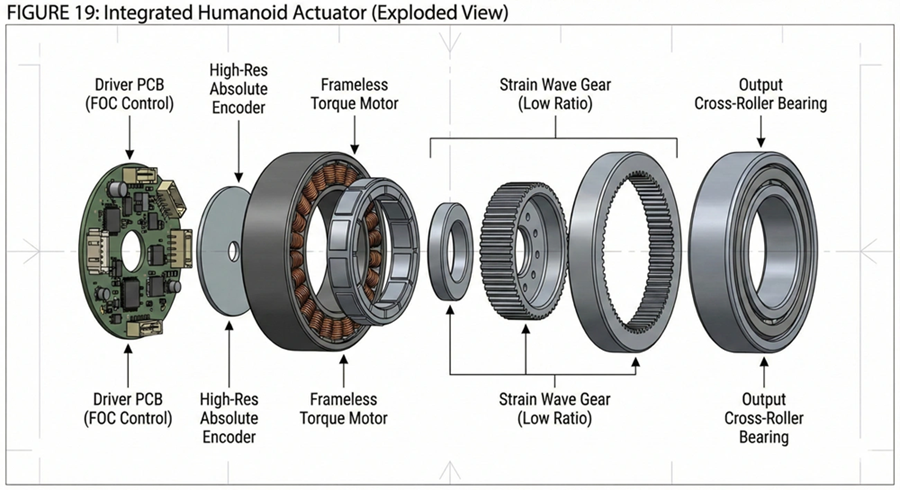
Rotary Joint Actuators: Harmonic and Planetary Gear Sets
Planetary gearboxes are ideal candidates for powder-metallurgy robot joint integration. In a typical planetary setup, a central sun gear drives multiple planet gears inside an internal ring gear, with the planet carrier transferring the output torque. Multiple mesh points distribute contact stress, allowing for an exceptionally compact, high-torque assembly. Modern humanoid platforms incorporate at least 14 to 28 rotary joint actuators across the shoulders, elbows, wrists, hips, knees, and ankles. PM processes routinely produce planet gears, sun gears, planet carriers, and internal ring gears via near-net-shape forming. Fully sintered PM gearsets achieve excellent surface fatigue limits when properly heat-treated. Meanwhile, MIM is preferred for miniaturized gear elements where micro-tooth profiles and tight packaging justify multi-cavity injection tooling.
Linear Actuator Mechanisms: Lead Screw Nuts and Structural Clevises
Linear actuators utilize precision lead screw or ball screw mechanisms to convert motor rotation into powerful linear thrust, particularly in leg and torso joints. The lead screw nut must maintain high thread accuracy, wear resistance, and controlled axial backlash (typically within ±0.03 to ±0.07 mm). MIM can easily mold compact nuts featuring complex internal threads, anti-rotation keys, and mounting flanges in a single step. For larger structural linkages, PM produces heavy-duty clevises, spacers, and mounting brackets, limiting secondary CNC operations strictly to critical bearing bores and high-precision mating faces.
Dexterous Hand Linkages: Micro-Gears, Finger Hinges, and Cable Guides
Humanoid hands require extreme miniaturization to fit dozens of micro-actuators within a human-sized palm envelope. MIM is the premier process for manufacturing micro-gears for humanoid robots, intricate finger hinges, tendon cable guides, lock housings, and multi-linkage levers. Micro-MIM capabilities allow the molding of module 0.1 to 0.3 gears for finger joint drive units. Concurrently, oil-impregnated PM bushings and porous bronze washers serve as self-lubricating pivot bearings across all finger joints, keeping hand mechanisms lightweight and maintenance-free.
How Press-and-Sinter PM Cuts Joint Part Costs
Direct cost savings begin when metal powder is compacted to near-net shape, eliminating the massive chip waste and long machining cycle times inherent to multi-axis milling. Humanoid robot joint components benefit from reduced billet consumption, shorter lead times, and stable part-to-part consistency across high-volume manufacturing runs.
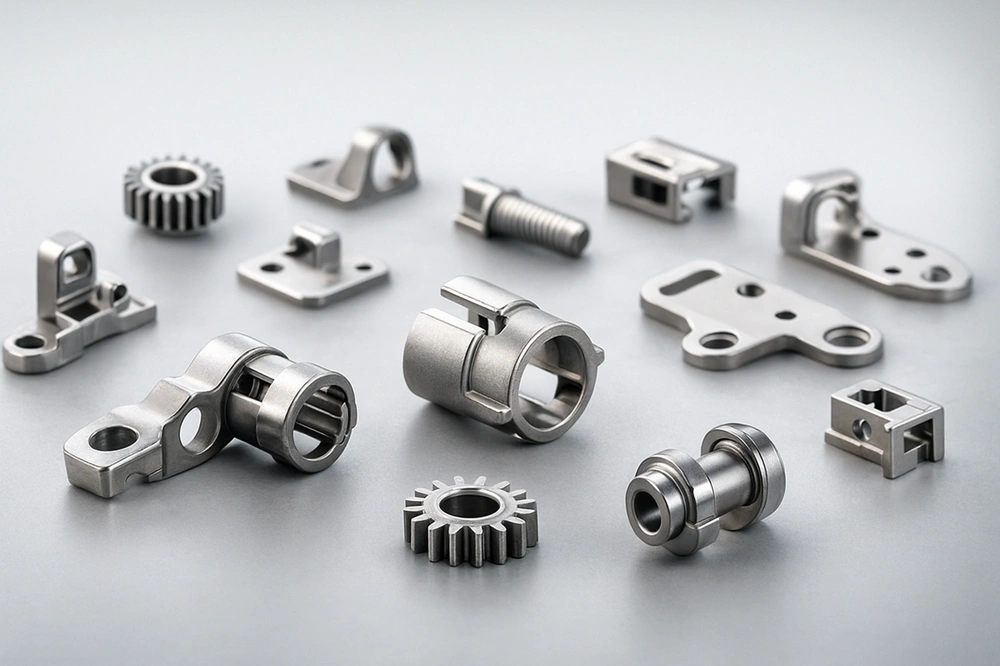
Near-Net-Shape Planetary Gears, Sun Gears, and Planet Carriers
Conventional press-and-sinter PM forms sun gears, planet gears, ring gears, and carriers nearly identical to their final engineering drawings. In a typical planetary gearset, input and output carrier flanges are pressed to net shape, eliminating costly multi-axis face milling and pocketing. PM processes achieve 90% to 97% raw powder utilization, compared to conventional bar-stock machining which routinely wastes 40% to 70% of raw material as swarf. This extreme material yield makes PM highly economical for high-volume powder metallurgy robot joints.
While compaction tooling represents an initial capital outlay, PM gears become cost-competitive against CNC machining at annual volumes as low as 2,000 to 10,000 units. As production scales beyond 50,000 units per year, unit costs drop drastically. Secondary operations like surface induction hardening, gear sizing (coining), or light CNC bore finishing refine critical tolerances without needing to machine the main tooth profiles.
Oil-Impregnated Bronze and Iron Bushings for Joint Pivot Bearings
Sintered porous bronze and iron bushings retain liquid lubricant within their interconnected pore networks. Under vacuum impregnation, oil fills these micro-pores; during joint rotation, frictional heat and capillary action draw the lubricant to the sliding interface. This provides quiet, self-lubricating, and maintenance-free operation for humanoid joint pivots. At production batches of 10,000 units, sintered bronze bushings cost 40% to 70% less than commercial needle or miniature ball bearings, while providing superior shock load absorption.
Soft Magnetic Composite (SMC) Cores for High-Torque Frameless Motors
High-torque frameless BLDC motors powering humanoid joints increasingly rely on Soft Magnetic Composite (SMC) stator and rotor cores. SMC technology uses surface-insulated iron powders pressed into net-shape motor geometries. Unlike traditional laminated electrical steel stacks, SMC cores facilitate true three-dimensional magnetic flux paths, enabling compact, high-power-density axial flux motor designs that fit within narrow joint housing envelopes.
Where MIM Fits Small, Complex Robot Parts
Intricate, highly contoured metal parts are essential for keeping humanoid robot joint assemblies compact without sacrificing structural integrity. Metal Injection Molding (MIM) combines fine metal powders with polymer binders to mold complex humanoid robot joint components that would otherwise require cost-prohibitive 5-axis CNC machining.
Metal Powder Injection, Debinding, and Sintering Mechanics
MIM feedstock flows like plastic, completely filling complex mold cavities that contain thin walls, internal gear teeth, cross-holes, undercuts, and external threads. After molding, solvent or thermal debinding extracts the binder matrix. Subsequent high-temperature sintering densifies the metal particles to 96%–99% of theoretical density. Because MIM experiences controlled linear shrinkage of 15% to 20%, precision tooling is oversized to guarantee tight final dimensions. Standard MIM achieves wall thicknesses of 0.3 to 0.4 mm, while specialized micro-MIM can mold features down to 0.2 mm.
Micro Gears for Humanoid Robots, Complex Linkages, and Lock Housings
Micro-gears and intricate linkage mechanisms fit directly into robotic hands, wrists, and compact joint locks. MIM enables the one-piece molding of gear-shaft combinations, dual-cluster gears, and internal keyways, consolidating multi-part assemblies into single components. MIM achieves gear pitch diameters down to 1.25 mm with high tooth profile repeatability. This process is equally suited for finger knuckle links, tendon cable guides, and joint brake housings, delivering maximum strength in minimal space.
Titanium and Stainless Steel Alloys for High Torque-to-Weight Ratios
Material selection directly dictates the torque-to-weight ratio of humanoid joints. Popular stainless steel MIM alloys include MIM-17-4PH, which offers yield strength up to 1,100 MPa following H900 precipitation heat treatment (reaching HRC 44–47). When extreme weight reduction is required, Titanium MIM (Ti-6Al-4V) delivers wrought-like fatigue strength at nearly half the density of steel, providing an ideal material solution for dynamic leg and arm linkages.
Design Guide and Material Selection for Robot Joint Components
Optimizing humanoid joint components for powder metallurgy requires balancing mechanical strength, dynamic fatigue limits, and manufacturing constraints. Selecting the right alloy and applying strict DFM principles ensures flawless molding and sintering performance.
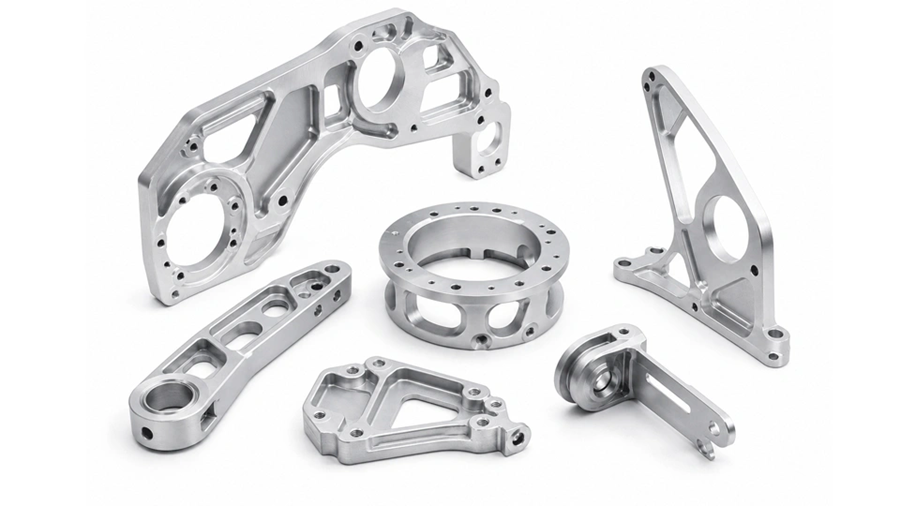
Material Capabilities: MIM-17-4PH, MIM-4605, Titanium, and SMC Composites
Engineers must match material capabilities to joint operating conditions. MIM-17-4PH is the workhorse for high-strength, corrosion-resistant structural hinges and gears. MIM-4605 low-alloy steel excels in high-impact gear applications where case hardening delivers superior surface wear resistance and high core toughness. Titanium Grade 5 (Ti-6Al-4V) targets lightweight arm and finger linkages, while Soft Magnetic Composites (SMC) optimize frameless motor efficiency.
MIM DFM Rules for Joint Parts: Uniform Wall Thickness, Draft Angles, and Undercuts
Successful MIM joint parts rely on uniform wall thickness to prevent sink marks, internal voids, and sintering distortion. Incorporating draft angles of 0.5° to 1.5° ensures clean mold ejection without damaging delicate micro-features. Internal radiusing (minimum 0.5 mm) reduces stress concentrations during binder removal. Utilizing moldflow simulation prior to tooling fabrication allows engineers to optimize gate placement and eliminate weld lines on high-stress gear teeth.
Precision Control: As-Sintered Tolerances vs. Secondary CNC Machining
As-sintered PM dimensions generally hold tolerances of ±0.05 to ±0.13 mm, whereas MIM holds ±0.3% to ±0.5% of nominal dimensions. While these tolerances are exceptional for thermal consolidation, critical precision interfaces—such as bearing press-fit bores, encoder mounting faces, and high-precision threads—should incorporate localized CNC machining or precision sizing. Restricting CNC finishing strictly to functional mating surfaces preserves the cost advantages of near-net-shape molding.
When MIM and PM Make Sense for Production
Determining the transition point from prototype manufacturing to mass production requires evaluating design maturity, annual volume thresholds, and stringent joint validation protocols.
CNC Machining and Titanium 3D Printing for Early Prototyping
During early R&D and functional proof-of-concept stages, CNC machining from solid billet is ideal for low-volume testing, allowing rapid design iterations without tooling commitments. For highly organic or lightweight joint brackets, Titanium 3D printing (SLM/LPBF) provides rapid prototyping capabilities. However, as production scales toward pilot manufacturing, 3D printing becomes cost-prohibitive, making MIM and PM the logical choice for volume scaling.
Tooling Amortization and Annual Volume Thresholds (ROI Breakdown)
Because MIM and PM require custom steel tooling ($15,000 to $45,000 per mold set), financial justification depends on production volume. MIM typically achieves ROI break-even at 5,000 to 10,000 units annually, with optimal unit cost reductions realized above 15,000 units. Conventional PM gears can break even at volumes as low as 2,000 to 5,000 pieces per year due to faster pressing cycle times and lower tooling amortization costs.
Validation Protocols: Fatigue Testing, Backlash Limits, and Load Audits
Validating sintered robot joint components involves rigorous mechanical testing. Dedicated joint test benches evaluate continuous torque, thermal dissipation, transmission efficiency, and backlash limits (cobot and humanoid joints typically mandate backlash under 1 to 3 arcmin). Dynamic fatigue testing must subject MIM gears and linkages to millions of reversing impact cycles to verify endurance limits under emergency stop conditions.
Conclusion
Designing competitive humanoid robot joints requires assigning each component to its optimal manufacturing route. MIM provides unmatched 3D design freedom for miniature gears, finger hinges, cable guides, and complex lock housings. Concurrently, press-and-sinter PM delivers cost-effective, high-density planetary gears, self-lubricating bushings, and soft magnetic motor cores at scale. By aligning part geometry, mechanical material selection, DFM guidelines, and volume thresholds, engineering teams can transition prototype humanoids into reliable, budget-friendly mass-production robots.
FAQs
Q1. How do MIM and PM differ for humanoid robot joint parts?
Metal injection molding (MIM) suits small, complex parts such as finger hinges and micro-gears. Press-and-sinter powder metallurgy (PM) generally suits simpler gears, carriers, and bushings produced in batches.
Q2. How can powder metallurgy lower robot joint manufacturing costs?
PM forms parts close to their final shape, reducing material waste and machining time. Savings depend on production volume, tooling costs, and the finishing required.
Q3. Which materials are suitable for MIM robot joint components?
17-4PH stainless steel offers strength, hardness, and corrosion resistance. Titanium is useful when low weight is a priority, while MIM-4605 requires evaluation for the intended hardness, fatigue loads, and heat treatment.
Q4. Do MIM and PM joint components need additional machining?
Not always. Critical features such as bearing seats, precision bores, and threads may need machining or sizing when their tolerances exceed what the sintered process can achieve.
Q5. When should manufacturers choose MIM or PM instead of CNC machining?
CNC machining suits prototypes and changing designs. For stable designs, PM gears may become cost-competitive at roughly 2,000–10,000 parts annually, while MIM often becomes attractive around 10,000–15,000, depending on part complexity and finishing needs.