
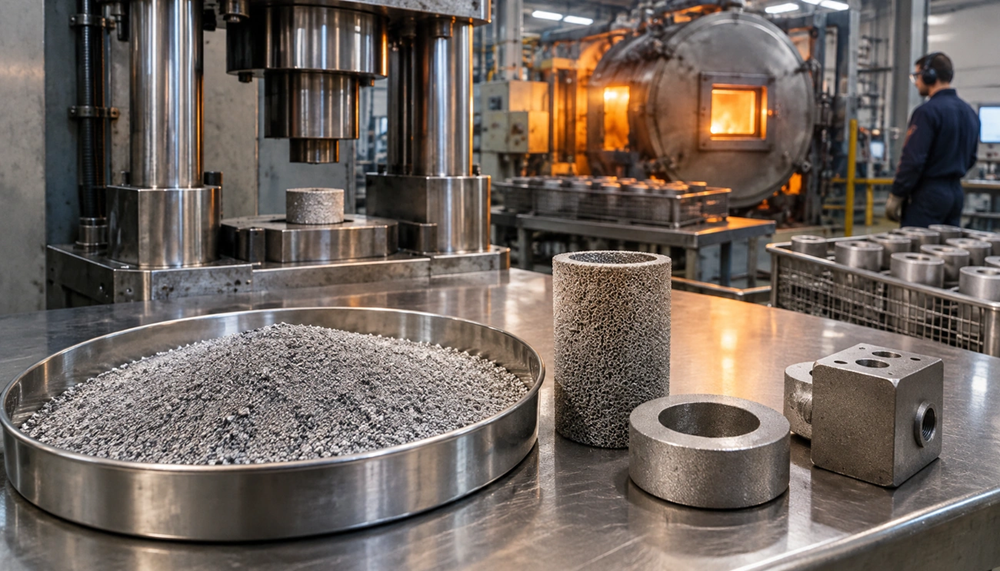
Sintered nickel transforms fine nickel powders into durable, high-performance components without requiring complete melting of the bulk material. The mechanical, chemical, and electrical performance of sintered components depends heavily on powder morphology, target density, interconnected porosity, furnace sintering conditions, and precise alloy selection.
This comprehensive guide examines sintered nickel’s core material properties—including mechanical strength, wear resistance, chemical durability, thermal/electrical conductivity, and magnetic behavior. It outlines the powder metallurgy manufacturing journey from initial compaction and controlled-atmosphere furnace processing to final finishing. Furthermore, it details key industrial applications, production limits, safety protocols for handling nickel powder, and best practices for selecting an experienced custom sintered nickel manufacturer.
What Is Sintered Nickel?
Sintered nickel is an engineering material produced when compacted nickel or nickel-alloy particles form metallurgical bonds under controlled thermal processing. The finished component can be engineered as a permeable porous structure (such as filters, wicks, and battery electrode supports) or a high-density structural component, depending entirely on the compaction pressure, powder characteristics, and sintering cycle.
How Nickel Powder Bonds Without Fully Melting
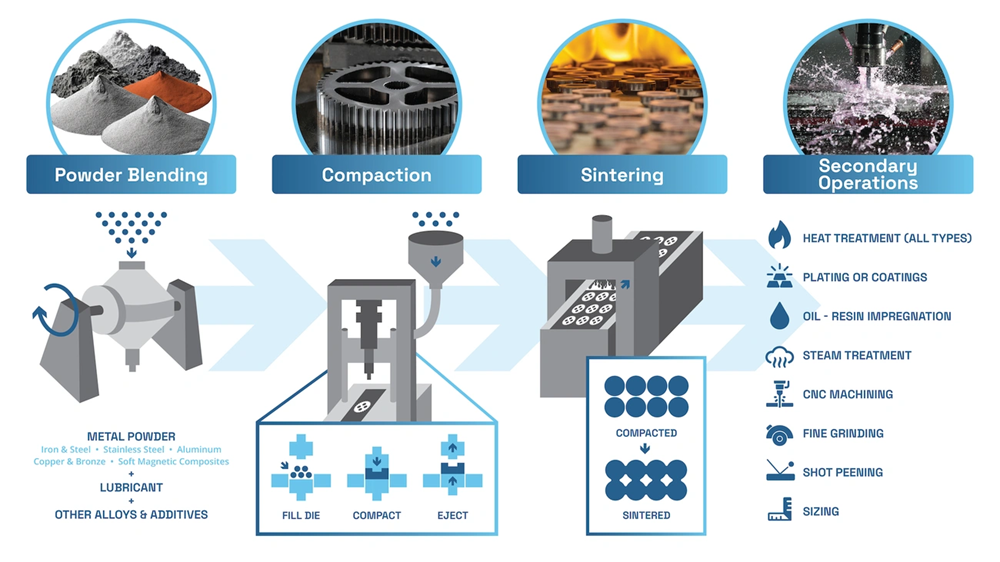
Production begins with pure or pre-alloyed nickel powders loaded into precision tooling. Compaction applies uniaxial or isostatic pressure (typically 200 to 1,500 MPa) to force particles into intimate mechanical contact. Lubricants are often blended in small amounts (under 1 wt%) to minimize die friction. The resulting compact is known as a green part, possessing sufficient handling strength despite a lack of strong atomic bonding.
The green part is then heated in a controlled furnace environment at temperatures ranging from 750°C to 1,300°C—strictly below nickel’s melting point (1,455°C). Solid-state atomic diffusion drives the process:
- Neck Formation: Initial atomic bonding creates small “necks” at particle contact points.
- Intermediate Sintering: Surface and volume diffusion enlarge these necks, round out pore structures, and initiate bulk component shrinkage.
- Final Densification: Interconnected pores gradually close into isolated voids, while grain growth stabilizes the microstructure.
Atmosphere control (using vacuum, dissociated ammonia, hydrogen, or hydrogen-nitrogen mixtures) is essential to prevent high-temperature oxidation and ensure clean metallurgical bonding.
Pure Sintered Nickel vs. Sintered Nickel Alloy Components
- Pure Sintered Nickel: Utilizes high-purity nickel powder (up to 99.8% purity) to deliver excellent electrical/thermal conductivity, corrosion resistance in caustic environments, and tailored porous permeability.
- Sintered Nickel Alloy Components: Blends nickel with chromium, copper, molybdenum, iron, or titanium. For instance, Monel (nickel-copper) alloys offer superior marine corrosion resistance, while nickel-molybdenum grades resist aggressive reducing acids like hydrochloric and sulfuric acid.
Sintered Nickel Properties and Their Effect on Performance
Sintered Nickel Density and Residual Porosity
Absolute solid nickel density is 8.91 g/cm³. Conventionally sintered compacts typically exhibit 6% to 37% residual porosity. While structural parts demand high density for load-bearing capacity, filtration and diffusion components rely on interconnected pores to ensure fluid permeability.
Strength, Ductility, and Wear Resistance
Tensile and yield strengths scale directly with sintered density as effective load-bearing area increases and stress-concentrating pores diminish:
- Tensile Strength: Increases dramatically from ~207 MPa to 966 MPa as interconnected porosity drops from 40% down to 3%.
- Yield Strength: Rises from 138 MPa to 724 MPa across the same density spectrum.
- Ductility: Elongation improves sharply once porosity falls below 5%–15%. Alloy hardening and heat treatment further enhance wear and compressive strength.
Sintered Nickel Corrosion Resistance in Different Environments
Pure sintered nickel forms a protective passive film in caustic and alkaline solutions. Alloyed variants provide targeted chemical resistance: copper additions protect against seawater and salt spray, molybdenum excels in reducing acids, and chromium-bearing nickel alloys withstand severe oxidizing and high-temperature environments.
Thermal Conductivity, Electrical Conductivity, and Magnetism
Pores act as thermal and electrical barriers, lowering bulk conductivity relative to solid wrought nickel. Magnetic performance (such as saturation induction and permeability) also scales with density and pore morphology in nickel-iron powder metallurgy parts.
How Nickel Powder Becomes a Sintered Part
Carbonyl, Atomized, and Reduced Nickel Powders
- Carbonyl Nickel Powder: Produced via thermal decomposition of nickel carbonyl [Ni(CO)₄], offering exceptional purity (>99.9%) and flexible particle morphologies (spherical, dendritic, or filamentary).
- Atomized Powder: Formed by molten metal stream disintegration, providing excellent flowability and packing density for pressing.
- Reduced Powder: Derived from chemical solution reduction, customized for specific porous structures.
Powder Blending, Compaction, and Green Part Formation
Powders are blended with lubricants and compacted in rigid dies at 200–1,500 MPa. The resulting green part requires uniform density distribution to prevent warping or cracking during subsequent furnace shrinkage.
Sintering Temperature, Holding Time, and Furnace Atmosphere
Parts are sintered in continuous or batch furnaces between 1,000°C and 1,300°C under protective reducing atmospheres (hydrogen, dissociated ammonia, or vacuum) to eliminate oxides and promote atomic diffusion.
Sizing, Heat Treatment, and Surface Finishing
Post-sintering operations include coining/sizing for tight dimensional control, heat treatments (annealing, hardening) for mechanical tuning, and surface finishing such as electropolishing, passivation, or plating.
Industrial Applications of Sintered Nickel
Porous Filters and Gas Diffusers
Sintered nickel porous elements achieve up to 99.999% removal efficiency for 0.3-micrometer particles. They are widely used in chemical processing, petrochemical skid filters, and micro-bubble gas diffusers capable of withstanding aggressive thermal sterilization and backflushing.
Porous Nickel Supports for Battery Electrodes
Utilized extensively in nickel-metal hydride, nickel-cadmium, and advanced battery/supercapacitor systems. High-porosity sintered nickel foam structures (reaching up to 97% porosity with ~0.25 mm pore size) maximize active material contact and electronic conductivity.
Catalyst Supports for Chemical Processing
Permeable sintered nickel structures serve as catalyst carriers for hydrocarbon steam reforming (operating up to 900°C and 20–40 bar) and industrial hydrogenation reactions, offering high thermal stability and low pressure drop.
Powder Metallurgy Nickel Parts for Electrical and Magnetic Uses
Leveraging high permeability and low coercive force, nickel-iron powder metallurgy parts are engineered into electromagnetic shielding, high-efficiency sensor cores, and specialized motor stators.
Nickel Alloy Components for Heat and Corrosion Exposure
Deployed in marine valves, heat exchangers, and furnace hardware where superior resistance to sulfidation, chloride stress corrosion cracking, and high-temperature oxidation is required.
Limits and Safety Risks of Sintered Nickel Production
Shrinkage, Open Pores, and Dimensional Limits
Furnace sintering causes significant volumetric contraction (often anisotropic based on green density gradients). Tooling must incorporate precise dimensional compensation. Balancing density with open porosity requires rigorous process control to prevent structural collapse or under-densification.
Nickel Powder Exposure, Dust Control, and Fire Risks
Fine nickel powder poses inhalation and sensitization risks. OSHA enforces an 8-hour PEL of 1 mg/m³, while NIOSH recommends 0.015 mg/m³. Facilities must utilize sealed processing, local exhaust ventilation, and HEPA vacuum cleaning systems. Because airborne nickel dust is combustible and sensitive to static ignition, operations require grounded explosion-proof equipment and Class D fire safety protocols.
Choosing a Sintered Nickel Manufacturer
Specifying Custom Sintered Nickel Parts
OEM engineering teams should clearly define powder grade, target sintered density, permeability specs, dimensional tolerances, and operational environments (temperature, chemical exposure). Partner with a supplier offering complete design-for-manufacturing (DFM) support.
Checking Material Certificates and Sample Part Test Results
Verify lot traceability, chemical mill test reports, density verification, and CMM inspection data. Ensure manufacturing partners maintain ISO 9001, AS9100, or IATF 16949 quality certifications.
Comparing Tooling Costs, Order Volumes, and Lead Times
Evaluate upfront tooling investment against per-part cost targets for high-volume production, with standard prototype lead times typically ranging from 4 to 8 weeks.
Conclusion: Partnering for Custom Sintered Nickel Solutions
Sintered nickel unites controlled porosity, advanced metallurgy, and versatile alloy compositions to solve demanding industrial engineering challenges. From high-efficiency porous filters and battery electrode supports to corrosion-resistant structural components, success depends on meticulous powder selection, thermal management, and safety compliance. Contact JHMIM today to discuss your custom sintered nickel component requirements.
FAQs
Q1. What is sintered nickel, and how is it made?
Sintered nickel is made by shaping nickel powder and heating it below its melting point. The particles bond together without fully melting, forming a porous or denser component.
Q2. How does porosity affect sintered nickel’s performance?
Interconnected pores let gasses and liquids pass through, making the material useful for filters and diffusers. Lower porosity generally improves strength and electrical and thermal conductivity.
Q3. What are the main industrial uses of sintered nickel?
Common uses include porous filters, gas diffusers, battery electrode supports, catalyst supports, and electrical and magnetic components. Nickel alloy versions also serve in hot or corrosive environments.
Q4. Is sintered nickel resistant to corrosion?
Yes, but its resistance depends on the nickel grade, porosity, and operating conditions. Pure nickel resists caustic solutions, while selected alloys offer better protection against seawater, acids, or oxidation.
Q5. What safety precautions are needed when handling nickel powder?
Use enclosed handling, local exhaust ventilation, suitable protective equipment, and HEPA-filtered vacuum cleaning. Fine nickel powder presents inhalation and fire hazards, so dust buildup and ignition sources must be controlled.