
OEM Custom MIM Angle Grinder Gears | Precision Sintered Bevel Gear Sets
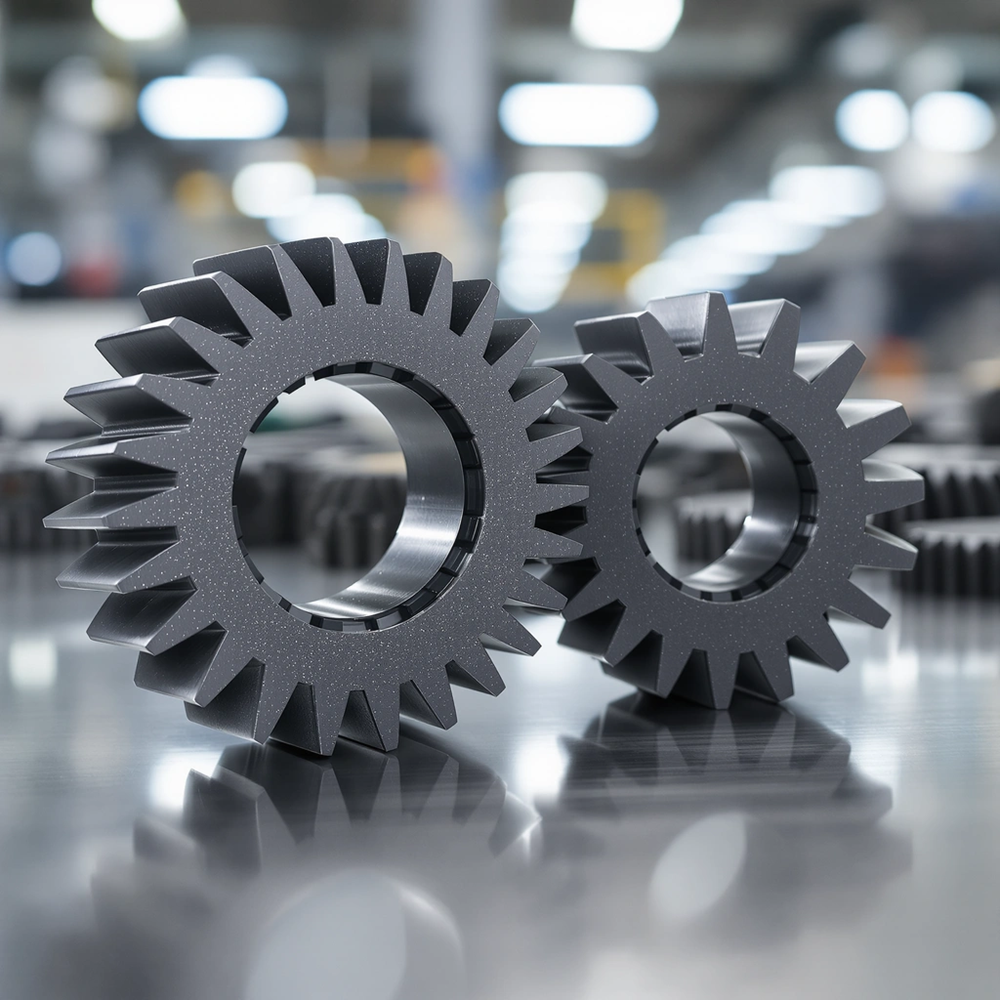
Angle grinder bevel gear sets serve as primary power transmission components in high-RPM, high-load power tools. Driving an angle grinder requires transmitting continuous torque across 90-degree intersecting shafts under intense shock loads and vibration. Traditional CNC hobbing or tooth milling often involves heavy material waste, long production cycles, and high cost constraints. Advanced Metal Injection Molding (MIM) and high-density powder metallurgy (PM) technologies overcome these barriers, producing net-shape sintered bevel gears engineered for superior wear resistance, precision mesh, and quiet operation.
MIM and Powder Metallurgy Process for Angle Grinder Gears
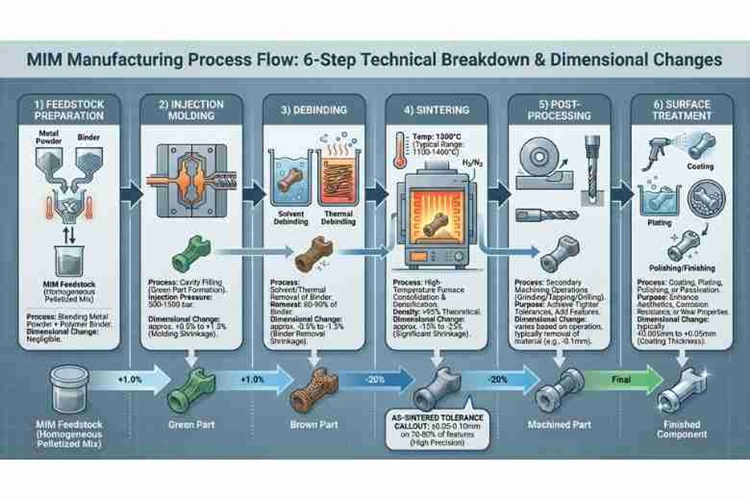
Manufacturing precision angle grinder gears relies on two primary powder metallurgy routes: Metal Injection Molding (MIM) for ultra-complex, high-torque small pinions, and conventional press-and-sinter compaction for larger ring gears. Both routes transform fine alloy powders into high-strength gear sets but differ significantly in particle size, molding kinematics, and achievable density.
Metal Injection Molding (MIM) Manufacturing Steps
MIM begins by combining ultra-fine metal powders (<20 µm) with custom thermoplastic polymer binder systems to create homogeneous feedstock pellets. The feedstock is heated and injected under high pressure into multi-cavity precision molds, forming “green parts” with 16–20% volumetric scale allowance for sintering shrinkage.
Solvent, water-bath, or catalytic debinding removes the primary polymer matrix, yielding a porous “brown part.” Subsequent vacuum sintering at 1,350°C to 1,400°C fuses the powder particles into solid metal, achieving 96%–99% of theoretical density with isotropic mechanical properties.
Conventional Powder Metallurgy Compaction Process
The press-and-sinter route uses coarser powders (50–100 µm) compacted in rigid tool-steel dies under 400 to 800 MPa axial pressure. Unlike MIM, press-and-sinter uses minimal organic lubricants rather than binder matrices. Mechanical particle interlocking produces a “green compact,” which is then sintered in atmosphere mesh-belt furnaces to achieve up to 95%–97% density. This process is highly cost-effective for flat, axisymmetrical ring bevel gears.
Sintering Temperature Control: 1,120°C to 1,400°C
Thermal processing parameters are carefully tailored to the alloy composition. Standard iron-copper-carbon alloys sinter at 1,120°C, while high-strength low-alloy steels (such as MIM-4605 or MIM-8620) require high-temperature vacuum sintering at 1,260°C to 1,380°C. Controlled vacuum or endothermic furnace atmospheres prevent surface oxidation and preserve exact carbon content for heat treatment responsiveness.
Final Density Achievement: Up to 99%
Density directly correlates with bending fatigue strength and gear tooth impact resistance. Conventional PM achieves 88%–95% density (suitable for lower-speed driven gears), whereas vacuum-sintered MIM components reach 96%–99% solid density. Near-full density closes internal pores, providing fatigue resistance comparable to wrought or forged steel under heavy shock loading.
Bevel Gear Types for Angle Grinder Applications
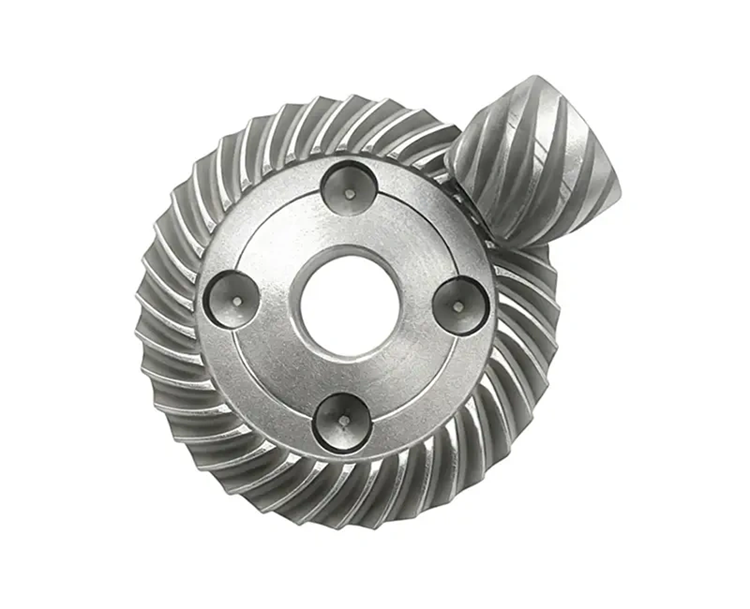
Angle grinder transmissions require bevel gear sets to redirect motor output through a 90-degree axis within extremely compact gear housings. Gear configurations are selected based on operating speed, torque loads, and noise emission requirements.
Spiral Bevel Gear Sets for High-Speed Rotation
High-performance angle grinders operating at motor speeds from 10,000 to 30,000 RPM utilize spiral bevel gears featuring curved teeth with 35-degree spiral angles. The curved profile allows continuous, overlapping tooth engagement—contact begins at one tooth tip and rolls smoothly across the face. This progressive meshing reduces impact stress, smooths high-speed torque delivery, and reduces transmission gear noise by up to 16 dB compared to straight bevel designs.
Straight Bevel Gears for Standard Power Tools
Straight bevel gears feature straight teeth converging toward the pitch cone apex. While simpler to produce via press-and-sinter PM, straight tooth engagement occurs along an entire line simultaneously, generating higher acoustic noise and vibration at pitch-line speeds above 5 m/s. They remain an economical choice for entry-level or low-speed utility tools.
Material Selection: MIM-4605, MIM-8620 & High-Strength Alloy Steels
High-torque angle grinder pinions demand superior case hardness and core toughness. JHMIM utilizes specialized alloy compositions:
- MIM-4605 (Ni-Mo Low-Alloy Steel): Delivers exceptional fatigue resistance and hardens to HRC 58–62 after carburizing heat treatment.
- MIM-8620 & 17-4PH: Provide high tensile strength (up to 1,200 MPa) and impact durability for heavy industrial grinding applications.
- Fe-Cu-C Alloys (FN-0205): Ideal for large, cost-sensitive driven ring gears where steady-state strength is paramount.
Tooth Profile Precision and Tolerances
Net-shape MIM processing produces precise tooth geometries matching AGMA Class 8 to Class 10 standards directly from sintering. Critical bores, keyways, and mounting faces can be held to ±0.01 mm through secondary sizing, honing, or grinding operations.
Custom OEM Manufacturing Capabilities
JHMIM partners with global power tool OEM engineers to transform complex gear geometries into mass-producible powder metallurgy components through structured Design for Manufacturability (DFM) reviews.
Design Adaptation for PM & MIM Production
Our engineering team evaluates CAD models for wall thickness uniformity, draft angles, root radius optimization, and tooling clearance. Mold flow simulation anticipates feedstock flow, preventing weld lines or density variations in high-stress gear tooth roots.
Tooling Development for Complex Geometries
Production molds utilize high-grade tool steels (H13, S7) processed via high-speed CNC milling and precision Wire EDM to form intricate spiral tooth cavities, internal splines, and weight-reduction recesses.
Volume Production from Prototype to Mass Scale
Rapid prototyping tools provide early-stage functional samples in 3 to 4 weeks. Upon prototype approval, automated multi-cavity MIM tooling scales seamlessly to monthly production volumes exceeding hundreds of thousands of gear sets.
Quality Control: Dimensional and Hardness Testing
Quality assurance includes ISO 9001:2015 / IATF 16949 compliant protocols. Every batch undergoes CMM 3D gear profile inspection, Rockwell surface hardness testing, metallurgical density measurement, and dynamic backlash testing.
Performance Advantages of Sintered Angle Grinder Gears
Cost Reduction: Up to 40% Material Savings vs. Machining
Powder metallurgy achieves over 95% raw material utilization. Traditional multi-axis CNC gear cutting wastes up to 50% of alloy steel stock in turnings and chips, giving MIM a decisive cost advantage in high-volume OEM manufacturing.
Net-Shape Manufacturing Without Tooth Hobbing
Net-shape molding produces completed spiral bevel profiles directly out of the sintering furnace. This eliminates costly multi-pass gear hobbing, shaping, and external deburring steps.
Noise Damping Through Precision Tooth Engagement
Near-full density MIM gears ensure consistent pitch line runout and smooth tooth profile engagement, minimizing gear mesh rattle, harmonic vibration, and acoustic noise in hand-held electric tools.
Heat Treatment Options for Load Capacity
Post-sintering heat treatments—including vacuum carburizing, carbonitriding, and induction hardening—create a wear-resistant outer case (HRC 58–62) supported by a tough, impact-absorbing core structure.
Exceptional Repeatability Across Batch Production
MIM process controls ensure tighter batch-to-batch dimensional consistency (IT8–IT9) than conventional casting or manual machining, ensuring seamless automated assembly on OEM power tool lines.
Partner with JHMIM for Custom Angle Grinder Gears (Free DFM Analysis)
Developing robust power tool transmissions requires dependable engineering support. JHMIM provides free DFM analysis and rapid quotation based on your 3D CAD drawings. Our technical team works directly with your engineers to optimize tooth geometry, select the ideal alloy material, and lower unit costs.
Conclusion
Metal Injection Molding and powder metallurgy deliver unmatched design freedom, high strength, and cost savings for OEM angle grinder gear manufacturing. By combining 98% density with precision heat treatment, MIM gear sets meet the rigorous durability standards of modern industrial power tools. Contact JHMIM today for a free DFM review and fast quote on your custom gear project.
MIM forms complex 3D spiral tooth geometries and integrated shaft keyways in a single injection step, saving up to 40% in manufacturing costs by eliminating multi-pass CNC tooth hobbing and raw material scrap.
Through secondary carburizing or case-hardening heat treatment, MIM-4605 and MIM-8620 alloy gears achieve surface hardness levels of HRC 58 to 62 with a ductile core for maximum fatigue resistance.
MIM processes achieve 96% to 99% of theoretical density under high-temperature vacuum sintering, providing fatigue and impact performance comparable to wrought or forged alloy steel.
MIM delivers precise tooth profile geometry (AGMA Class 8–10) and smooth tooth curvature, ensuring ideal mesh contact that eliminates acoustic vibration and gear whine at speeds up to 30,000 RPM.
Initial DFM analysis and quotes are delivered within 24 to 48 hours. Custom prototype tooling and sample production take approximately 3 to 4 weeks, with fast-track volume production following sample approval.