
A sintered abs tone ring serves as a critical component in automotive anti-lock braking systems. It generates magnetic pulses that enable wheel speed sensors to prevent brake lockup during emergency stops. The tone ring sensor relies on teeth spaced precisely to produce accurate signals. The purpose of the ABS tone ring centers on live wheel rotation monitoring. Powder metallurgy automotive parts, especially tone wheel sensor rings, must meet abs tone ring tolerances of ±0.02mm to ensure reliable performance. Powder metallurgy processes can achieve dimensional precision ranging from ±0.05 mm to ±0.10 mm and maintain signal amplitudes exceeding 0.5V. This piece explores design specifications and manufacturing processes for producing high-precision sintered reluctor rings.
Understanding Sintered ABS Tone Ring Components
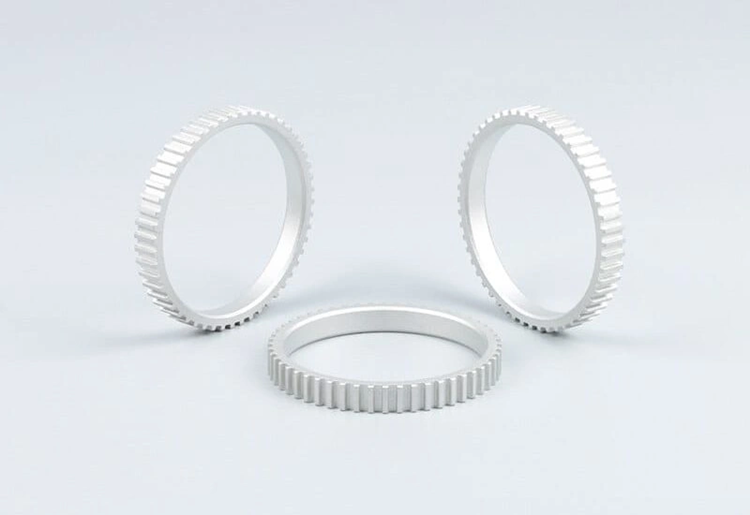
What is a Tone Ring (Reluctor Ring) in Automotive ABS Systems?
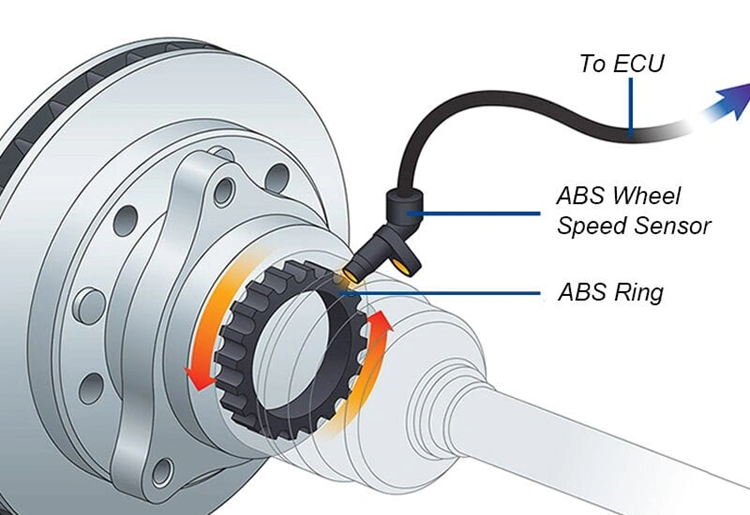
The tone ring sensor consists of a ferrous metal ring with teeth or notches machined around its circumference. This passive component mounts on brake rotors, wheel hubs or axle shafts and rotates with the wheel. It generates no electricity on its own. Teeth pass by a stationary inductive sensor positioned millimeters away as the tone wheel sensor spins. This creates the tooth-and-gap pattern that makes wheel rotation detection possible.
Electromagnetic induction is what makes it work. A permanent magnet surrounded by wire windings sits within the stationary sensor coil. The magnetic field alternates between stronger states when teeth pass and weaker states during gaps. This induces a small alternating voltage in the coil windings. Signal frequency increases with wheel speed since faster rotation causes more teeth to pass the sensor per second. The ABS module converts this frequency into wheel speed data and compares signals from all four wheels to detect impending lockup conditions.
Air gap precision between sensor and ring affects signal quality. The gap must remain within 0.016 to 0.050 inches (0.40 to 1.3 mm) during operation. Gaps that are too wide produce weak or absent signals. Narrow gaps risk physical damage. Dimensional stability throughout the component’s service life determines ABS system reliability.
Why Powder Metallurgy (PM) Is Ideal for ABS Sensor Parts
Powder metallurgy automotive parts hit tight tolerances of ±0.02mm after sizing. This precision keeps performance consistent across vehicle lifespan. Net-shape production capabilities cut down on material waste. Powder metallurgy automotive parts utilize over 97% of starting raw material in finished components. Material utilization exceeds 95% in typical applications.
Optimal magnetic properties come from F-0000 iron-based powder compositions at 96-98% with copper additions of 1.5-2.0%. Controlled porosity of 5-8% boosts magnetic field characteristics. Sintered components deliver radial tensile strength over 300 MPa and provide sufficient durability for high-speed wheel rotation demands.
Sintered vs. Machined Reluctor Rings: Cost, Precision, and Performance Comparison
Sintered reluctor rings generate scrap rates as low as 3%. Machining operations produce up to 50% material waste. The additive nature of powder metallurgy builds parts from ground up and makes geometrically complex designs possible that conventional machining cannot achieve. Sintered components offer superior cost-effectiveness for high-volume production due to reduced material waste and energy consumption. This totals about 43% of forging or machining energy requirements.
Sintered gears demonstrate greater hardness and durability than machined alternatives. CNC machining gives better dimensional precision on a part-to-part basis, but powder metallurgy delivers reliable repeatability for large orders. Manufacturing time favors sintering for substantial production volumes since tooling represents a one-time investment applicable throughout production runs.
ABS Tone Ring Design Specifications and Material Selection
Ferromagnetic Material Requirements: 400 Series Stainless Steel & Iron-Nickel Alloys
Material selection determines signal generation capability in abs reluctor ring design. The 400 series stainless steel provides ferromagnetic properties compatible with variable reluctance sensors. Iron composition creates magnetic characteristics absent in 300 series austenitic grades. FC-0000 iron-based powder at 96-98% purity with 1.5-2.0% copper additions delivers adequate permeability for consistent signal generation. Iron-nickel alloys containing 40-50% nickel offer improved magnetic permeability, with saturation polarization reaching 1.3 T to 1.55 T. These soft magnetic alloys maintain coercivity between 2 A/m and 8 A/m. This makes them suitable for sensor applications that require high sensitivity.
Tooth Count, Ring Diameter, and Pitch Geometry
Tooth count specifications range from 50 to 80 teeth depending on application requirements. Ring diameter of 3.5 inches (88.9 mm) represents a common configuration for custom abs tone ring manufacturer applications. Consistent pole pitch maintains uniform tooth-to-slot ratio across the circumference. Non-uniform tooth spacing creates sinusoidal irregularities that trigger false ABS activation events.
Tooth Profile and Slot Width/Depth Tolerances (±0.05–0.10 mm)
Powder metallurgy automotive parts achieve dimensional tolerances of ±0.05 mm to ±0.10 mm. Slot width measures 0.125 inches with depth at 0.100 inches (2.54 mm) for standard designs. Sintered abs tone ring components maintain tolerances of ±0.02mm after sizing operations. Surface runout specifications require less than 0.1 mm TIR (Total Indicator Reading).
Press-Fit Interface, Runout Control, and Shaft Mounting Design
Press-fit installation secures tone rings to differential carriers or axle shafts. The sensor-to-ring air gap must remain at 0.027-0.030 inches during operation. Runout control prevents wobble effects that compromise signal accuracy. Circular runout tolerances ensure all surface points lie within the specified tolerance zone relative to the datum axis.
Powder Metallurgy Manufacturing Process for ABS Tone Rings
Precision Powder Compaction and Tooling Setup
Compaction tooling consists of upper and lower punches, die cavity, and core rods designed for each custom abs tone ring manufacturer specification. Hydraulic presses apply pressures between 400-800 MPa to densify metal powder into green compacts. This stage produces parts with dimensional control approaching 0.001 mm tolerances through tungsten carbide tooling. The green compact holds shape through particle contact points and lubricant bonding before sintering.
Sintering Parameters: Temperature, Atmosphere, and Density Control
Sintering furnaces heat iron-based powder metallurgy automotive parts to temperatures between 1120°C and 1300°C for 15-60 minutes. Nitrogen-hydrogen atmospheres with dew points below -30°F prevent oxidation while maintaining carbon neutrality. Temperature reaches 60-70% of the base metal melting point to initiate atomic diffusion at particle boundaries. Controlled atmosphere furnaces regulate oxide reduction and densification.
Surface Treatment: Steam Oxidation and Corrosion Resistance Coating
Steam treatment heats sintered reluctor ring components at 510-570°C to form magnetite (Fe3O4) surface layers. The oxide develops a hardness of HRC 50 while sealing surface porosity. Parts reach 1000°F in dry steam for 30-60 minutes based on application needs.
Secondary Operations: Sizing, Coining, and Machining
Sizing represses sintered parts to improve ABS tone ring tolerances by up to 50%. Machining adds features perpendicular to the pressing direction through drilling, turning, or milling operations.
Quality Control, Magnetic Testing, and Signal Verification
Tooth Spacing Uniformity and Pitch Error Inspection
Visual inspection identifies damaged, cracked, or bent teeth that compromise sensor readings. The teeth edges must maintain consistent appearance in all positions. Uniform tooth patterns prevent false ABS activation events. Missing pulse patterns trigger erroneous wheel slip conditions. Non-uniform tooth spacing creates sinusoidal irregularities that the ABS controller misinterprets as braking anomalies.
Magnetic Flux Pattern and Air Gap Performance Testing
Feeler gages verify spacing at four different positions on the tone wheel sensor. The acceptable range spans 0.005-0.050 inches (0.127-1.27 mm). Excessive gaps reduce signal amplitude. Insufficient clearance risks sensor damage from physical contact during wheel rotation.
Sensor Signal Validation: Peak Voltage & AC Waveform Output (0.5V Min)
Wheels must be spun by hand while measuring AC voltage output. Front wheel sensors should produce 0.5V when rotated manually. Systems that function properly generate 1.0-1.5V peak-to-peak. Oscilloscope analysis reveals sine wave patterns where consistent amplitude confirms uniform abs tone ring magnetic properties.
Degaussing / Demagnetization Standards Post-Inspection
Automotive standards limit residual magnetism to 2-6 Gauss in gear components and dual-mass flywheels. Residual magnetization occurs in 400 stainless steel during machining operations. Degaussing becomes necessary when sensors produce erratic output.
Press-Fit Retention and Torque-Out Verification
Press-fit integrity testing occurs before and after secondary machining operations. Retention force measurements ensure the sintered reluctor ring maintains secure mounting throughout service life.
Conclusion & Custom ABS Tone Ring Engineering Assistance
Powder metallurgy delivers affordable production of ABS tone rings with precision, achieving tolerances of ±0.02mm through controlled sintering and sizing operations. The manufacturing process combines precise tooth geometry and rigorous quality testing to ensure reliable sensor signal generation. Proper air gap control and magnetic flux patterns are critical for consistent wheel speed detection. Sintered reluctor rings provide automotive manufacturers with durable, high-performance components that improve vehicle safety systems while minimizing production costs and material waste.
FAQs
Q1. What is the purpose of an ABS tone ring in a vehicle’s braking system? An ABS tone ring is a critical component that generates magnetic pulses to enable wheel speed sensors to monitor real-time wheel rotation. As the ring rotates with the wheel, its precisely spaced teeth pass by a stationary sensor, creating alternating magnetic fields that produce electrical signals. The ABS module uses these signals to detect wheel speed and prevent brake lockup during emergency stops, enhancing vehicle safety.
Q2. Why is powder metallurgy preferred for manufacturing ABS tone rings? Powder metallurgy offers exceptional dimensional precision with tolerances of ±0.02mm after sizing, while utilizing over 97% of raw materials with minimal waste. The process produces net-shape components with optimal magnetic properties through controlled porosity and material composition. Additionally, it consumes approximately 43% less energy compared to forging or machining, making it highly cost-effective for high-volume production while maintaining consistent quality.
Q3. What materials are commonly used for ABS tone rings? ABS tone rings typically use ferromagnetic materials such as 400 series stainless steel or iron-nickel alloys. The most common composition is FC-0000 iron-based powder at 96-98% purity with 1.5-2.0% copper additions, which provides adequate magnetic permeability for reliable signal generation. Iron-nickel alloys containing 40-50% nickel offer enhanced magnetic properties with saturation polarization reaching 1.3 T to 1.55 T for applications requiring higher sensitivity.
Q4. What are the critical tolerance requirements for ABS tone ring manufacturing? ABS tone rings must maintain dimensional tolerances between ±0.05 mm to ±0.10 mm for tooth profiles and slot dimensions. After sizing operations, sintered components achieve even tighter tolerances of ±0.02mm. Surface runout must remain below 0.1 mm TIR (Total Indicator Reading), and the air gap between sensor and ring must stay within 0.016 to 0.050 inches (0.40 to 1.3 mm) to ensure proper signal generation and system reliability.
Q5. How is the quality of an ABS tone ring verified during testing? Quality verification includes multiple tests: visual inspection for damaged or bent teeth, air gap measurements at four positions (acceptable range 0.005-0.050 inches), and sensor signal validation where output voltage must exceed 0.5V minimum when wheels are rotated manually. Oscilloscope analysis confirms uniform sine wave patterns across all teeth, while press-fit retention testing ensures secure mounting. Residual magnetism is also checked and limited to 2-6 Gauss per automotive standards.