
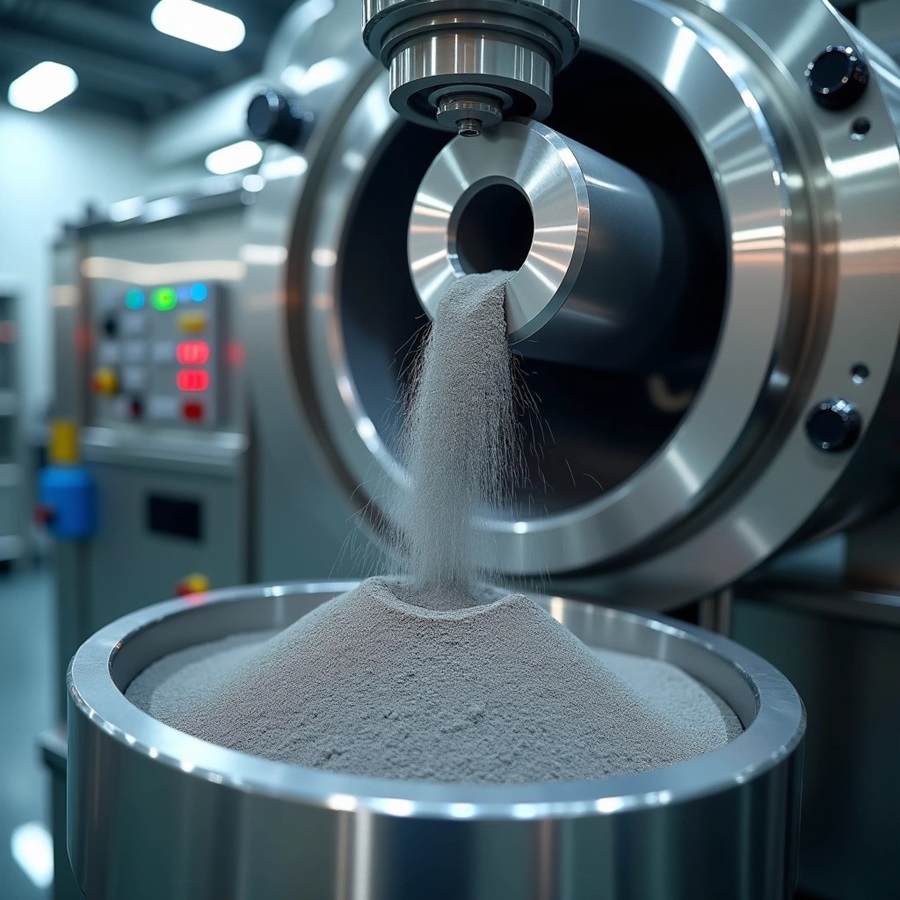
Solid blending in powder metallurgy is where component quality gets secured or compromised. A poorly blended powder batch then produces parts with inconsistent hardness, premature wear and dimensional variations that devastate scrap rates. Proper mixing of powder is vital for providing a uniform blend of materials for subsequent process stages and remains central for achieving final part consistency. Powder metallurgy would be limited to producing with one material at a time without this step that combines materials to create new alloys. This complete guide gets into the differences between solid powder blending and liquid mixing. It explores industrial blending methods from V-blenders to high-energy planetary mixers and details the process parameters that ensure uniform distribution of base metal powders and alloying elements throughout every batch.
Fundamentals of Solid Blending vs. Liquid Mixing in Powder Metallurgy
Microstructural Definition and Core Purpose of Solid-State Blending
Particles of the same chemistry but with different characteristics intermingle during blending. Mixing combines dissimilar material compositions. Powder metallurgy blending serves three distinct functions: achieving uniform particle size distribution, incorporating lubricants and binders to improve powder fluidity and reduce die friction, and integrating alloying elements to boost mechanical properties. Quality-controlled blending will give material homogeneity, improved sintering behavior, and increased mechanical properties like hardness, wear resistance and corrosion resistance.
Fluid Dynamics: Why Solid Powder Behavior Is Different from Liquid Mixing
Solid powder systems exhibit mechanics that are different from liquid mixing processes. Interparticle forces such as van der Waals, capillary forces, and electrostatic forces determine powder flow behavior. Van der Waals forces begin to overcome gravity and dominate powder behavior for particles below 100 micrometers. Powders become cohesive when attractive forces exceed particle weight by at least one order of magnitude. Particles no longer flow individually but as aggregates. Spherical particles slide over each other and blend with ease. Irregular or angular particles tend to lock together, disrupting smooth mixing but creating stronger bonds in the final product.
Managing the Triad: Base Metal Powders, Micro-Alloying Elements, and Solid Lubricants
Base metal powders are the foundations and include iron, copper, aluminum, tungsten and stainless steel. Alloying elements such as nickel, chromium, molybdenum and manganese improve corrosion resistance and mechanical strength. Manufacturers add these elements to molten metal during powder production and atomize them as prealloyed powders. Lubricants reduce friction between particles. Metal powders in press-and-sinter methods receive up to 1.5 weight percent addition. Zinc stearate provides good lubrication for iron-based structural parts. Acrawax offers complete removal during pre-sintering without residue.
Solid Blending Methods: Selecting the Right Mixer for Complex Geometries
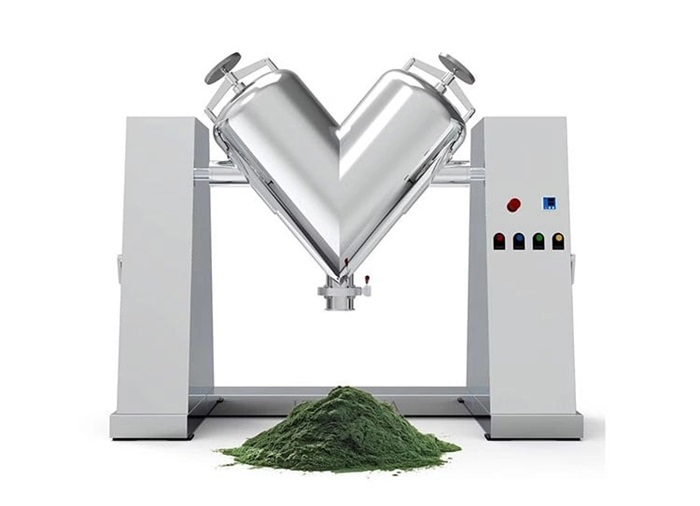
Equipment selection determines whether powder blends achieve the uniformity just needed by precision sintering operations. Different mixer geometries address distinct particle size ranges, flow characteristics, and production volumes.
V-Blender & Double Cone Mixers: Optimizing Gentle Tumbling Action for Coarse Powders
Double cone mixers use two conical ends connected by a cylindrical section. This design creates efficient material cascading through gravity-driven tumbling. The conical geometry proves effective for free-flowing powders and materials with disparate particle sizes. It provides both axial and radial movement. These systems operate at low rotational speeds. Gravitational forces separate and reunify powder samples inside the slowly rotating vessel. V-blenders generate a similar gentle tumbling motion but may face challenges with cohesive materials. Double cone designs handle materials prone to agglomeration more effectively.
Ribbon Blenders: High-Volume Production and Mechanical Shearing Dynamics
Ribbon mixers produce improved homogeneity when blending particles of different sizes because of the large shearing forces these systems provide. The folding action enables uniform blends in short timeframes. Many formulations achieve complete mixing in 15 minutes or less. Their U-shaped horizontal trough houses helical ribbons pitched to move material axially in opposing directions while moving radially at the same time. This promotes fast and thorough blending. Ribbon blenders that are well-designed easily last 20 to 30 years and beyond under normal conditions.
High-Energy Planetary Mixers: De-agglomerating Fine Powders for Advanced MIM Applications
Double planetary mixers employ two rotors in planetary motion with uniform, fast, and accurate heating. MIM industrial production uses these systems for original high-precision mixing of binders and metal powders. They are optimized for cost and throughput. Getting a uniform mixture with a double planetary mixer becomes difficult for sub-micron fine powders.
Three-Dimensional Tumbler Mixers: Achieving Total Homogeneity for Ultra-Fine Particles
Three-dimensional mixers achieve uniform blending through rotation in multiple axes at the same time. The entire batch reorients in space. This multi-axis movement eliminates fixed tumble patterns and reduces segregation caused by density or size differences. Studies demonstrate that increases in mixing speed from 10 to 30 rpm, mixing time from 5 to 25 minutes, and mixing volume from 20 to 120 liters do not affect blend homogeneity by a lot.
Critical Blending Process Parameters and Rheological Testing
Precision Proportioning and Multi-Stage Ingredient Charging Sequences
Progressive dosing introduces materials in controlled, alternating sequences rather than loading all at once. A formulation requiring 1,000 pounds of base metal and 500 pounds of alloying elements loads 100 pounds of base metal followed by 50 pounds of alloying elements, repeating this cycle over time. Blending begins from the first stage with this method and prevents stratification.
Optimizing Lubricant Dispersion (EBS/Zinc Stearate) to Improve Green Strength
Metal powders used in press-and-sinter methods commonly receive up to 1.5 weight percent of lubricant. Adding this lubricant makes compacting and ejecting of powder compacts easier and directly influences green strength. Zinc stearate functions as both lubricant and dispersing agent. It reduces friction during processing and molding. Fillers distribute evenly throughout the powder matrix.
Controlling Critical Process Windows: Rotational Speed (RPM) and Optimal Blending Time
Double cone blenders need filling between 35 and 55 percent of the blender’s volume for good mixing. The optimum rotation speed establishes conditions whereby centrifugal force remains only a fraction (10^-5 to 10^-1) of gravitational force. Parameters determine mixing time, which varies between 5 and 30 minutes.
High-Performance Industrial Applications of Customized Powder Blends
Precision-blended powder formulations enable performance across demanding industrial sectors where component failure carries catastrophic consequences. Solid blending techniques ensure these custom alloy systems deliver consistent microstructures throughout production batches.
Automotive Componentry: High-Strength Iron-Carbon Alloys for Heavy-Duty Gears
More than 1,000 powder metallurgy parts populate modern automobiles, with sintered components ranging from 13 to 45 kg per vehicle. Iron-based alloys form the backbone of gear applications, where carbon additions increase hardness and strength for moderate load applications. Ferrous powder metallurgy components commanded $5.10 billion in 2025 market valuation, representing 65.4% of total automotive PM share. Sintered components demonstrate 15-25% superior fatigue strength compared to conventionally cast iron due to homogeneous microstructure and absence of large shrinkage porosity defects.
Aerospace Engineering: Homogenizing Titanium Alloy Blends (Ti-6Al-4V) for Fatigue Resistance
Titanium powder consists of spherical particles ranging from 15 to 150 microns depending on application requirements. Ti-6Al-4V represents the most commonly used titanium alloy in aerospace, aircraft, automotive, and biomedical industries. The exceptional strength-to-weight ratio translates directly to final components, enabling engineers to design parts meeting stringent performance requirements while contributing to system efficiency through weight reduction. Selective Laser Melting works optimally with 20-45 μm particles, while Electron Beam Melting employs coarser 45-106 μm powders.
Medical Devices: Biocompatible Cobalt-Chromium and Stainless Steel Powder Synthesis
Cobalt-chromium alloys exhibit tensile strengths of 800-1,200 MPa in annealed conditions, significantly exceeding the 490 MPa of UNS S31673 stainless steel. These compositions typically comprise 50-72 wt.% cobalt and 25-35 wt.% chromium, with chromium content between 13-30 wt.% establishing the passive oxide layer critical for corrosion resistance in physiological environments. MIM-produced 316L stainless steel offers strong balance of corrosion resistance and mechanical integrity, ideal for temporary implants and surgical instruments.
Advanced Electronics: Copper-Based and Refractory Metal Mixtures for High-Conductivity Heat Sinks
Cu-W composites deliver excellent thermophysical properties, combining copper’s high thermal conductivity with tungsten’s low coefficient of thermal expansion. Research achieved thermal conductivity of 210.4 W/(m·K) with W-40 wt%Cu composition at 97.9% relative density. Metal injection molding enables economic mass production of expansion-matched heat sinks, with tungsten-copper 80/20 wt% compositions showing CTE of 8.8 ppm/K and densities exceeding 98% after sintering.
Partner with JHMIM for Custom Powder Metallurgy Formulations
Strict Cross-Contamination Control and Cleanroom-Grade Powder Storage Infrastructures
Many metallic powders present pyrophoric characteristics and pose most important fire hazards during bulk handling. Improper storage leads to non-reusable powders or quality degradation in sintered parts. So advanced powder storage systems maintain O₂ and H₂O levels through inert gas pressure regulation. This protects materials from oxygen and humidity that cause ignition risks or diminish powder quality. These completely leak-tight enclosures feature inflatable gaskets. They ensure minimal inert gas consumption while providing operators with safe handling.
Contaminating one powder alloy with another produces unpredictable compositions and failed builds. Cross-contamination prevention requires containing each alloy in physically separate, clearly marked zones within facilities. Dedicated tools, sieves and containers serve individual material types. Color-coded containers or barcode systems visually and digitally distinguish between powder formulations. Climate-controlled storage maintains humidity below 5% with consistent moderate temperatures, especially when you have reactive materials like titanium.
Submit Your Material Specifications and 3D CAD Files for a Complete DFM and Metallurgy Review
JHMIM operates a state-of-the-art 18,000+ square meter manufacturing facility in China with over 20 years of deep expertise in powder metallurgy and metal injection molding (MIM). We deliver high-density, zero-defect complex metal components globally, backed by 150+ highly skilled technicians and advanced high-tonnage sintering and pressing equipment. We streamline your supply chain by solving tight-tolerance manufacturing challenges under one roof.
Design engineers review drawings, material requirements, tolerance specifications, post-processing needs and production quantities before manufacturing begins. This analysis reduces mold risks and avoids unnecessary secondary machining while improving batch production stability. Material analysis verifies powder chemistry, particle size distribution and physical-mechanical properties. Finished components undergo testing for hardness, impact resistance, tensile strength and density.
FAQs
Q1. What is the main difference between blending and mixing in powder metallurgy? Blending involves intermingling particles of the same chemistry but with different particle characteristics, while mixing combines dissimilar material compositions. In powder metallurgy, blending serves to achieve uniform particle size distribution, incorporate lubricants and binders for improved powder fluidity, and integrate alloying elements to enhance mechanical properties.
Q2. Which blending equipment is best for small batch sizes of metal powders? For small batch sizes of 1-2 kg, V-blenders and double cone mixers are effective options that use gentle tumbling action. Three-dimensional tumbler mixers like the Turbula 3D Shaker Mixer also work well for lab-scale applications, producing very homogeneous mixtures for powder metallurgy applications, though they may face limitations with powder amounts exceeding 1.5 kg.
Q3. How do you prevent segregation after blending metal powders? Segregation occurs when powders have wide differences in particle size distribution or density. To minimize this, use the blended powder as soon as possible after mixing—ideally within a day or two—and avoid significant handling or transport steps. The challenge is that even after thorough blending, materials with disparate properties tend to separate during storage or conveying.
Q4. Should all powder ingredients be added at once or in stages during blending? Progressive dosing, where materials are introduced in controlled, alternating sequences rather than all at once, is recommended for optimal results. For example, if a formulation requires 1,000 pounds of base metal and 500 pounds of alloying elements, loading 100 pounds of base metal followed by 50 pounds of alloying elements in repeated cycles ensures blending begins efficiently from the initial stage and prevents stratification.
Q5. What are the typical mixing times required for powder metallurgy blending? Mixing time varies depending on the blending method and parameters, typically ranging from 5 to 30 minutes. Ribbon blenders can achieve uniform blends in 15 minutes or less for many formulations. For tumbler mixers, studies show that mixing times from 5 to 25 minutes produce consistent homogeneity, with the specific duration depending on powder characteristics and batch size.