
Key Takeaways
Understanding the distinct roles of Fe-Ni and Fe-Si magnetic alloys enables engineers to optimize robotic sensor and actuator performance while managing costs effectively.
• Fe-Ni permalloy excels in precision sensing with permeability up to 30,000, making it ideal for position encoders and tactile feedback systems requiring high sensitivity to weak magnetic fields.
• Fe-Si silicon steel dominates power applications with saturation magnetization reaching 2.0T and superior electrical resistivity, delivering efficient actuation in high-speed electromagnetic valves.
• Metal Injection Molding (MIM) revolutionizes magnetic component manufacturing by producing complex 3D geometries impossible with CNC machining while maintaining 99% material utilization for cost-effective production.
• Frequency determines material selection – Fe-Ni performs best in static to low-frequency applications, while Fe-Si handles high-frequency switching with minimal eddy current losses.
• Thermal stability and EMI shielding capabilities of Fe-Ni alloys (Curie point 460°C, permeability 100,000) make them essential for harsh industrial environments and high-density electronic systems.
The future of magnetic robotics lies in miniaturization for surgical applications, integration with soft robotics, and sustainable manufacturing practices that combine performance optimization with environmental responsibility.
No text was provided to rewrite. Please provide content within the user_text tags for me to humanize.
Soft Magnetic Alloys: The Science of Fe-Ni vs. Fe-Si
Soft magnetic materials split into distinct families based on their compositional foundation and resulting electromagnetic behavior. Fe-Ni and Fe-Si alloys represent two fundamentally different approaches to achieving soft magnetic performance, with each optimized for separate operational domains within robotic systems.
Fe-Ni Alloys (Permalloy): Achieving maximum sensitivity for low-field sensor applications
Fe-Ni alloys, commonly known as permalloys, deliver exceptional magnetic permeability that makes them the preferred choice for precision sensing applications. The Fe21.5Ni78.5 composition stands out with minimized coercivity and peaked magnetic permeability. This specific ratio targets the chemical-ordered low-temperature FCC phase, which possesses superior sensitivity characteristics for detecting minute magnetic field variations.
Permeability values in Fe-Ni systems reach extraordinary levels. Standard Fe-50%Ni permalloy demonstrates maximum permeability rising from 1000 in the as-built state to 5000 after proper heat treatment. Annealing processes decreased the coercivity in these materials from 200 A/m to 100 A/m, though these values remain high compared to materials produced through conventional manufacturing routes. High-nickel compositions, especially those with 80% nickel content, exhibit very high initial permeability and maximum permeability with minimum hysteresis loss. These materials operate well at very low magnetic field strengths, which makes them suitable for miniature transformers and sensing elements where compact size and minimal weight matter.
Specialized processing can further boost the magnetic softness of permalloy films. Recent studies show major improvements in magnetic properties after ion irradiation treatments. Permalloy-based magnetoresistive devices achieve sensitivity exceeding 100 mV/V/kA/m in optimized barber-pole designs for sensor applications. This sensitivity level enables detection of magnetic fields produced by minimal electrical currents, which proves valuable for tactile feedback systems in robotic grippers.
Manufacturing processes affect Fe-Ni alloy performance by a lot. Additive manufacturing of Fe-Ni permalloy produces fine FCC crystallographic structures with elongated grains, though internal stresses accumulate during layer-by-layer deposition. The mode angle of misorientation in as-built samples approaches 0.5°, showing substantial residual stress. Heat treatment protocols modify these characteristics and shift the misorientation angle to about 1° while reducing microhardness from 275 HV to 190 HV.
Fe-Si Alloys (Silicon Steel): Balancing saturation induction and core losses for power efficiency
Silicon steel incorporates silicon content ranging from 0.5% to 6.5% by weight to boost electrical resistivity and suppress eddy current losses. The 3% silicon steel variant, widely used in electrical power transformers and inductors, contains up to 3.2 mass % silicon. This addition increases electrical resistivity by a lot and reduces energy dissipation during alternating current operation at typical frequencies of 50-60 Hz.
Grain-oriented electrical steel undergoes cold rolling processes that align crystallographic structures along the rolling direction. This texturing boosts magnetic properties in the preferred orientation and makes the material suitable for applications where magnetic flux flows mostly in one direction. The manufacturing involves precise control of rolling and annealing stages to achieve optimal grain alignment without compromising mechanical integrity.
Higher silicon content yields additional performance benefits. Fe-6.5%Si alloys offer both high flux density and high electrical resistivity, delivering lower eddy current losses and smaller hysteresis losses compared to conventional 3% silicon grades. These materials approach nearly zero magnetostriction, which minimizes mechanical vibration and acoustic noise during operation. Magnetostriction couples magnetic and mechanical domains, so its elimination proves valuable in high-frequency applications where vibration dampening matters.
The resistivity improvements in silicon steel affect core loss characteristics directly. Eddy current losses scale inversely with material resistivity and make high-silicon variants attractive for medium and high-frequency electromagnetic valves operating above 400 Hz. Powder core implementations of Fe-Si alloys demonstrate core loss values ranging from 70 to 800 kW/m³ at frequencies spanning from kilohertz to megahertz ranges. Optimized Fe-6.5%Si powder cores achieve much lower iron losses than Fe-3.2%Si equivalents, especially at elevated frequencies.
Saturation magnetization in Fe-Si systems depends strongly on iron content. Higher Fe mass ratio boosts saturation properties, with compositions like Fe87.1-Si9.9-Al3 reaching saturation magnetization of 141.3 emu/g. This represents an 11% improvement over the classical Sendust composition of Fe85-Si9.6-Al5.4. Higher saturation values enable greater mechanical force generation in electromagnetic actuators and allow for more compact valve designs in hydraulic and pneumatic robotic systems.
Comparative Analysis: A Quick-Reference Table for Engineers (Permeability, Saturation, and Cost)
The selection between Fe-Ni and Fe-Si alloys requires balancing multiple performance parameters against cost constraints. To name just one example, nickel-iron alloys command premium pricing due to high nickel content, while silicon iron materials offer more economical alternatives for applications tolerating lower permeability.
| Property | Fe-Ni Alloys (Permalloy) | Fe-Si Alloys (Silicon Steel) |
|---|---|---|
| Maximum Permeability | 1,000-5,000 (Fe-50%Ni); 30,000+ (Ni80Fe20) | 15,000-28,000 (3% Si) |
| Saturation Magnetization | 0.65-0.82 T (Ni78Fe) | 1.8 T (Fe-6.5%Si), 2.0 T (Fe-3.2%Si) |
| Coercivity | 100-200 A/m (annealed Fe-50%Ni) | 20 A/m (3% Si NGO) |
| Electrical Resistivity | 60 µΩ·cm (typical permalloy) | 82 µΩ·cm (Fe-6.5%Si) |
| Core Loss (W/kg) | 2-3 at 1.5T/50Hz | 0.6-1.2 at 1.5T/50Hz (3% Si) |
| Relative Cost | High (nickel-based) | Low to moderate |
| Main Applications | Precision sensors, magnetic shielding, low-field detection | Power transformers, motor laminations, high-frequency valves |
The data reveals distinct operational niches. Fe-Ni alloys excel in sensitivity-critical applications where detecting weak magnetic signals matters more than power handling capacity. Fe-Si materials dominate power conversion applications where saturation induction and energy efficiency drive design decisions. Cost considerations often favor silicon steel for high-volume manufacturing, especially in mobile robots, where battery-operated constraints need both material economy and power efficiency.
Grain orientation introduces another differentiation axis. Grain-oriented silicon steel provides better performance along specific crystallographic directions, while non-oriented grades offer uniform properties suitable for rotating magnetic fields in motors. Permalloy materials maintain isotropic magnetic characteristics, though processing can induce preferred orientations for specialized sensor geometries.
Precision Sensing: Fe-Ni in Robotic Perception
Robotic perception just needs sensors that detect minute variations in position, force, and mechanical stress with minimal drift and maximum reliability. Fe-Ni alloys deliver these capabilities through three distinct sensing mechanisms: magnetic field encoding for position tracking, magnetoresistive detection for tactile feedback, and magnetostrictive conversion for strain measurement.
High-Sensitivity Position Sensors: Utilizing Fe-Ni’s high permeability for zero-drift magnetic encoders
Magnetic encoders detect rotational position information by measuring changes in magnetic field strength and converting them into electrical signals. The simplest configuration combines a permanent magnet attached to a rotating shaft with a Hall element sensor mounted on a fixed circuit board. The Hall element detects directional changes in the magnetic field when the magnet rotates. This enables accurate determination of both rotational position and speed.
A shaft-end configuration that combines radially magnetized permanent magnets with Hall elements detecting horizontal magnetic field strength proves robust against mechanical misalignment. This tolerance matters in practical robotics where assembly tolerances and vibration introduce positioning errors. The horizontal field detection approach maintains accuracy even when the sensor shifts from its ideal alignment. Vertical field detection systems would otherwise degrade in performance under such conditions.
PAL Robotics integrated non-contact magnetic encoders into their REEM-C humanoid robot to achieve balance control during biped locomotion. The robot incorporates rotary encoders including AksIM and Orbis variants into knee, wrist, and elbow joints. Precise encoder feedback becomes critical for calculating the zero-moment point with 40 degrees of freedom across the humanoid platform. This metric assesses stability and prevents the robot from tipping during walking.
Balance control requires encoder outputs that enable estimation of robot posture and generation of position, speed, and acceleration references for each joint. The magnetic sensing approach provides flexible position measurement solutions that meet stringent space and performance requirements in compact joint assemblies. High encoder accuracy minimizes errors in control signals. Controllers can adjust robot positions faster and maintain the zero-moment point within the support region of the feet.
Environmental robustness distinguishes magnetic encoders from optical alternatives. The magnetic field detection mechanism remains unaffected by dust, oil, and water contamination. These sensors suit industrial sewing machines and machine tools operating in harsh conditions. Small size, lightweight construction, and high reliability further support applications requiring compact sensor packages with minimal maintenance.
Tactile Feedback & Force Sensing: How Fe-Ni thin films and cores enable “human-like” touch in robotic grippers
Magnetic tactile sensors offer distinct advantages, including high sensitivity, superior spatial resolution, and robust endurance with multidirectional force detection. These characteristics enable robots to perceive contact forces and surface textures like human tactile perception. This facilitates dexterous manipulation in robotics, human-machine interfaces, and healthcare.
Planar Hall magnetoresistance sensors fabricated with Ni80Fe20 ferromagnetic layers achieve sensitivity values from 0.859 µV/Oe·mA at 10 nm thickness to 13.06 µV/Oe·V at 25 nm thickness, depending on the driving mode. The optimal Ni80Fe20 thickness varies between constant current mode (10 nm) and constant voltage mode (25 nm). Magnetic field resolution reaches 279 nT/√Hz and 18.4 nT/√Hz respectively. These sensors detect magnetic fields produced by minimal electrical currents and enable tactile feedback systems in robotic grippers.
Advanced tactile systems demonstrate sensitivity of 198.45 kPa⁻¹ with pressure detection spanning from 0.0137 to 207 kPa. This range exceeds human tactile perception capabilities while maintaining rapid response times. The sensors switch between dynamic and static sensing modes within 1 millisecond. Robots can detect both transient vibrations and sustained pressure applications. This dual-mode capability enables detection of object placement, continuous force monitoring, and force superposition during manipulation tasks in robotic gripper applications.
Soft robotic grippers require sensors that maintain compliance and flexibility while providing accurate force feedback. The integration of magnetic sensing elements into deformable structures presents challenges since sensor stiffness must not alter the gripper’s mechanical impedance. Thin-film magnetic sensors address this requirement by conforming to curved surfaces while preserving sensing capabilities during repeated deformation cycles.
Magnetostrictive Effects: Converting mechanical stress into magnetic signals for advanced strain gages
Magnetostriction enables direct conversion of mechanical stress into magnetic signals through stress-magnetoresistance effects in Ni-Fe magnetic films. This transduction mechanism creates strain sensors that detect mechanical deformation without requiring direct electrical contact with the measured structure.
FeNi magnetostrictive films exhibit narrow and steep magnetic hysteresis with small coercive field variation. These characteristics improve sensor symmetry and reduce measurement errors compared to alternative magnetostrictive materials like FeCo. A surface acoustic wave sensor utilizing 500 nm thick FeNi coating achieved current sensitivity of 10.7 KHz/A with detection limit of 0.2 mA and hysteresis error of only 0.97%. The FeNi material’s excellent rust resistance and superior processability relative to FeCo alloys support sensor fabrication and long-term reliability in ambient operating environments.
Magnetostrictive Fe-Co/Ni clad plates demonstrate mass sensing capabilities at the microgram level through detection of resonance frequency shifts. The resonance frequency decreases when proof masses attach to the vibrating structure. This decrease is proportional to the added mass and enables wireless detection of minute mass changes. This principle extends to strain gages where applied mechanical stress alters the magnetostrictive response and produces measurable changes in magnetic properties.
Magnetostrictive resonators operating in the kHz regime on millimeter scales convert mechanical vibrations into magnetic signals through deformation-induced magnetization. The non-invasive and contactless measurement approach eliminates the need for physical attachment of strain gages. This supports applications where sensor mounting proves difficult or where the sensor presence would alter structural behavior.
Efficient Actuation: Fe-Si in Micro-Electromagnetic Valves
Electromagnetic valves control fluid flow in robotic hydraulic and pneumatic systems through rapid magnetic field switching that actuates mechanical components. The core material determines switching speed, energy consumption, and operational lifetime under continuous cycling conditions.
Solenoid Core Performance: Why Fe-Si is the industry standard for high-speed switching valves in hydraulic/pneumatic robots
Fast-switching valves achieve switching times as low as 2 milliseconds with maximum repetition accuracy. These valves incorporate poppet designs that are actuated and use Fe-Si cores to generate electromagnetic forces sufficient to overcome spring preload and fluid pressure resistance. The Festo MHE2 series demonstrates switching times of 1.7 ms for activation and 2 ms for deactivation when equipped with integrated fast-switching electronics. The same valve requires 7 ms for activation without electronic control. This illustrates how core material properties interact with drive circuitry to achieve performance targets.
Silicon steel cores enable nominal flow rates of 100 liters per minute in compact 10mm-wide valve bodies. Operating pressure ranges from -0.09 to 0.8 MPa support vacuum and pressurized applications. The valves maintain degree of protection IP65. This allows mounting in industrial environments without additional enclosures. Service life exceeds 500 million cycles during continuous three-shift operation, a durability metric linked to core material selection and electromagnetic design optimization.
High-speed solenoid valves generate electromagnetic forces through current-driven coils wrapped around Fe-Si cores. Peak forces reach 134.54 kN within 0.24 ms in optimized designs, though such extreme forces create mechanical stress approaching material yield strength. Composite core architectures using different Fe-Si grades in main poles versus side poles reduce peak forces to 97.0 kN while maintaining sufficient actuation speed. This design completes full stroke displacement of 15 mm within 1.8 ms and meets requirements for rapid fluid circuit switching in hydraulic operating mechanisms.
The relationship between boost voltage and valve response involves tradeoffs between switching speed and power dissipation. Higher driving voltages accelerate valve opening but increase eddy current losses in the core material. Hold current optimization reduces power consumption during steady-state operation while maintaining sufficient electromagnetic force to keep valves open. These parameters require careful tuning based on core material properties, including electrical resistivity and magnetic saturation characteristics.
Minimizing Eddy Current Losses: Optimizing grain orientation and lamination in micro-valves
Eddy current losses follow the relationship Pe = (π² / 6ρ) × d² × f² × Bpk², where ρ represents electrical resistivity, d indicates lamination thickness, f denotes frequency, and Bpk specifies peak flux density. This equation reveals that halving lamination thickness reduces eddy losses by 75% and explains the industry move toward thinner electrical steel sheets for high-frequency applications.
Grain-oriented electrical steel provides crystal orientation with anisotropic properties of permeability, flux density, and core loss. Magnetic properties improve along the rolling direction and boost inductive characteristics in transformers and inductors where flux alignment matches material orientation. Thinner materials reduce negative effects of eddy currents for higher frequency applications, and lower core loss translates to less heat buildup. Thickness recommendations range from 0.006 inches (0.15mm) for frequencies below 1 kHz to 0.001 inches (0.025mm) for applications approaching 5 kHz.
Non-grain-oriented electrical steel manufactured as Arnon provides efficiency improvements at frequencies above 400 Hz with exponential gains as frequency increases. Thin gage Arnon delivers up to 50% lower core loss than competitive non-oriented silicon steel when driven by the same field conditions. The material remains usable at frequencies extending to 10 kHz at about one-third the cost of cobalt-iron alternatives.
Eddy current loss distribution varies across valve components during actuation cycles. The main pole contributes the largest share of eddy losses during actuation and release processes in composite high-speed solenoid valves. Material selection for different valve sections optimizes performance by matching electrical resistivity to local flux density and frequency characteristics.
Power Efficiency in Battery-Operated Robots: How material selection extends the operational life of mobile robots
Battery-powered mobile robots require energy management strategies that maximize operational time between charging cycles. A 38.1% reduction in power consumption proves achievable through coordinated optimization of navigation software and hardware configurations including motor controllers. Power efficiency affects the percentage of time autonomous mobile robots spend working versus charging.
Weight reduction through component selection decreases battery drain in mobile platforms. Moving from metal to optimized magnetic components reduces mass by up to 80% and lowers strain on batteries while extending operational duration. Core material choice affects component weight and electromagnetic efficiency, creating multiplicative effects on total system energy consumption.
Valve power consumption in pneumatic systems ranges from 1.25 watts during low-current phases to 5 watts during high-current actuation. Duty cycle rating of 100% permits continuous operation without thermal derating. Cumulative energy consumption over mission duration determines feasible operating time before recharging becomes necessary for battery-operated robots executing frequent valve switching cycles.
Material properties influence thermal management requirements in compact valve assemblies. Restricted ambient temperature ranges narrow as switching frequency increases due to self-heating from resistive losses and core losses. Proper material selection maintains electromagnetic performance across industrial temperature spans while preventing thermal runaway conditions that would compromise mission reliability.
Why MIM (Metal Injection Molding) is the Future for Magnetic Components
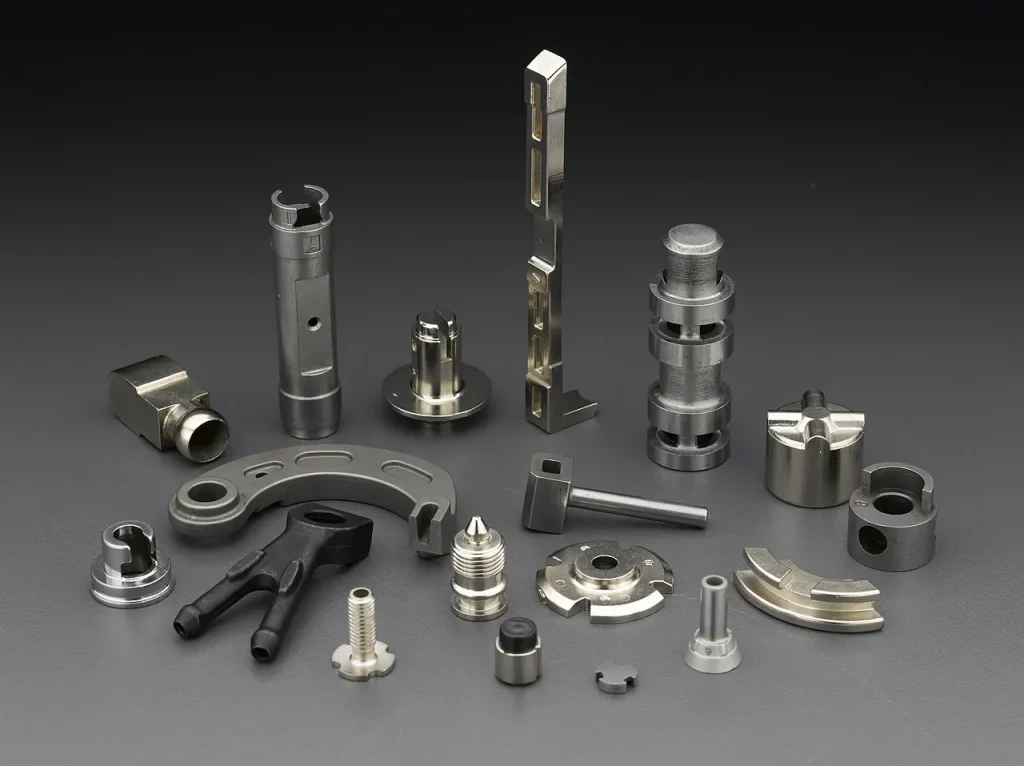
Manufacturing technology for magnetic components in robotics has reached an inflection point where traditional machining approaches cannot meet emerging design requirements. Metal injection molding addresses this limitation by combining powder metallurgy precision with injection molding’s geometric freedom, creating a pathway to produce soft magnetic materials with shapes previously considered unfeasible.
Overcoming Geometric Constraints: How MIM produces complex 3D magnetic cores that CNC machining can’t reach
Traditional CNC machining imposes fundamental restrictions on internal geometries, undercuts, and thin-walled sections that magnetic sensor housings and valve armatures require more and more. MIM eliminates these constraints by injecting metal powder mixed with polymer binders into molds. This enables features like internal threads, stepped bores, and curved channels without post-processing. The process handles parts weighing from fractions of a gram to components exceeding 100 grams with dimensional tolerances matching precision machining standards.
Complex three-dimensional magnetic cores benefit from this geometric freedom directly. A Grand Prize-winning stator assembly for aerospace servo valves demonstrates MIM’s capability to produce flux-carrying devices with intricate internal pathways that deliver magnetic and coil flux to armatures at much lower cost compared to traditional methods. Sensor housings that combine magnetic shielding with mounting features integrate multiple functions into single components. This eliminates assembly steps that introduce tolerance stack-up and reduce reliability.
Part consolidation represents another advantage. Components previously needing assembly of two or more pieces can be designed as single-piece structures with internal and external threads formed during molding without secondary machining. This consolidation matters for magnetic components where air gaps and joint interfaces disrupt flux paths and degrade electromagnetic performance. MIM-produced magnetic cores then achieve tighter control over magnetic circuit geometry than assembled alternatives.
Maintaining Magnetic Integrity: The JHMIM approach to controlled sintering for optimal grain growth and magnetic flux
Sintering processes determine final magnetic properties through control of temperature, holding time, and atmosphere composition. For Fe-2Ni MIM compacts, sintering temperatures from 1050°C to 1350°C produce relative densities from 92% to 97.2%. Optimal mechanical properties appear at 1275°C under hydrogen atmosphere. This temperature delivers excellent balance between density and grain size without excessive grain growth that would compromise performance.
Atmosphere control during sintering prevents surface oxidation and controls carbon content, both critical for soft magnetic materials. Hydrogen-based reducing atmospheres maintain low carbon levels in stainless steel magnetic components while preserving chromium oxide layer integrity. For Fe-3%Si soft magnetic materials, sintering under controlled atmospheres with dew points below -40°C ensures reduction of surface oxides and proper densification. The atmosphere composition influences grain boundary chemistry directly, which affects domain wall motion and overall magnetic permeability.
Grain size optimization follows precise thermal cycles. Holding time at sintering temperature drives grain growth, with extended periods producing coarser microstructures. For soft magnetic applications needing maximum permeability, uniform grain size distribution minimizes pinning sites that impede domain wall movement. Controlled cooling rates following peak temperature further refine microstructure by managing residual stress development and phase transformations that alter magnetic anisotropy.
Cost-Efficiency for Scale: Reducing secondary operations for high-volume sensor housing and valve armatures
Production economics favor MIM when volumes exceed 50,000 parts a year, where tooling costs amortize across large production runs. The automotive sector, representing 41.5% of MIM parts demand, makes use of this high-volume advantage for sensor housings and turbocharger components. Near-net-shape manufacturing minimizes material waste, with up to 99% of feedstock incorporated into finished parts compared to subtractive processes that convert raw material to chips.
Secondary operations drop when MIM replaces machining. Parts emerge from sintering within 8-11% of final dimensions. They need minimal finish machining only on critical surfaces. Heat treatment and plating steps integrate into MIM processing sequences directly, creating complete sensor assemblies or valve armatures ready for installation. This reduction in handling and processing steps lowers labor costs while improving consistency in production batches.
The global MIM parts market, valued at $5.2 billion in 2025, projects growth to $16.4 billion by 2035 at 12.2% CAGR, driven in part by soft magnetic materials adoption in electronics and medical devices. This expansion reflects growing recognition that MIM delivers budget-friendly options for complex magnetic components where traditional manufacturing reaches geometric or economic limits.
Design Optimization: Selecting the Right Material for Your Robot
Material selection for magnetic robot components requires matching electromagnetic properties to specific operational parameters that define the application environment. The difference between frequency regimes, temperature ranges, and electromagnetic interference exposure determines whether Fe-Ni or Fe-Si alloys deliver the best performance.
High Frequency vs. Static Fields: Matching material properties to the operational environment
Operating frequency establishes the main selection criterion for magnetic materials in robotics. Ferrite material FR79 performs best below 1 MHz, while new FR80 material targets the 1-5 MHz range where silicon carbide and gallium nitride power semiconductors operate. FR67 material has better loss characteristics for applications exceeding 5 MHz. This frequency-dependent behavior comes from the interaction between permeability, core loss, and skin depth as switching rates increase.
Performance factor curves reveal that core size increases cause optimal operating frequency to decrease. A 0.17 cm³ toroid achieves peak performance above 1 MHz. A 24.50 cm³ core optimizes around 100 kHz. High-frequency operation becomes loss-limited rather than flux-density-limited and changes design priorities from saturation induction to minimizing power dissipation. Permalloy-polymer composites maintain flat permeability to 10 MHz with resonance beyond 100 MHz. This makes them right for high-speed magnetic microrobots that need rapid field response.
Thermal Stability & the Curie Point: Ensuring consistent sensor accuracy in fluctuating industrial temperatures
Curie temperature defines the thermal ceiling beyond which ferromagnetic materials lose magnetic ordering. Silicon steel maintains ferromagnetism to 750°C, while Fe-Ni permalloy alloys exhibit Curie points near 460°C. Cobalt-iron alloys containing 27-43% cobalt demonstrate magnetic stability to 600°C, though 49% cobalt compositions limit operational range to 500°C. These temperature thresholds matter to robotic sensors in industrial environments where ambient conditions fluctuate.
Materials that approach 500°C and return to room temperature experience irreversible magnetic property changes. Geometry and atmospheric conditions during thermal exposure influence degradation rates. Oxidation-induced strain degrades magnetic performance in air-exposed components. Nanocomposite soft magnetic materials maintain stable operation at elevated power densities and temperatures compared to conventional alloys. This extends operational envelopes for battery-powered mobile robots in harsh thermal environments.
Shielding & Interference: Employing Fe-Ni for EMI shielding in high-density electronic environments
Electromagnetic interference disrupts robotic control systems when multiple electronic components operate in close proximity. Permalloy with 80% nickel and 20% iron achieves relative magnetic permeability of 20,000 at 1 kHz, while mu-metal reaches 100,000. These high permeability values allow effective absorption of electromagnetic radiation through magnetic dipole interaction with incident fields.
Shielding effectiveness increases with both permeability and electrical conductivity. Frequencies above 1 MHz require shielding only 0.1 mm thick. This supports compact sensor housings in space-constrained robotic assemblies. The skin effect concentrates alternating currents near conductor surfaces. Thin Fe-Ni films become effective barriers against high-frequency interference without adding mass to mobile platforms.
Future Trends: The Convergence of Smart Materials and MIM
Emerging applications redefine the limits of magnetic materials beyond conventional robotics into domains where size, compliance, and environmental responsibility reshape design priorities. Three converging trends define the next generation of magnetic robot components.
Miniaturization for Surgical Microrobots
Magnetic microrobots operating at dimensions from nanometers to submillimeters guide through biological fluids and tissues to reach specific surgical targets. These miniaturized systems access deep, complex regions of the human body’s blood vessels and brain tissue with minimal invasiveness. Devices smaller than 1 mm incorporate magnetic components for wireless actuation and enable contactless manipulation in vivo where traditional surgical instruments cannot reach. Targeted drug delivery, minimally invasive surgery, and medical imaging show particular promise with magnetically actuated microrobots.
Integration with Flexible and Soft Robotics
Magneto-active soft materials combine magnetic particles with compliant polymers and hydrogels to create deformable structures. Four-dimensional printing of these smart materials makes soft robots, actuators, and grippers that respond to magnetic field stimuli. The integration permits diverse magneto-deformations through magneto-thermal coupling actuation and facilitates development of individual-specific devices with boosted shape-morphing capabilities.
Sustainable Sourcing and Near-Net-Shape Manufacturing
Additive manufacturing reduces raw material usage compared to traditional magnet production while enabling near-net-shape fabrication. Metal injection molding achieves up to 99% material utilization in magnetic components, with leftover powder reprocessed and reused. Direct recycling of end-of-life magnets through remelting and atomization creates new alloy powders and supports circular economy principles in magnetic materials manufacturing.
Conclusion
Fe-Ni and Fe-Si alloys occupy distinct performance niches within robotic systems. Each material is optimized for specific electromagnetic demands. Permalloy’s exceptional permeability makes precision position sensing and tactile feedback possible in robotic grippers. Silicon steel’s superior saturation magnetization and electrical resistivity deliver efficient actuation in high-speed electromagnetic valves. Metal injection molding has emerged as the manufacturing solution that bridges geometric complexity with magnetic performance requirements.
Engineers selecting materials for robotic applications must balance frequency response and thermal stability against cost constraints. Smart materials meeting with advanced manufacturing techniques continue to push magnetic components into surgical microrobots and flexible robotic systems. Environmentally responsible processing methods address environmental needs in high-volume production.
FAQs
Q1. What types of sensors do robots typically use for perception? Robots utilize various sensors to perceive and interact with their environment, including vision systems for object recognition and navigation, tactile sensors for touch feedback, position sensors for tracking movement, force sensors for measuring applied pressure, and magnetic sensors for detecting magnetic fields. These sensors work together to enable robots to perform complex tasks with precision and adaptability.
Q2. How do magnetic sensors work in robotic applications? Magnetic sensors detect changes in magnetic fields and convert them into electrical signals. Hall Effect sensors, for example, sense fields produced by permanent magnets, electromagnets, or current-carrying conductors. In robotics, these sensors enable precise position tracking, force measurement in grippers, and contactless detection of movement, making them essential for applications requiring high sensitivity and reliability.
Q3. Which magnetic materials are commonly used in robotic sensors and actuators? Fe-Ni alloys (permalloy) and Fe-Si alloys (silicon steel) are the primary magnetic materials used in robotics. Permalloy offers exceptional permeability for precision sensing applications like position encoders and tactile feedback systems. Silicon steel provides high saturation magnetization and electrical resistivity, making it ideal for electromagnetic valves and actuators in hydraulic and pneumatic systems.
Q4. What advantages does Metal Injection Molding (MIM) offer for magnetic components? MIM enables the production of complex three-dimensional magnetic cores with intricate internal geometries that traditional CNC machining cannot achieve. The process delivers near-net-shape parts with up to 99% material utilization, reduces secondary operations, and maintains tight dimensional tolerances. This makes MIM cost-effective for high-volume production of sensor housings and valve armatures while preserving magnetic performance.
Q5. How does operating frequency affect magnetic material selection in robots? Operating frequency is a critical factor in choosing magnetic materials. Fe-Ni permalloy maintains stable permeability up to 10 MHz, making it suitable for high-frequency sensor applications. Fe-Si silicon steel performs optimally at lower frequencies (50-400 Hz) where its high saturation and low core losses benefit power conversion applications. Material selection must match the frequency regime to minimize energy losses and maximize electromagnetic performance.