
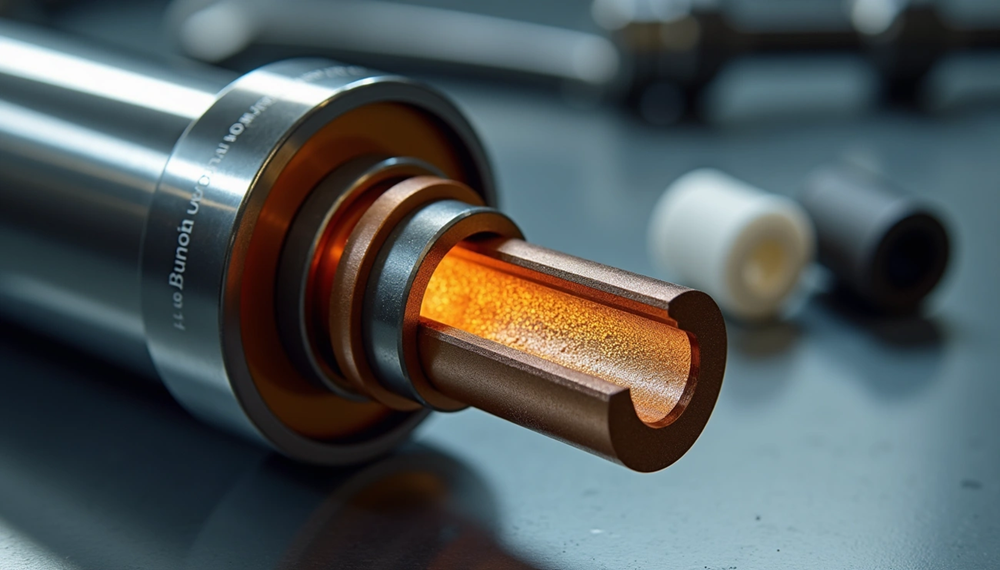
Self-lubricating materials eliminate the need to re-grease routinely, reducing unplanned stops and cutting contamination risk in critical applications. These oil-free polymer bushings and greaseless bearings deliver clean, maintenance-free motion where uptime, hygiene, and access matter most. Self-lubricating bearing materials resist corrosion and tolerate contamination better than greased metal solutions when you remove external lubrication requirements. This piece explains what self-lubricating means, covers how self-lubricating materials work through transfer film formation, and walks through selecting the right self-lubricating bearing for food processing, medical, and industrial applications.
What Does Self-Lubricating Mean?
Definition and Core Concept
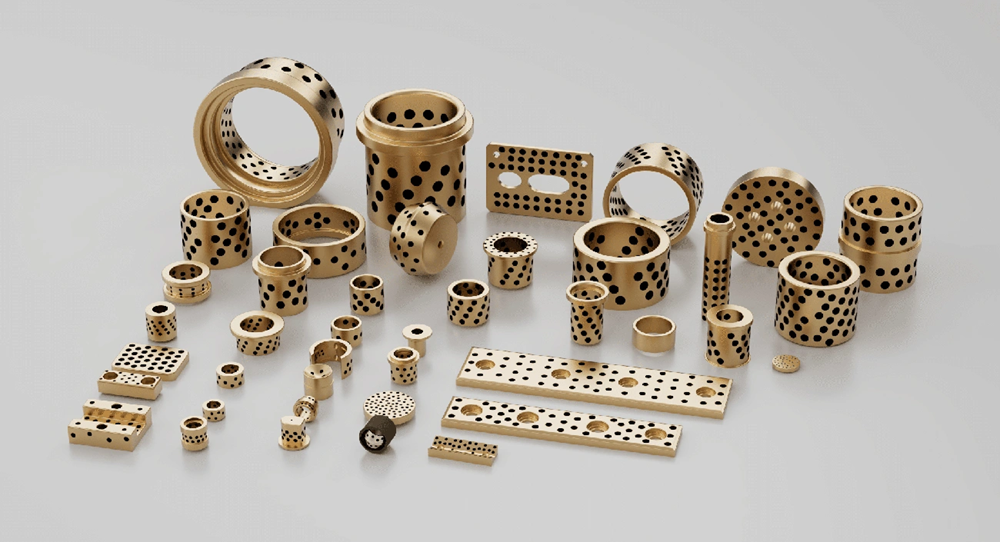
Self-lubricating refers to materials engineered to provide their own lubricant without external oil or grease applications. These bearing materials contain lubricant impregnated within their sliding layer, which releases through microscopic pores during operation to create a protective film on mating surfaces.
Transfer film formation is central to how these materials work. During the original run-in period, a small amount of material transfers from the bearing layer to create a solid lubricating film. This film contacts moving parts and protects and lubricates mating components throughout the bearing’s service life. Friction generates heat and causes embedded lubricant to seep from pores and form a thin layer that reduces wear. This process happens on its own.
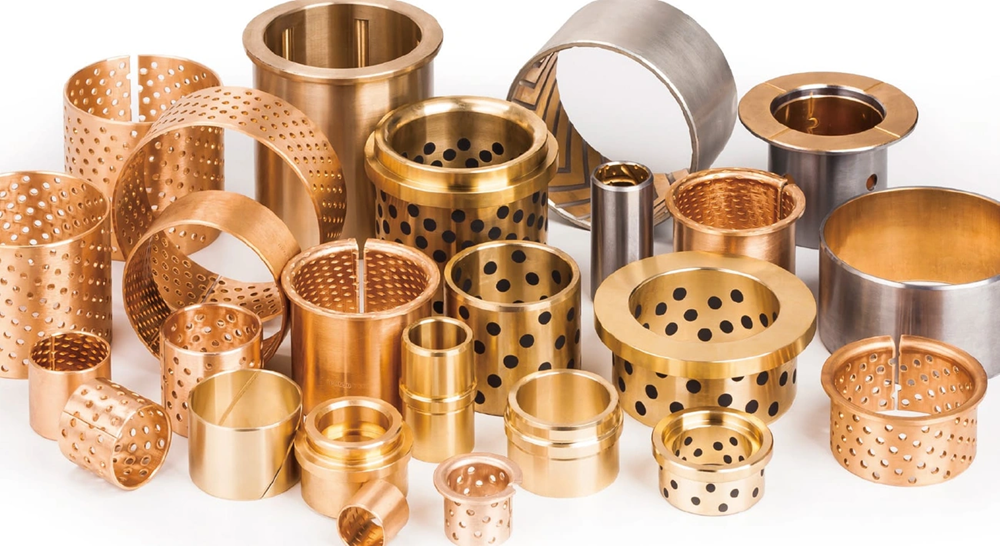
Self-lubricating materials incorporate solid lubricants into their structure through several approaches. Sintered bronze bearings feature microscopic pores filled with oil, while composite materials blend base polymers with solid lubricants like PTFE, graphite, or molybdenum disulfide. Polymer-based solutions use tribologically-optimized blends that combine base materials for wear resistance, reinforcing fibers for load capacity, and solid lubricants that eliminate external oil requirements.
Core Characteristics of Self-Lubricating Materials
Acceptable friction coefficients remain at or below 0.2 for dry sliding conditions in self-lubricating bearings. This threshold gives smooth operation without liquid lubrication. Temperature increases up to around 315°C (600°F) cause the friction coefficient to decrease, which represents high-temperature capability for polymeric materials in plain bearing applications.
Non-galling behavior defines another critical characteristic. Materials must maintain low wear rates while generating wear surfaces with acceptable topography. Surfaces must not become rough or transfer large amounts of material between mating components. New solid lubricant particles become exposed as the coating wears and maintain continuous self-lubrication.
Corrosion resistance proves critical since polymers remain inert in most dry bearing environments. But some hydraulic fluids and liquid lubricants show incompatibility with certain polymers, requiring careful selection where liquid contamination might occur. Wear particles formed on contact surfaces act as solid lubricants themselves in self-lubricating composites, which further reduces friction coefficients and wear rates.
These materials combine hard and soft reinforcements. Hard phases like ceramics boost physical properties including strength and stiffness, while soft reinforcements such as solid lubricants improve tribological properties by reducing friction and wear. Companies with nearly 20 years of experience in powder metallurgy, like JH MIM, produce precision-engineered sintered metal solutions that use these material combinations for demanding applications.
Self-Lubricating vs Traditional Lubrication Methods
Traditional lubricated bearings need manual greasing schedules, creating ongoing maintenance demands and downtime risks. Self-lubricating bearings eliminate oil holes and grooves, removing machining costs for lubrication channels and external oiling systems. This simplification reduces machinery running costs as lubricant oil consumption drops.
Maintenance requirements differ between the two. Conventional bearings need periodic re-lubrication to prevent failure, while self-lubricating solutions solve oiling operation problems and save bearing maintenance costs. Built-in solid lubricant releases during operation and keeps friction low without manual intervention.
Environmental concerns separate the two approaches. Self-lubricating bearing materials work without oil and meet ROHS directives for environmental compliance. They minimize contamination risk in sensitive environments and eliminate concerns about oil leaks or grease contamination in food processing equipment. Traditional lubricants can attract debris that destroys conventional bearings, whereas dry-running self-lubricating designs resist environmental contamination.
Cost structures also diverge. Self-lubricating bearings carry higher upfront costs but deliver lower total ownership costs through reduced downtime, minimal maintenance, longer service life, and more reliable performance. Traditional bearings accumulate expenses from lubricant purchases, labor for re-greasing, and potential failures from poor lubrication.
Design simplification represents another advantage. Maintenance-free features, thin wall thickness, higher load capacity, and excellent wear resistance make mechanical designs more economical. Traditional systems need external lubrication components that add cost and complexity to assemblies.
How Do Self-Lubricating Materials Work
Transfer Film Formation Process
Molecular chain scission and free radical exposure help transfer film formation on mating surfaces during operation. Friction generates localized stresses that pull polymer chains from the bearing material and deposit them onto the counterface as a microscopically thin layer. This sacrificial film fills the mating shaft’s microscopic asperities and creates a smooth interface where primary contact becomes lubricant-on-lubricant rather than metal-on-metal.
The process relies on developing what researchers call a shear layer between sliding surfaces. This layer reduces adhesive interactions and plowing effects that occur between relatively moving surfaces. Thinner shear layers perform better. The layer needs to remain bonded to the bulk polymer while exhibiting a “flowing into itself” quality where molecules slide over one another without apparent structural changes.
PTFE chains can be drawn out on the surface to form an extended chain crystal structure conducive to low shear. The friction coefficient maintains values lower than 0.1 over wide temperature ranges, with minimum values at -70°C due to the combined effects of transfer film formation and thermally activated sliding. Polyimides also form thin shear layers, but only under vacuum conditions or at temperatures above 100°C in air. Water molecules hydrogen bond to polymer chains and inhibit their ability to extend on surfaces.
Lower loads during running-in help establish the original transfer film before you increase to full operating loads. The bulk material supports higher unit loads once you establish the film due to lower tangential stress contributions from the sliding component.
Solid Lubricant Dispersion Mechanism
Solid lubricants possess unique lamellar structures that enable their superior lubrication properties. Materials such as transition metal dichalcogenides, hexagonal boron nitride and graphite contain layers that line up parallel to the direction of applied force and slide over each other to reduce friction during relative motion.
These solid lubricants become exposed to the surface during sliding when embedded in various matrices and maintain continuous lubrication. Dispersed PTFE particles improve formation of a continuous phase on composite surfaces and create lubricating transfer films on steel counterfaces. The solid lubricant phase undergoes tribo-chemical reactions during operation and ended up leading to constant lubricant supply at interfaces.
The tribo-film’s quality and thickness formed during operation determines performance. A thin film guides to improved tribological performance, with effectiveness depending on intrinsic mechanical properties of both film and substrate, plus contact pressure between them. MoS2 exhibits more pronounced plastic flow behavior than graphite, though it scratches polished steel surfaces more readily.
Porous Metal Oil Retention
Sintered metal bearings use capillary action and thermal expansion to manage lubrication on their own. These components contain interconnected pores that occupy 10% to 35% of total volume and store lubricating oil that feeds through pores to bearing surfaces. Localized friction generates heat as the shaft rotates. The oil within pores has a higher coefficient of thermal expansion than surrounding metal and causes it to squeeze out onto the sliding surface.
A thin pressurized film of oil separates the shaft from the bearing wall at increased speeds and eliminates metal-to-metal contact virtually. Cooling metal and oil surface tension create a wicking effect once the machine stops and draw lubricant back into the pore reservoir. This cycle repeats for thousands of hours. JH MIM produces precision-engineered sintered metal solutions that optimize this self-sustaining lubrication cycle with almost 20 years of experience in powder metallurgy.
High porosity with maximum oil suits high-speed light-load applications. Low-oil-content low-porosity material with high graphite content works better for oscillating and reciprocating motions where oil film buildup proves difficult.
Self-Renewal During Operation
Self-lubricating materials replenish protective films through ongoing operation continuously. Shaft movement replenishes the lubricant layer from internal reservoirs on its own if the transfer film becomes scratched by debris. Wear particles formed on contact surfaces act as solid lubricants themselves and further reduce friction coefficients and wear rates.
The lubricant remains dispersed throughout the sliding layer uniformly and ensures no reduction in bearing performance even as the sliding layer wears. This contrasts with grease-lubricated bearings that trap abrasive particles in lubricant, whereas self-lubricating designs with transfer films push particles into lubricant pockets or maintain surfaces less prone to particle adhesion.
Types of Self Lubricating Bearing Materials
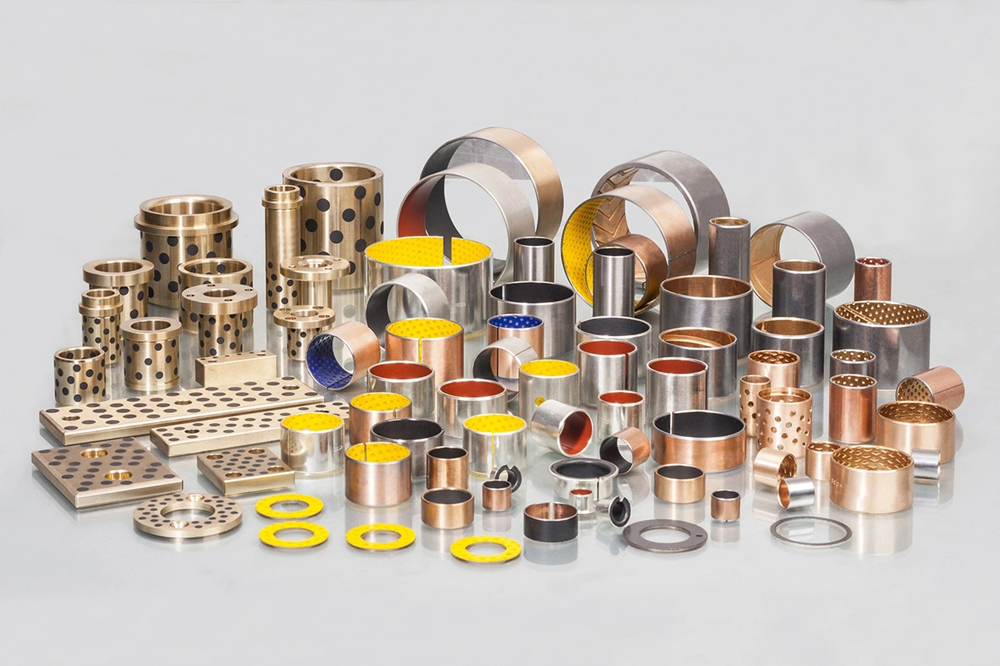
Bearing manufacturers produce five distinct categories of self-lubricating bearing materials, each engineered for specific load, speed, and environmental conditions.
PTFE-Based Polymers and Composites
PTFE-based bearing materials bond an anti-static PTFE coating to one side of aramid fabric. The uncoated side then bonds to steel or other metal surfaces. The smooth PTFE surface makes friction-resistant sliding easier while the fabric component improves resistance to cold flow and allows higher load support. These constructions maintain self-lubrication properties across temperature ranges from -100°F to 350°F (-73°C to 177°C).
Engineering polymers incorporate PTFE fillers and other high-performance blends for sleeve, flanged bushings, and thrust washers. Chemical resistance and corrosion immunity make these materials suitable for oscillating or low-to-moderate speed applications combined with high loads. Performance remains strong in dirty or wet environments. Designers must avoid speeds over 400 feet per minute and specify shaft finishes that support proper film formation.
Various filler combinations optimize specific properties. Fiberglass-filled grades at 25% concentration serve common seal and bushing applications. Stainless steel-filled materials at 50% handle bearing and valve seats where high loads and corrosion present the biggest problems. Carbon fiber-filled grades at 35% concentration deliver high strength and wear performance. Moly/bronze-filled variants containing 55% bronze and 5% molybdenum provide strong load strength for bearing applications.
Filament-Wound Composite Materials
Filament wound bearings integrate PTFE or graphite lubricants within their resin matrix. This provides continuous dry lubrication and eliminates manual greasing requirements. The woven Teflon fiber liner requires no lubrication, while the filament wound fiberglass and epoxy resin matrix produces bearings that combine design flexibility with maintenance-free operation.
Structural strength reaches impressive levels. Wound fiberglass structures exhibit ultimate crush strength under radial load exceeding 77,000 PSI. These bearings operate self-lubricated up to 30,000 psi dynamically and 77,000 psi statically. The fiberglass construction weighs 77% less than steel and 30% lighter than aluminum while functioning as an electrical insulator.
Temperature tolerance spans from cryogenic conditions to temperatures exceeding 325°F. The non-metallic construction allows operation without lubrication. Corrosion never occurs, even in extreme environments. The woven Teflon and polyester liner delivers low friction coefficients across wide application ranges without oil or grease.
Metal-Polymer Lined Systems
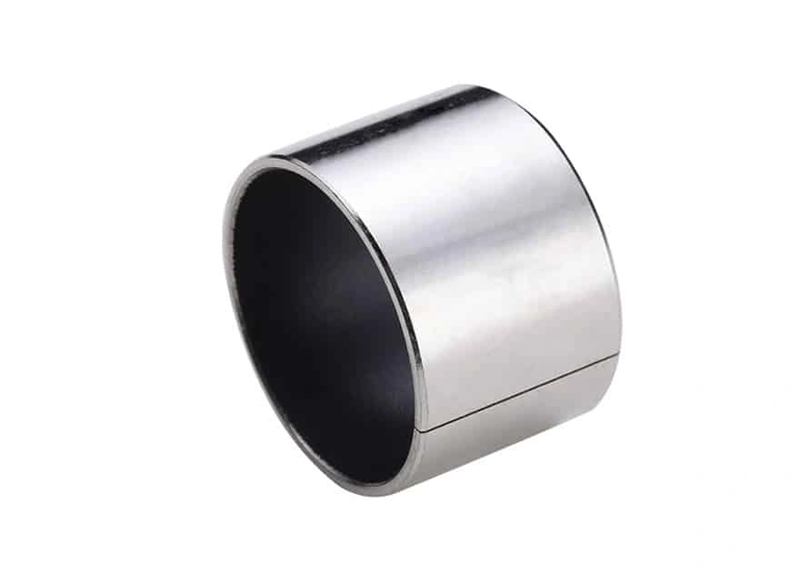
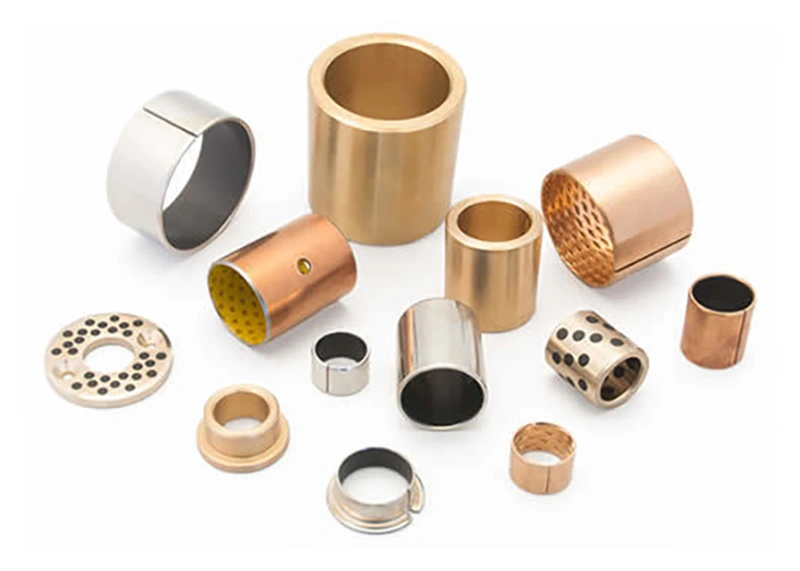
Metal-polymer composite bushings feature multi-layer construction: steel backing, porous bronze sinter, and PTFE with lead forming the complete structure. This configuration combines low-friction PTFE bearing surfaces with the strength and dimensional stability of metal backing. The steel backing provides high mechanical strength and structural integrity under extreme loads.
The sintered bronze interlayer contains a porous structure that stores and releases lubricant over time. It also boosts heat dissipation and load distribution. Static load capacity reaches 250 N/mm2, with dynamic capacity at 140 N/mm2 and oscillating capacity at 60 N/mm2. Operating temperature range spans -200°C to +280°C. The friction coefficient remains between 0.03 and 0.20μ depending on conditions.
Lead-free variants combine PTFE bearing surfaces with metal backing strength while meeting environmental requirements. Moisture-resistant versions function even in water applications.
Sintered Metals and Powder Metallurgy Solutions
Sintered metal bearings contain high porosity between 20-25% in volume, impregnated with lubricant oil. The interconnected pores occupy 10% to 35% of the total volume. JH MIM, with nearly 20 years of experience in powder metallurgy, produces precision-engineered sintered metal solutions optimized for diverse industrial requirements.
Bronze bearings containing 90% copper and 10% tin represent the most common porous bearing material. These exhibit wear resistance, ductility, conformability, and corrosion resistance. Leaded bronzes reduce tin content by 20% and copper by 4%, adding 14% to 16% lead. This results in lower friction coefficients and good galling resistance.
Iron and iron-copper variants provide higher compressive strength for shock and heavy load applications. Graphite additions from 1% to 3.5% boost lubricity and create dry lubricant effects even when the impregnated oil depletes.
Graphite and Molybdenum Disulfide Composites
Solid graphite bearings exploit natural lubricating properties for applications requiring minimal friction and maintenance. Graphite-impregnated versions infuse graphite into metal or composite base materials. This boosts self-lubrication while benefiting from the structural strengths of the base. Composite bearings combine synthetic polyester resins with fabric for strength and incorporate PTFE and molybdenum disulfide as lubricants for marine and hydro applications, or graphite for industrial bearings.
Molybdenum disulfide excels in extreme environments where conventional lubricants fail. It offers low friction and strong load-carrying capabilities. This precision dry lubrication technology proves valuable for greaseless bearings and oil-free bearing systems used in critical defense and aerospace applications.
Selection Criteria for Self Lubricating Bushings
No content was provided in the user_text tag. Please provide the text you would like me to humanize and rewrite.
Application-Specific Material Selection
Matching self-lubricating bearing materials to specific operating environments requires analyzing contamination risks, chemical exposure, load patterns, and regulatory requirements that define each industry sector.
Food and Beverage Processing Equipment
FDA-compliant materials meeting 21 CFR Section 177.15 and USDA 3A Sanitary Standards 20-17 enable direct food contact applications. Self-lubricating nylon bearing materials prove especially useful where additional lubrication creates cleanability concerns or contamination risks. Grease and oil near open product create audit issues and recall risks. This drives OEMs toward stainless steel structures combined with food-grade self-lubricating plastic bearings.
EU 10/2011 certified polymers operate dry without external lubricants and eliminate contamination risk while resisting corrosion and chemicals found in washdown environments. Components face exposure to water, caustic solutions, acidic chemicals, and temperature swings from frequent foam cleaning and CIP. Metal detectable plastics support visual inspection and X-ray systems in high-risk zones over open product. Graphalloy bearings handle temperature extremes from -450°F to +750°F. They stand up to steam and pressure washes while operating submerged in hot oils.
Marine and Outdoor Environments
Saltwater corrosion and intermittent operation just need materials that maintain film integrity under shock loads and direct spray exposure. Self-lubricating bearings in marine propulsion shaft systems eliminate external lubricant supply requirements and provide advantages in energy conservation and environmental protection. Water-lubricated bearing materials must maintain structural integrity and tribological properties while submerged. They use polymers and specialized metal alloys resistant to corrosion.
Bronze shaft marine bearings installed on over 2,000 ships prevent harmful substance release into the sea while delivering exceptional wear life guarantees. These systems withstand saltwater corrosion, abrasive particles, shock loading, and vibrations. Self-lubricating bearings offer lower maintenance requirements and higher system integration compared to designs requiring external water supply and filtration. JH MIM produces precision-engineered sintered metal solutions optimized for marine environments requiring corrosion resistance, with nearly 20 years of powder metallurgy experience.
Manufacturing and Automation Systems
Automation lines just need clean, quiet motion in sliders and pivot joints without frequent lubrication stoppages. Self-lubricating plastic bearings operate completely dry and make them suitable for labs where cleanliness matters. The lack of oil or grease enables performance in dirty environments since bearings do not attract dust and dirt. Standard silicones stick together in automated bowl feeders and slow manufacturing or contribute to scrapped parts, whereas self-lubricating materials feed consistently with less downtime.
Medical and Pharmaceutical Applications
Biocompatibility and sterilization resistance define medical device bearing selection. 316 stainless steel radial ball bearings run without lubrication or use the liquid environment as lubricant in stirred-tank bioreactor systems. Additional post-machining passivation will give purity for pharmaceutical production. Self-lubricating liquid silicone rubber provides lubricious surfaces after vulcanization and eliminates secondary lubrication processes. Delayed lubricant surface bloom prevents mold fouling while reducing self-healing of slit valves in needleless IV access systems. Nitrogen-enhanced stainless steel withstands repeated cleaning and sterilization cycles.
Heavy Equipment and Industrial Machinery
Heavy-duty applications accommodate medium to heavy loads at slow to medium speeds in power generation, large structures, bridges, and offshore oil platforms. Self-lubricating bearings operate in wet or dry environments under extreme temperature conditions while bearing heavy static and dynamic loads. Custom bearing production reaches outer diameters up to 124 inches with assembly weights up to 35 tons. Mining, construction, and materials handling equipment cope with high temperatures, chemicals, dirt, and complex lubrication challenges.
Performance Factors and Design Considerations
Proper installation techniques and operational protocols influence whether self-lubricating materials achieve their rated service life or fail before their time.
Installation and Press-Fit Guidelines
Alignment proves critical to prevent cocking motion during insertion, which damages bearings or housings. Polymer and composite self-lubricating bushings require allowances for thermal expansion. Appropriate interference fits, generous lead-ins, and chamfers hel,p while knife edges should be avoided. Press-tool alignment must prevent ovality, with wall thickness verified before installation. Manufacturers recommend bearing-to-housing fits between 0.0002 tight to 0.0008 loose with 32 Ra bore finish for metal-polymer systems.
Correct bearing selection and installation prevents one-sixth of bearing failures. Misalignment concentrates loads at edges and disrupts transfer films, which induces early wear. Housing geometry, shoulder relief and fixtures maintain coaxiality. Shaft surface finish between 8-16 Ra supports stable film formation. Excessively polished surfaces delay film development while overly rough surfaces tear films and raise wear. JH MIM produces precision-engineered sintered metal solutions with optimized dimensional tolerances for proper fit, drawing on nearly 20 years of powder metallurgy experience.
Break-In Process and Film Development
Transfer film establishment requires 50-100 strokes of continuous operation. Lower loads during running-in help establish the film before increasing to full operating loads. The break-in confirms friction and temperature performance under expected duty cycles. Stroke and reversal patterns must maintain film continuity across travel for linear systems.
Common Failure Modes and Prevention
Improper installation practices cause immediate damage or show as uneven wear, vibrations and reduced operational life. Contamination damages rollers and races when metal and dirt particles enter bearing spaces. Over-greasing generates heat and lifts torque, which can blow seals. Self-lubricating solutions eliminate these human-driven variables by removing relubrication schedules. They still require correct shaft finish, alignment and temperature control.
Maintenance Requirements and Service Life
Self-lubricating bearings require no relubrication and remain maintenance-free. Periodic inspection catches issues before major failures occur. Adding grease interferes with transfer-film mechanisms and attracts abrasive contaminants. Service life depends on application parameters including load, speed and temperature, with manufacturers providing formulas based on PV values.
Conclusion
The right self-lubricating bearing material determines whether your application achieves maintenance-free operation or experiences premature failure. Each material type delivers specific advantages, so match PTFE composites, sintered metals, or metal-polymer systems to your load, speed, temperature, and environmental conditions. Think over shaft finish requirements, installation procedures, and break-in protocols among other material selection factors, since proper implementation matters as much as material choice.
Companies with deep powder metallurgy experience, like JH MIM with nearly two decades in the industry, provide precision-engineered solutions for demanding applications. The right material selection combined with expert manufacturing delivers lower total ownership costs, extended service life, and reliable performance without ongoing lubrication demands.