
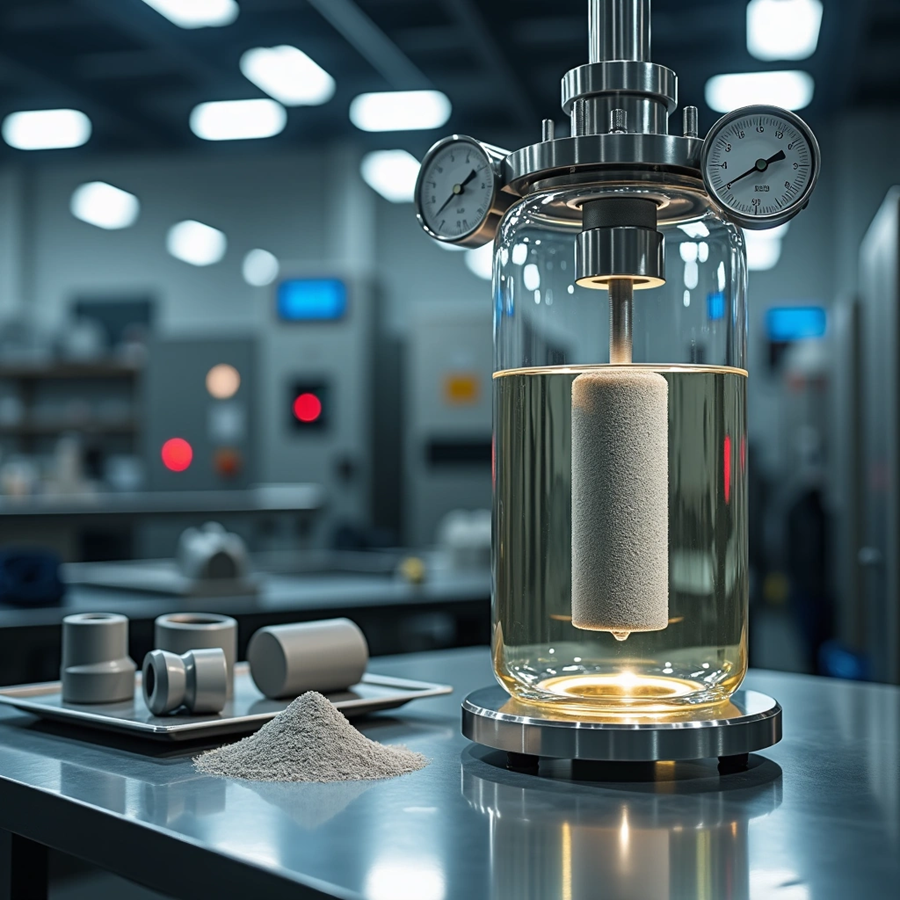
What is cold isostatic pressing, and how does it achieve uniform powder densification under pressures ranging from 5,000 psi to 100,000 psi? Cold isostatic pressing (CIP) is a powder forming technique that applies uniform hydrostatic pressure from all directions to a powder contained in a flexible mold at room temperature. The cold isostatic pressing process works by sealing the powder in an elastomeric mold and submerging it in a liquid-filled pressure vessel. The material is then compressed to create a green body with high density uniformity. This method yields parts with 60% to 80% of their theoretical density. More, CIP can manufacture components with complex geometries and longer aspect ratios that traditional uniaxial pressing cannot achieve. This piece explores the step-by-step cold isostatic pressing process and compares wet bag and dry bag methods. Applications in refractory metals and advanced ceramics are also covered.
The Cold Isostatic Pressing Process: Step-by-Step
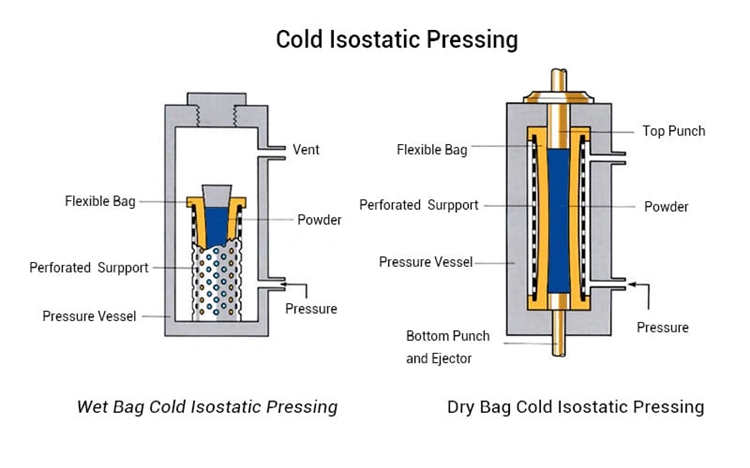
The cold isostatic pressing process follows a controlled sequence that transforms loose powder into a dense solid through uniform pressure application.
Elastomeric Mold Preparation and Powder Filling Density
The process begins with selecting a flexible mold made from elastomer materials such as polyurethane, rubber, or silicone. These materials serve as an impermeable membrane that contains the powder and transmits hydraulic pressure uniformly from all directions. Powder is poured into the mold. Achieving high filling density remains critical for successful compaction. Bulk and tap density measurements according to standards help estimate powder flowability. The mold is hermetically sealed after filling to prevent liquid contamination during pressurization.
Fluid Pressure Vessel Setup: Understanding Liquid Media (Water/Oil)
The sealed mold is placed inside a high-strength pressure vessel filled with liquid medium. Water, oil, or glycol mixtures serve as transmission media. Some systems use a non-corrosive water and soluble oil mixture, while food applications may use water exclusively. The fluid acts as the pressure transmission medium and ensures no air gaps exist between the pressure source and the mold.
Applying Uniform Hydrostatic Pressure: From 5,000 psi to 100,000 psi
Pressures for compacting range from less than 5,000 psi to more than 100,000 psi (34.5 to 690 MPa). Operating pressures can reach as high as 150,000 psi (1,000 MPa) depending on material requirements. Pascal’s law states that pressure applied to the enclosed fluid transmits equally in all directions against the mold surface. This omnidirectional force compacts the loose powder and reduces porosity to create a solid structure.
Decompression Control and Uniform Green Body Extraction
Decompression represents the most critical step in the cold isostatic pressing process. Sudden pressure release can cause severe cracking due to compressed air escaping from residual porosity. Elastic rebound, known as the spring-back effect, can range between 0.5% to 2%. Controlled decompression through throttle valves prevents compact failure. The compacted green body is extracted from the mold with sufficient strength for handling once depressurized.
Types of Cold Isostatic Pressing Methods: Wet Bag vs. Dry Bag
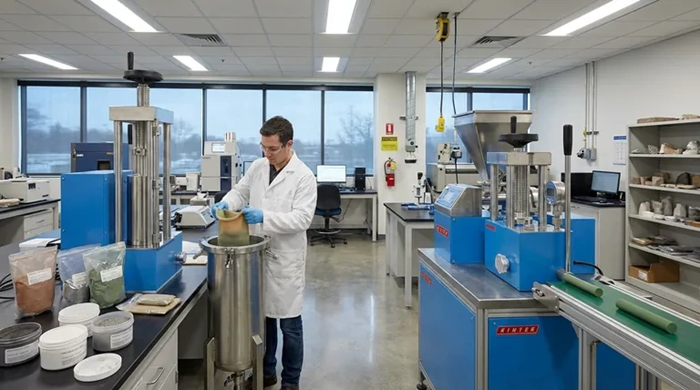
Cold isostatic pressing divides into two distinct implementation methods based on tooling configuration and production objectives.
Wet Bag Isostatic Pressing: Best for Complex, Large-Scale, and Low-Volume Components
The mold exists as a separate, removable container in wet bag pressing. Workers fill it with powder and seal it outside the pressure vessel. This sealed assembly is then submerged into the pressure fluid and placed in contact with the liquid medium. Cycle times range from 5 to 30 minutes. This approach is slower than automated alternatives. Wet bag systems accommodate vessel diameters from 50mm up to 2000mm and enable production of massive components. The method handles multiple parts of different shapes within a single pressure cycle. This provides unmatched geometric flexibility for undercuts and high length-to-diameter ratios that rigid tooling cannot eject.
Dry Bag Isostatic Pressing: High-Automation and Fast-Cycle Production
Dry bag pressing integrates a fixed, flexible membrane into the pressure vessel. This permanent barrier isolates the mold from the pressure fluid throughout all pressing cycles. The integrated design makes rapid automation possible. Some systems produce one compact per minute or faster. This translates to 240,000 parts based on 66 percent uptime across three shifts, five days weekly for 50 weeks annually. The method excels at manufacturing simple, symmetrical shapes such as rods, tubes, and spark plug insulators. Complex geometries or very large components remain sort of hard to produce and require the more flexible wet bag approach instead.
Comparative Evaluation: Choosing Between Wet Bag and Dry Bag Systems
| Selection Factor | Wet Bag Method | Dry Bag Method |
|---|---|---|
| Production Volume | Low-volume, prototypes | High-volume, mass production |
| Part Complexity | Complex geometries, large parts | Simple, symmetrical shapes |
| Cycle Time | 5-30 minutes | 1 minute or faster |
| Automation Potential | Manual, batch-oriented | Highly suitable for automation |
| Mold Configuration | Separate, removable | Fixed, integrated |
Balancing part geometry against required production speed determines the appropriate selection.
Technical Advantages and Engineering Limitations of CIP
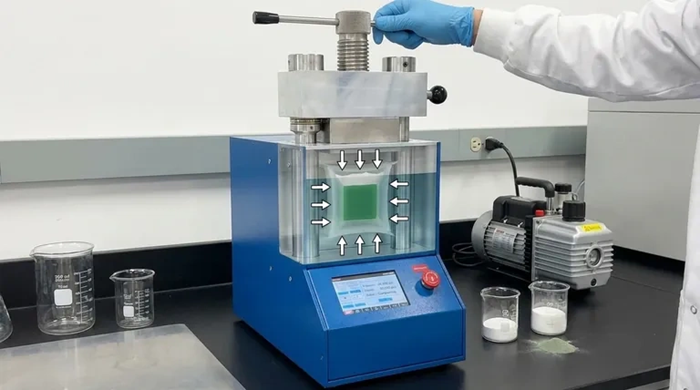
Hydrostatic pressure application eliminates friction-related density variations that come with uniaxial pressing. This gives you better material properties and geometric capabilities.
Key Benefits: Uniform Green Density, High Green Strength, and Complex Geometric Shapes
The elimination of die-wall friction produces uniform density throughout the compact. This results in higher green densities and more homogeneous structures. Green strength can reach up to 10 times greater than die-compacted counterparts. Parts can be handled safely and machined before sintering without risk of crumbling. The flexible mold accommodates intricate designs and undercuts that rigid dies cannot eject. The absence of wall friction eliminates lubricant requirements. This produces cleaner microstructures and higher green densities at the start.
Longer Aspect Ratios: Overcoming the Geometrical Constraints of Uniaxial Die Pressing
Components with height-to-diameter ratios greater than 3:1 can be produced with ease. Uniaxial pressing restricts this geometry. This capability makes it possible to manufacture long tubes and rods with consistent density along the entire axis.
Low Mold and Tooling Costs Compared to Rigid Tungsten Steel Dies
Mold materials consist of natural rubber or polyurethane rubber. These offer much lower costs compared to expensive tool steel used in traditional powder pressing. This economic advantage works best for low-volume production and complex geometries where rigid die costs cannot be justified.
Dimensional Accuracy Limitations and the Necessity of Post-Sintering Machining
The elastic properties of flexible molds limit dimensional accuracy compared to rigid dies. Surface roughness remains high as the die wall yields during pressurization. Parts require secondary processing after sintering to achieve tight tolerances. The high green strength makes green machining possible before final sintering.
Advanced Applications and Material Compatibility for CIP
Material selection for cold isostatic pressing depends on powder characteristics and the final application’s performance requirements. CIP excels at uniting materials that resist conventional forming methods.
Refractory Metals and High-Melting-Point Powders (Tungsten, Molybdenum, Tantalum)
Refractory metals present distinct processing challenges due to high melting points. Tungsten reaches 3,422°C, molybdenum 2,623°C, and tantalum 3,017°C. Traditional casting becomes impractical or economically inefficient at these temperatures. Cold isostatic pressing unites these metal powders at room temperature without thermal energy during shaping. Applications span nozzles, crucibles and electronic components where extreme temperature resistance is essential.
Sputtering Targets: Achieving Near-Theoretical Density Over 95%
Sputtering target manufacturing needs precise density control to minimize arcing and particle generation during thin film deposition. Targets over 95% theoretical density reduce arcing incidents. Cold isostatic pressing of indium tin oxide (ITO) powder produces ceramic preforms that achieve 95% theoretical density after sintering. The process creates TiN particles dispersed through aluminum matrices at densities reaching 90% to 99% of theoretical values.
Advanced Ceramic Components and Industrial Structural PM Parts
Ceramic manufacturing uses CIP across aerospace, automotive, electronics, nuclear and medical device sectors. Material systems include silicon nitride, silicon carbide, boron nitride, boron carbide, titanium boride and spinels. JHMIM operates an 18,000+ square meter facility backed by 150+ skilled technicians and advanced high-tonnage sintering equipment. The company has over 20 years of expertise in powder metallurgy and metal injection molding. They deliver high-density, zero-defect complex metal components that solve tight-tolerance manufacturing challenges under one roof.
Optimize Your Complex Component Manufacturing with JHMIM
Design optimization before manufacturing prevents tooling revisions and production delays that can get pricey. Evaluating component stress distributions and manufacturability constraints early in development reduces the risk of late-stage design changes that compromise delivery schedules.
Submit Your Component Stress Profiles and 3D CAD Drawings (STEP/IGS) for a Free CIP Tooling and DFM Evaluation
Identifying stress profiles working on components is the quickest way to evaluate load and property requirements. Automated analysis engines review uploaded CAD files in STEP or MESH formats within seconds and compare part geometry against extensive manufacturing databases. The evaluation addresses critical design elements including wall thickness, internal corners, and dimensional tolerances that affect cold isostatic pressing feasibility.
Manufacturability assessment at an early stage determines 80% of a product’s lifecycle performance. Engineers receive green checkmarks confirming CNC-compatible features or red alerts with specific design modification instructions. This front-loaded analysis eliminates downstream surprises, especially when you have organizations experiencing recurring DFM issues or rapid team growth.
JHMIM provides CIP tooling assessments and design-for-manufacturing feedback at no cost upon receiving component stress data and 3D CAD files. Upload STEP or IGS formats to receive expert recommendations on mold configuration, pressure parameters, and post-sintering requirements. This pre-production collaboration streamlines complex geometries into manufacturable designs while maintaining functional specifications.
FAQs
Q1. How does the cold isostatic pressing process work? Cold isostatic pressing works by sealing powder material inside a flexible elastomeric mold, which is then placed in a pressure vessel filled with liquid (water or oil). Hydrostatic pressure ranging from 5,000 to 100,000 psi is applied uniformly from all directions, compacting the powder into a dense green body. The pressure transmits equally throughout the liquid medium according to Pascal’s law, creating uniform density without the friction issues found in traditional die pressing.
Q2. What are the main limitations of cold isostatic pressing? The primary limitations include reduced dimensional accuracy compared to rigid die pressing, as the flexible molds yield elastically during pressurization. This results in relatively high surface roughness and the need for post-sintering machining to achieve tight tolerances. Additionally, fully automatic dry bag systems typically require expensive spray-dried powders, which increases overall production costs.
Q3. What is the difference between wet bag and dry bag cold isostatic pressing? Wet bag pressing uses a removable mold that is filled with powder, sealed, and then submerged in the pressure fluid, making it ideal for complex geometries and low-volume production with cycle times of 5-30 minutes. Dry bag pressing features a fixed membrane integrated into the pressure vessel, enabling high-speed automation with cycles as fast as one minute, but is limited to simple, symmetrical shapes suitable for mass production.
Q4. What materials can be processed using cold isostatic pressing? Cold isostatic pressing is compatible with refractory metals like tungsten, molybdenum, and tantalum, which have extremely high melting points. It’s also used for advanced ceramics including silicon nitride, silicon carbide, and boron carbide, as well as sputtering targets that require densities exceeding 95% of theoretical values. The process works with any powdered material that needs uniform consolidation at room temperature.
Q5. How does cold isostatic pressing differ from hot isostatic pressing (HIP)? Cold isostatic pressing operates at room temperature and increases the green strength of powder compacts by consolidation, improving handling and mechanical properties before sintering. Hot isostatic pressing, in contrast, applies both high temperature and pressure simultaneously to eliminate internal porosity, heal defects, and significantly enhance the final mechanical properties, fatigue life, and toughness of already-sintered components.