
Key Takeaways
Understanding the fundamental differences between silicon nitride and silicon carbide enables engineers to select the optimal ceramic material for demanding applications based on specific performance requirements.
• Silicon carbide excels in extreme heat applications above 1300°C with thermal conductivity up to 200 W/(m·K), making it ideal for furnaces and power electronics • Silicon nitride dominates impact-sensitive environments with fracture toughness reaching 9.8 MPa·m^(1/2) and superior thermal shock resistance up to 800°C • Cost and availability favor silicon carbide at $10/kg versus silicon nitride’s $18/kg, though SiC requires 20-30 week lead times • Application temperature determines material choice: silicon carbide for >1300°C operations, silicon nitride for <1300°C with thermal cycling • Weight-critical applications benefit from silicon nitride offering 58% weight reduction over steel in bearing applications
The decision ultimately hinges on balancing temperature requirements, thermal shock conditions, fracture toughness needs, and thermal management demands against cost and manufacturing constraints. 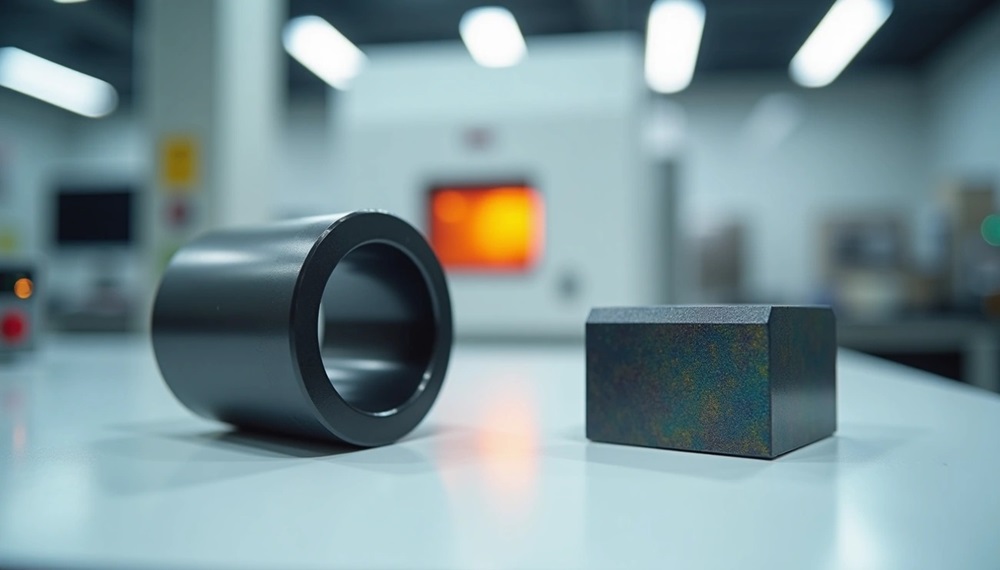 Silicon nitride vs silicon carbide is a critical material comparison. Both rank among the most used technical ceramics in demanding industries of all types . Silicon nitride hardness reaches 15GPa with exceptional fracture toughness, and silicon carbide mohs hardness climbs to 25GPa, just below diamond . These materials differ substantially in thermal performance. Silicon nitride thermal conductivity ranges from 15-20 W/(m·K), whereas silicon carbide conducts heat at 100-120 W/(m·K) . Application requirements like temperature limits, wear resistance and thermal management needs determine the choice between them.
What is Silicon Nitride vs Silicon Carbide
Silicon Nitride (Si₃N₄): Chemical Formula and Composition
Silicon nitride exists as a chemical compound combining silicon and nitrogen elements. The chemical formula Si₃N₄, representing trisilicon tetranitride, describes the most thermodynamically stable composition with a molecular weight of 140.28 g/mol. This white, high-melting-point solid demonstrates relative chemical inertness, though dilute HF and hot H₃PO₄ can attack it.
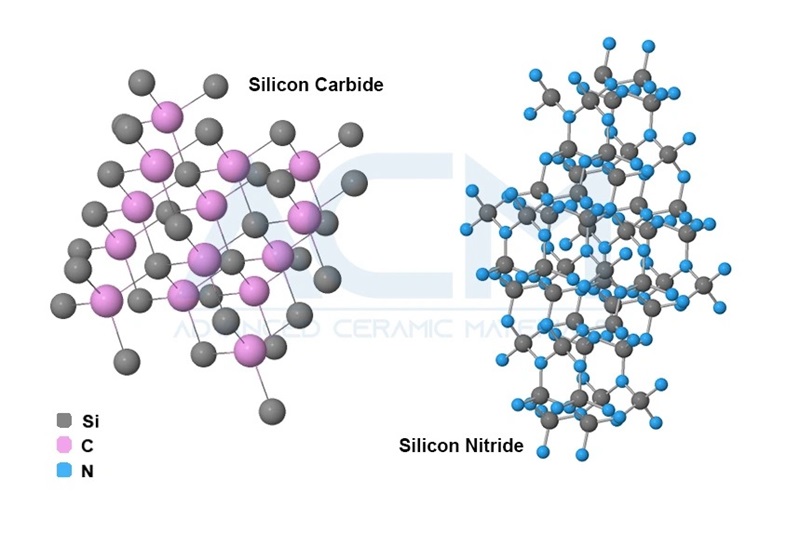
Three crystallographic structures define silicon nitride: α, β, and γ phases. The α and β phases form under normal pressure conditions and represent the most common variations. α-Si₃N₄ adopts a trigonal structure while β-Si₃N₄ features a hexagonal configuration, both built from corner-sharing SiN₄ tetrahedra. The γ phase requires high pressures and temperatures for synthesis and achieves a remarkable hardness of 35 GPa. These structures create a three-dimensional framework through strong covalent Si-N bonds that provide the material’s characteristic stability.
Silicon Carbide (SiC): Structure and Formation
Silicon carbide combines silicon and carbon atoms in a compound also known as carborundum. The material exists in approximately 250 crystalline forms, characterized by a large family of polytypes. These polytypes represent variations of the same chemical compound that remain similar in two dimensions but differ in the third.
Temperature dictates which polymorph forms. Alpha silicon carbide (α-SiC) develops at temperatures exceeding 1,700°C and exhibits a hexagonal crystal structure like Wurtzite. Beta modification (β-SiC) forms below 1,700°C with a zinc blende crystal structure like diamond. Common polytypes include 3C-SiC with cubic structure and 4H-SiC with hexagonal configurations. Each polytype maintains a consistent density of 3.21 g/cm³. Silicon carbide functions as a semiconductor that can be doped n-type by nitrogen or phosphorus and p-type by beryllium, boron, aluminum, or gallium.
Key Differences in Atomic Bonding
The atomic bonding arrangements distinguish these materials at a fundamental level. Silicon nitride develops from a network of Si-N tetrahedra that forms a three-dimensional structure with notable flexibility. Silicon carbide builds from strong covalent bonds between silicon and carbon atoms and results in a dense, hard structure with minimal ionic character.
Silicon nitride serves as an electrical insulator with a bandgap of 5.0 eV. Silicon carbide exhibits semiconductor properties with a bandgap of 3.2 eV and adjustable conductivity. This difference stems from their bonding characteristics and influences their respective applications in electronic systems.
Property Comparison: Silicon Nitride vs Silicon Carbide
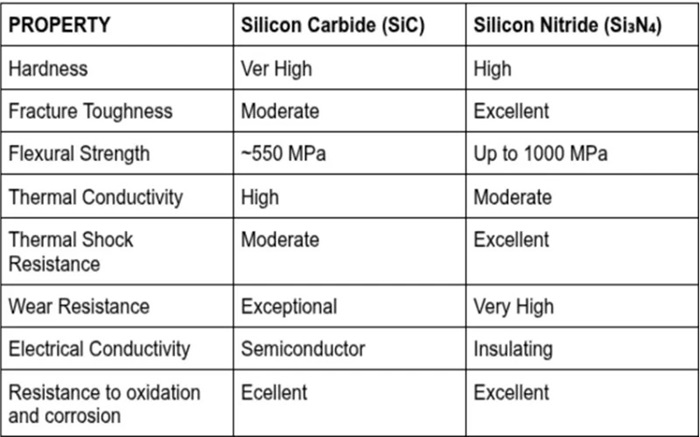
Material properties determine application suitability, and silicon nitride vs silicon carbide exhibit distinct performance characteristics across critical parameters.
Silicon Nitride Hardness vs Silicon Carbide Mohs Hardness
Silicon nitride hardness measures between 14-16 GPa (Vickers) and values around 15 GPa are typical. The Mohs scale shows silicon nitride registers at 9. Silicon carbide mohs hardness reaches 9.5 on the Mohs scale. Vickers hardness spans 22-23 GPa for sintered variants. Silicon carbide’s Knoop hardness ranges from 2500-3000 kg/mm². Only diamond and cubic boron nitride surpass it.
Thermal Conductivity: Silicon Nitride Thermal Conductivity vs SiC
Silicon nitride thermal conductivity ranges from 12-31 W/m·K at room temperature. Commercial grades achieve 20-30 W/(m·K). Specific grades show thermal conductivity of 28 W/(mK) for Syalon 101 and 27.0 W/(mK) for Syalon 110. Silicon carbide demonstrates much higher thermal conductivity between 120-200 W/m·K. Direct sintered variants reach 170 W/m·K at 20°C. This performance difference stems from silicon nitride’s interlocking needle-like structure that creates anisotropic thermal properties.
Flexural Strength and Fracture Toughness
Silicon nitride demonstrates flexural strength that ranges from 130-810 MPa. Hot-pressed variants achieve 830 MPa. Fracture toughness for silicon nitride spans 3.1-6.2 MPa·m^(1/2) and reaches up to 9.8 MPa·m^(1/2) in optimized compositions. Silicon carbide exhibits flexural strength between 410-600 MPa. Liquid phase sintered grades achieve 620 MPa. Silicon carbide’s fracture toughness measures 3.4-4.6 MPa·m^(1/2), much lower than silicon nitride.
Maximum Operating Temperature Limits
Silicon nitride maintains mechanical integrity up to 1000-1330°C. Commercial components offer maximum use temperatures of 1300°C in oxidizing environments. Neutral atmospheres allow silicon nitride to reach 1600°C. Silicon carbide operates at higher temperatures therefore. Direct sintered forms function up to 1500-1600°C and CVD variants maintain performance at 1600°C.
Density and Thermal Expansion Coefficients
Both materials exhibit similar densities. Silicon nitride density measures 2.2-3.4 g/cm³, around 3.2-3.3 g/cm³ in most cases. Silicon carbide density ranges from 3.0-3.2 g/cm³. The coefficient of thermal expansion is different between them: silicon nitride shows 2.5-3.2 × 10^(-6)/K while silicon carbide exhibits 4.0-4.5 × 10^(-6)/K.
Electrical Insulation vs Semiconductor Properties
Silicon nitride functions as an electrical insulator with resistivity that exceeds 10^(12) Ω·cm, >10^(14) Ω·cm for standard grades. Silicon carbide possesses semiconductor properties with variable resistivity from <0.1 to >10^5 Ω·cm that depends on doping. This enables applications in power electronics with its 3.26 eV bandgap.
Application Scenarios: Which Material Wins Where
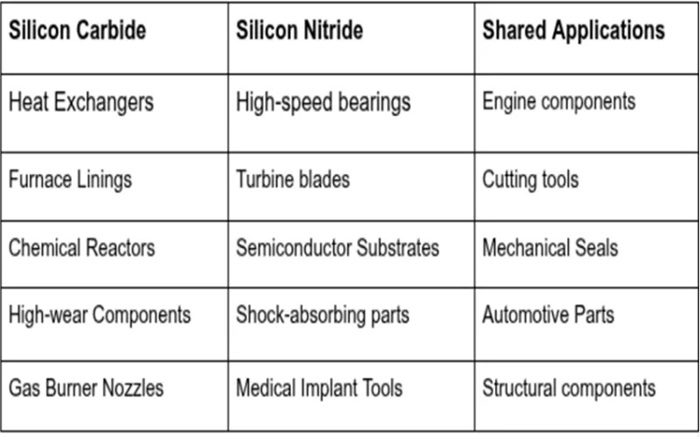
Application requirements determine material selection, and each ceramic dominates specific industrial domains based on its performance characteristics.
Bearings and Rotating Components: Si₃N₄ vs SiC Performance
Silicon nitride excels in bearing applications due to weight advantages and dynamic performance. Silicon nitride balls weigh 58% less than steel equivalents and reduce inertial loads in high-speed rotating systems. This material operates in temperatures up to 1000°C and delivers 121% higher hardness than steel. Silicon nitride bearings serve wind turbines, aerospace engines, machine tools and automotive applications. Silicon carbide bearings handle corrosive environments and temperatures up to 1400°C, but their higher density makes them less suitable for weight-sensitive high-speed applications. Silicon nitride remains the preferred choice for turbine engines and high-speed spindles.
Mechanical Seal Faces and Pump Components
Silicon carbide dominates mechanical seal applications in chemically aggressive environments. SiC seal faces withstand corrosive fluids, acids and high-temperature liquids while maintaining low friction coefficients between 0.02-0.1. Chemical processing, petrochemical plants and water treatment facilities rely on silicon carbide seals. Silicon nitride seal rings perform better in dissimilar pairings against gray cast iron and achieve wear coefficients of 4.2×10⁻⁸ mm³ N⁻¹ m⁻¹. Silicon carbide’s extreme hardness extends seal life in pump assemblies, compressors and centrifugal pumps.
High-Temperature Furnace and Thermal Applications
Silicon carbide heating elements operate at temperatures exceeding 1800°C, well above silicon nitride’s 1330°C limit. SiC maintains strength up to 1600°C in ceramic materials and exhibits superior oxidation resistance among non-oxide ceramics. Furnaces, kilns and metallurgical equipment employ silicon carbide components for consistent heating and durability.
Electronic Substrates and Semiconductor Uses
Silicon nitride substrates provide electrical insulation for power electronics modules, especially when you have electric vehicle battery management systems. The material’s high fracture toughness and flexural strength exceeding 700 MPa ensure reliability under thermal cycling. Silicon carbide serves as a wide-bandgap semiconductor material in power electronics, electric vehicles and renewable energy systems. The SiC device market projects growth to $14 billion by 2030.
Cutting Tools and Wear-Resistant Parts
Silicon nitride ceramic tools machine cast iron and hardened steel at high speeds, with tool life reaching 2400 m in continuous cutting when α-Si₃N₄ content reaches 49.7 wt%. Silicon carbide cutting tools handle non-ferrous materials like aluminum and copper alloys and provide wear resistance in abrasive grinding applications.
How to Choose Between Silicon Nitride and Silicon Carbide
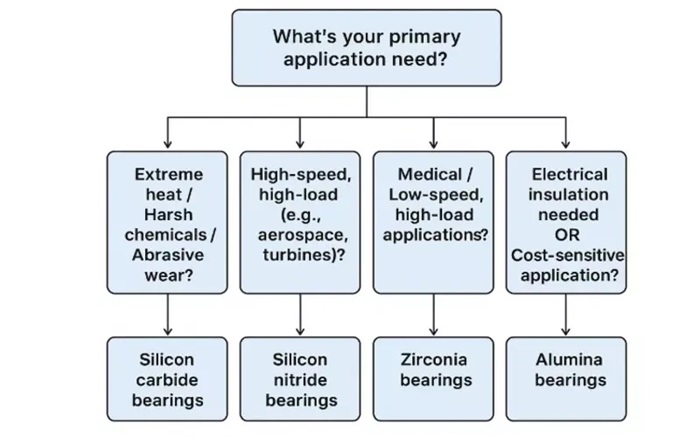
Selecting between these ceramics requires matching material characteristics to specific operational needs and environmental conditions.
Temperature Requirements: Above 1300°C vs Below
Silicon carbide becomes the optimal choice for applications exceeding 1300°C. SiC maintains mechanical strength at temperatures up to 1600°C, whereas silicon nitride demonstrates maximum use temperatures around 1200-1300°C. To cite an instance, furnace components and high-temperature heat exchangers operating above 1400°C benefit from silicon carbide’s thermal stability.
Impact and Thermal Shock Considerations
Thermal shock resistance favors silicon nitride in environments with rapid temperature fluctuations. Silicon nitride withstands thermal shock up to 800°C, compared to silicon carbide’s 400°C. The fracture toughness of silicon nitride reaches 6-10 MPa·m^(1/2) and enables superior performance under sudden force or heating-cooling cycles. Silicon carbide’s lower fracture toughness below 3 MPa·m^(1/2) creates sensitivity to thermal gradients and impact loads.
Wear Resistance and Hardness Needs
High-abrasion environments need silicon carbide’s superior hardness between 22-28 GPa. This hardness advantage positions SiC as ideal for cutting tools and abrasive applications. Silicon nitride hardness around 15 GPa proves sufficient for applications that prioritize toughness over extreme hardness.
Heat Dissipation and Thermal Management
Thermal management applications need silicon carbide’s thermal conductivity up to 200 W/(m·K), far higher than silicon nitride’s 80-90 W/(m·K). Power electronics, heat exchangers and semiconductor processing benefit from SiC’s heat dissipation capabilities.
Electrical Insulation Requirements
Silicon nitride serves applications that need electrical insulation with resistivity exceeding 10^(20) mΩ·cm and breakdown strength above 25 kV/mm. Silicon carbide’s semiconductor properties with adjustable conductivity suit power electronics and high-temperature electronic devices.
Cost, Manufacturing, and Practical Considerations

Economic and production factors influence material selection by a lot beyond performance specifications alone.
Material Cost Comparison: Si₃N₄ vs SiC Pricing
Silicon carbide costs around USD 10.00 per kilogram for ceramic-grade material. Silicon nitride reaches USD 18.00 per kilogram. Raw silicon carbide material spans USD 800-2,000 per ton, and black silicon carbide ranges from USD 1,400-2,700 per ton while green silicon carbide goes from USD 2,000-3,300 per ton. Six-inch SiC wafers cost USD 1,000-1,500 each for semiconductor applications. Production costs reach USD 1,500 per 200mm wafer. SiC devices cost 3-5 times more than equivalent silicon devices, though this premium projects to fall to 1.5-2 times by 2030 through yield improvement.
Manufacturing Methods and Processing Difficulty
Silicon nitride production employs gas over-pressure sintering, hot pressing, hot isostatic pressing and extrusion methods. These processes just need high temperatures and precision-controlled environments. Sintering causes around 20% shrinkage that complicates tolerance control. Silicon carbide manufacturing proves more challenging. Boule growth requires weeks at temperatures near 2,200°C. Silicon ingots grow in hours at 1,500°C. Yield rates remain problematic and produce only 40-60 wafers per boule. The resulting SiC wafers measure half as thick as silicon and exhibit brittleness. They appear transparent, which complicates handling and processing.
Availability and Lead Times
Silicon carbide supply constraints create extended procurement cycles. Lead times span 20-30 weeks for certain specifications and potentially exceed 6-9 months during peak demand periods . Global production capacity utilization exceeds 90% and limits immediate availability.
Machining and Fabrication Challenges
Silicon carbide ranks as the third hardest material after diamond and cubic boron nitride. It requires diamond tools for shaping. Silicon nitride permits easier green-state machining but just needs diamond grinding when fully densified. Both materials present fabrication challenges that get pricey.
Comparison Table
Silicon Nitride vs Silicon Carbide: Property Comparison Table
| Property | Silicon Nitride (Si₃N₄) | Silicon Carbide (SiC) |
|---|---|---|
| Chemical Formula | Si₃N₄ (trisilicon tetranitride) | SiC (carborundum) |
| Molecular Weight | 140.28 g/mol | Not mentioned |
| Crystal Structure | α (trigonal), β (hexagonal), γ (high-pressure) phases | ~250 polytypes; α-SiC (hexagonal, >1700°C), β-SiC (cubic, <1700°C); Common: 3C-SiC, 4H-SiC, 6H-SiC |
| Hardness (Vickers) | 14-16 GPa (typical: 15 GPa) | 22-28 GPa (sintered: 22-23 GPa) |
| Hardness (Mohs) | 9 | 9.5 |
| Hardness (Knoop) | Not mentioned | 2500-3000 kg/mm² |
| Thermal Conductivity | 12-31 W/(m·K) at room temperature (commercial: 20-30 W/(m·K)) | 120-200 W/(m·K) (direct sintered: 170 W/(m·K) at 20°C) |
| Flexural Strength | 130-810 MPa (hot-pressed: 830 MPa) | 410-600 MPa (liquid phase sintered: 620 MPa) |
| Fracture Toughness | 3.1-6.2 MPa·m^(1/2) (optimized: up to 9.8 MPa·m^(1/2)) | 3.4-4.6 MPa·m^(1/2) (below 3 MPa·m^(1/2) in some sources) |
| Maximum Operating Temperature | 1000-1330°C (oxidizing); up to 1600°C (neutral atmosphere) | 1500-1600°C (direct sintered and CVD variants) |
| Density | 2.2-3.4 g/cm³ (typical: 3.2-3.3 g/cm³) | 3.0-3.2 g/cm³ (consistent: 3.21 g/cm³) |
| Coefficient of Thermal Expansion | 2.5-3.2 × 10⁻⁶/K | 4.0-4.5 × 10⁻⁶/K |
| Thermal Shock Resistance | Up to 800°C | Up to 400°C |
| Electrical Properties | Insulator; Resistivity: >10¹² Ω·cm (>10¹⁴ Ω·cm standard); Bandgap: 5.0 eV | Semiconductor; Resistivity: <0.1 to >10⁵ Ω·cm (doping-dependent); Bandgap: 3.2-3.26 eV |
| Electrical Breakdown Strength | >25 kV/mm | Not mentioned |
| Material Cost | ~USD 18.00 per kilogram | ~USD 10.00 per kilogram (ceramic-grade); Raw: USD 800-2,000 per ton |
| Weight vs Steel | 58% lighter (for balls) | Not mentioned |
| Manufacturing Methods | Gas over-pressure sintering, hot pressing, hot isostatic pressing, extrusion | Boule growth at ~2,200°C (weeks-long process) |
| Manufacturing Shrinkage | ~20% during sintering | Not mentioned |
| Lead Times | Not mentioned | 20-30 weeks (up to 6-9 months during peak demand) |
| Machining Difficulty | Easier green-state machining; diamond grinding when densified | 3rd hardest material globally; requires diamond tools |
| Main Applications | Bearings, rotating components, high-speed spindles, turbine engines, electrical insulation substrates, cutting tools for cast iron and hardened steel | Mechanical seals, pump components, high-temperature furnaces (>1800°C), power electronics, semiconductor devices, cutting tools for non-ferrous materials, heat exchangers |
| Main Advantages | Superior fracture toughness, excellent thermal shock resistance, lightweight, better impact resistance | Higher hardness, superior thermal conductivity, higher maximum temperature, better heat dissipation, semiconductor properties |
| Main Limitations | Lower thermal conductivity, lower maximum temperature (<1300°C), lower hardness | Lower fracture toughness, poorer thermal shock resistance, more difficult and costly to manufacture, longer lead times |
Conclusion
The silicon nitride vs silicon carbide debate has no universal winner. Both materials deliver exceptional performance, but in different scenarios.
Silicon nitride dominates applications that need fracture toughness, thermal shock resistance, and lightweight components. Bearings, high-speed rotating machinery, and impact-sensitive environments benefit from its superior toughness reaching 9.8 MPa·m^(1/2) and 58% weight reduction over steel, especially when you have these requirements.
Silicon carbide takes the lead where extreme temperatures exceed 1300°C, superior hardness matters, or thermal management needs conductivity up to 200 W/(m·K). Furnace components, mechanical seals, and power electronics applications rely on SiC’s unmatched thermal capabilities.
So the right choice depends on your specific requirements: temperature thresholds, thermal shock conditions, weight constraints, and budget. Silicon carbide costs roughly half as much per kilogram but needs longer lead times and more complex manufacturing processes.
FAQs
Q1. What makes silicon carbide different from silicon nitride in terms of composition and structure? Silicon carbide (SiC) is a compound of silicon and carbon atoms with approximately 250 crystalline forms called polytypes, functioning as a semiconductor. Silicon nitride (Si₃N₄) combines silicon and nitrogen in three main crystallographic structures (α, β, and γ phases) and serves as an electrical insulator. Their atomic bonding differs fundamentally: silicon nitride forms a flexible three-dimensional network of Si-N tetrahedra, while silicon carbide creates a dense, hard structure with strong covalent Si-C bonds.
Q2. Which material performs better in high-temperature applications? Silicon carbide excels in extreme temperature environments, maintaining mechanical strength up to 1600°C, while silicon nitride’s maximum operating temperature reaches approximately 1300°C in oxidizing conditions. For applications exceeding 1300°C, such as furnace components and high-temperature heat exchangers, silicon carbide is the optimal choice due to its superior thermal stability.
Q3. Does Tesla use silicon carbide in their vehicles? Yes, Tesla pioneered the use of silicon carbide in electric vehicles by developing a silicon carbide (SiC) drivetrain inverter for their Model 3 in 2017, becoming the first EV manufacturer to implement this technology. Silicon carbide’s semiconductor properties and superior thermal management capabilities make it ideal for power electronics in electric vehicles.
Q4. What are the main disadvantages of silicon nitride? Silicon nitride has several limitations including lower thermal conductivity (12-31 W/(m·K)) compared to silicon carbide, a maximum operating temperature below 1300°C, and lower hardness (14-16 GPa versus SiC’s 22-28 GPa). Additionally, manufacturing involves approximately 20% shrinkage during sintering, which complicates tolerance control, and the material costs around USD 18.00 per kilogram, making it more expensive than silicon carbide.
Q5. Which material is better for bearing applications? Silicon nitride is superior for bearing applications, particularly in high-speed rotating systems. Silicon nitride balls weigh 58% less than steel equivalents, reducing inertial loads while delivering 121% higher hardness than steel. The material operates reliably at temperatures up to 1000°C and offers exceptional fracture toughness, making it the preferred choice for turbine engines, wind turbines, aerospace applications, and high-speed spindles.