
Introduction
In the realm of high-precision manufacturing, Metal Injection Molding (MIM) is the definitive solution for complex, net-shape components. However, the true challenge of mass production lies not in molding but in the sintering stage. This critical thermal phase determines whether a part achieves its required density, strength, and geometry.
At JHMIM, we leverage over 15 years of metallurgical expertise and advanced internal production loops to master the variables of sintering, ensuring that every batch meets the uncompromising standards of the global market.
1. Why Consistency is the “Lifeblood” of Mass Production
During sintering, MIM parts undergo a dramatic 15% to 22% isotropic shrinkage. Without rigorous process control, this shrinkage becomes unpredictable, leading to catastrophic dimensional failures.
The JHMIM Quality Benchmark:
-
Dimensional Precision: We maintain a tight tolerance band of ±0.3% to ±0.5% by stabilizing the thermal environment across millions of parts.
-
Statistical Reliability: For automotive (PPAP) and medical (ISO 13485) sectors, we target a Process Capability Index (Cpk) > 1.33, ensuring production clusters tightly around the mean.
-
Commercial Viability: By maintaining a 95%+ yield rate, we help our clients reduce waste and optimize their total cost of ownership (TCO).
2. Common Failure Modes: The Cost of Inconsistency
Large-scale MIM production often faces technical bottlenecks that only an experienced partner can navigate:
-
Warping & Distortion: Often caused by uneven heating or gravity-induced sagging at peak temperatures.
-
Blistering & Internal Porosity: Occurs when residual binders outgas too rapidly before pore closure.
-
Carbon Instability: In alloys like 316L stainless steel or 4140 low-alloy steel, failing to balance the carbon potential can compromise hardness and corrosion resistance.
-
Density Deficits: Falling below the 96% theoretical density threshold leaves parts vulnerable to premature fatigue failure.
3. The JHMIM Advantage: Core Sintering Variables
JHMIM eliminates quality risks by managing every variable within our ISO-certified facilities:
Advanced Thermal Profiling
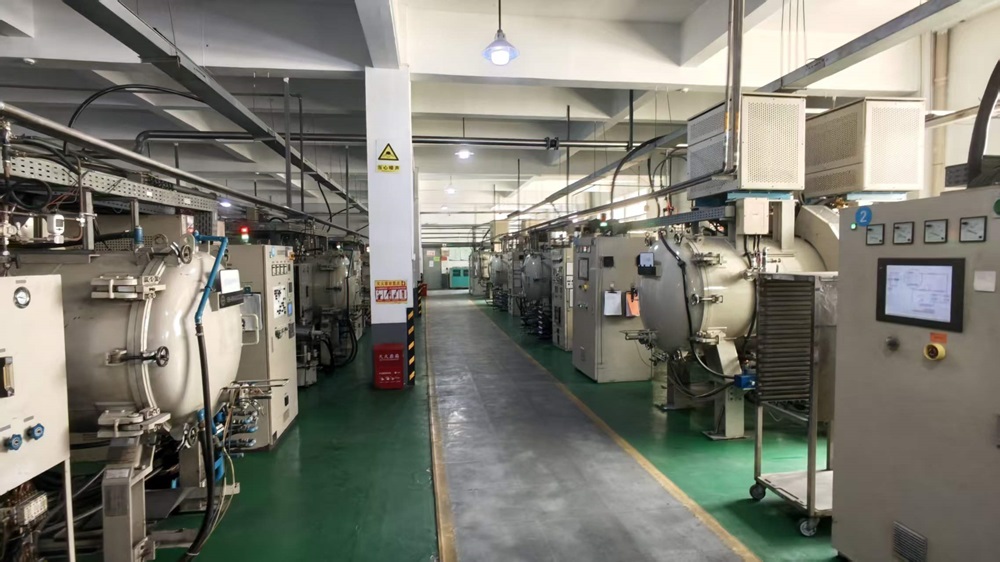
We explicitly define ramp rates, hold times for oxide reduction, and peak sintering temperatures (1200°C–1400°C) within our Standard Operating Procedures (SOP). This ensures that every run in Furnace A is identical to Furnace B.
Atmosphere & Pressure Control
Whether using pure hydrogen for stainless steel reduction or deep vacuum for high-performance Titanium (Ti-6Al-4V), our real-time monitoring of gas flow and dew points prevents oxidation and guarantees metallurgical purity.
High-Tonnage Capacity
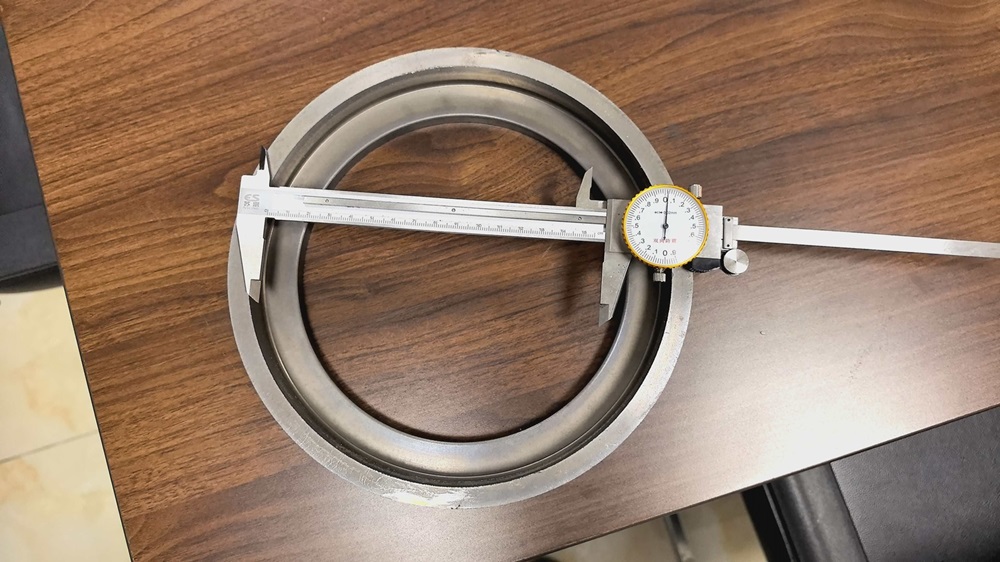
Our facility features 1,000-ton (10,000KN) presses and specialized large-scale sintering furnaces. This unique infrastructure allows us to handle large-diameter gears and components (up to 150mm) that conventional MIM shops cannot produce.
4. DFM: Solving Problems Before They Reach the Furnace
At JHMIM, we act as more than just a manufacturer; we are your engineering consulting partner. Through Design for Manufacturing (DFM) analysis, we assist clients in:
-
Optimizing Geometry: Reducing stress concentrations that lead to sintering cracks.
-
Custom Fixture Design: Creating specialized ceramic setter plates (Alumina/Zirconia) that allow the part to “glide” during the 20% shrinkage phase, preventing drag-related distortion.
5. Multi-Layered Quality Validation
-
In-Line Monitoring: Real-time logging of thermal curves and gas purity via mass flow controllers (MFCs).
-
At-Line Inspection: Automated dimensional optical scanners and Archimedes-method density balances on the factory floor.
-
Laboratory Analysis: Periodic metallographic sectioning and carbon content verification (held to ±0.02% for high-spec alloys).
Conclusion: Partner with JHMIM for Precision
In large-scale manufacturing, the cost of poor quality—measured in scrapped batches and lost market time—far outweighs the price of process excellence. JHMIM combines a decade and a half of technical mastery with high-tonnage equipment to define the new height of metal manufacturing.
Ready to secure your supply chain with precision? Visit our website at https://jhmim.com/ to request a technical review or explore our full range of MIM materials.
Frequently Asked Questions (FAQ)
Q: What is the typical density of a JHMIM sintered part? A: Most of our components achieve 96%–98% of theoretical density, offering mechanical properties comparable to wrought materials.
Q: Can you handle large MIM components? A: Yes. With our 1,000T presses and large-zone furnaces, we successfully produce parts up to 150mm in diameter with high complexity.
Q: Do you offer secondary processing? A: Absolutely. We provide a complete internal closed-loop including 5-axis CNC machining, PVD coating, and heat treatment to ensure quality and lead-time control.